
The First 90 Days After Outsourcing




The first 90 days after outsourcing are a transition that goes from issuing initial instructions to establishing reliable working routines. What to expect varies from month to month and from business to business, but some patterns typically repeat.
During Month 1, expect questions, closer guidance, and early corrections while your remote team member learns about your business and its processes.
Month 2 should bring steadier execution and increased ownership from your remote staff when their work supports it.
By Month 3, you can compare the results with your starting point and decide what to do next. Setting clear expectations, reusable documented processes, giving detailed feedback, and having the right role fit are the basis of a reliable operating relationship.
Key Takeaways of What You Can Expect in the First 90 Days of Outsourcing
- The first 90 days usually require active guidance before you can transfer all responsibilities reliably. This is a gradual process.
- Month 1 is when you define tasks and level of responsibility, expected results, decision limits, communication channels, and initial performance measures.
- In the first 90 days after outsourcing, expect repetitive questions. Repeated confusion may point to missing access, unclear instructions, lack of training, or poor role fit.
- In Month 2, you can gradually add work or complexity. Use the current quality, turnaround times, and workload to guide you.
- Update your standard operating procedures (SOPs) as real work reveals exceptions, missing details, process gaps, and slow approvals.
- By Month 3, you can now compare output, quality, reliability, time returned, and business effects with the Month 1 baseline.
- If progress came to a stop, before retraining your staff, redefining or redistributing the responsibilities, or reassigning the role, seek the cause.
What Should You Expect During the First 90 Days After Outsourcing?
The first 90 days after outsourcing are about ramping up: moving from initial learning to taking real ownership, and eventually, reviewing the concrete results. How fast that happens depends on the role, the quality of your documentation, system access, training needs, and how fast you provide feedback.
This phase is an onboarding and adjustment period. It gives a remote team member the context they need to deliver their work up to your standard. It also highlights which processes, expectations, or system permissions might need a tune-up.
Noticing early questions or mistakes doesn’t mean the outsourcing arrangement is falling apart. This simply pinpoints where your procedures need more clarity. SHRM's current onboarding guide notes that new hires do not absorb every expectation in a week or a month. Learning about the company’s structure, values, policies, and procedures can easily overload them. Although the mentioned onboarding guidance focuses on traditional employees, the core lesson applies here: any new working relationship needs structure and active support as non-negotiable conditions to succeed.
Finally, try not to treat 90 days as a strict universal deadline for full independence. A straightforward administrative workflow may settle and run smoothly within a couple of weeks, but specialized work will most likely take longer. The goal is steady, measurable progress and knowing what to do when progress stops.
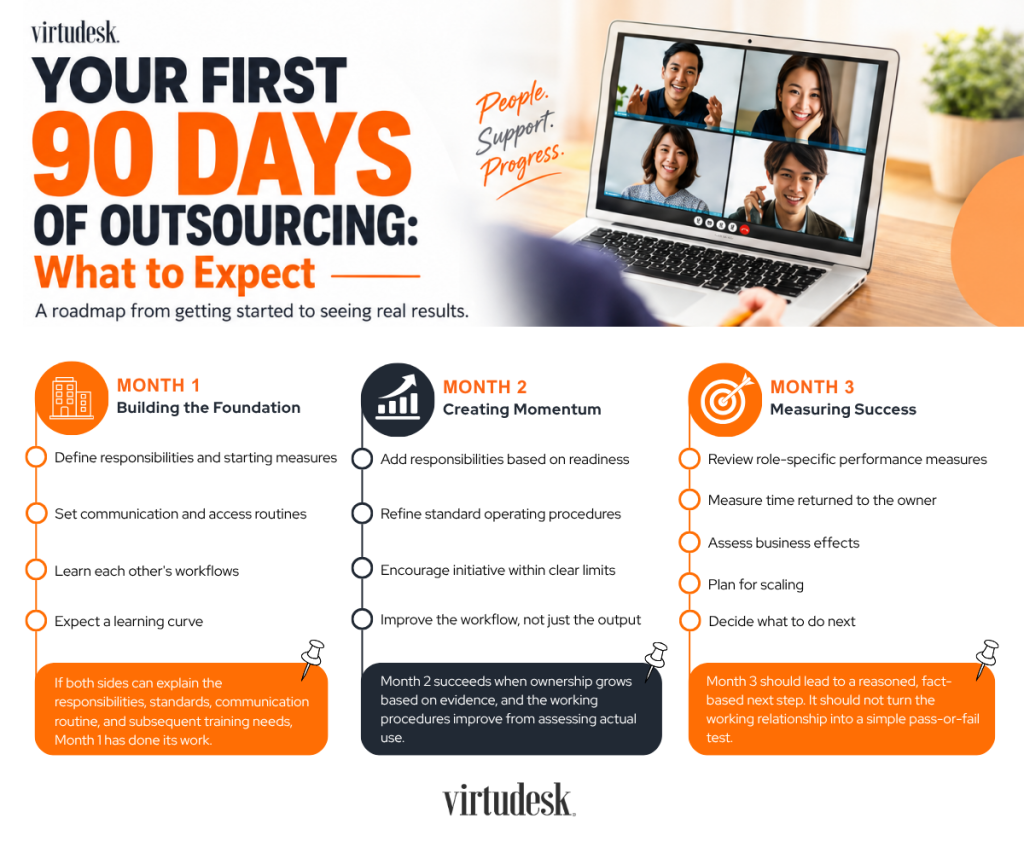
Month 1: Building the FoundationMonth 1 is when business context is transferred. Expect to provide closer supervision, answer more questions, and see a somewhat uneven speed while the new remote team member learns about your standards, work ethic, and operational systems.
Define responsibilities and starting measures
Write down the role’s scope. CIPD's current onboarding guidance recommends outlining responsibilities, expected performance, goals, measures (key metrics), and ways of working. Bringing those same categories to an outsourced role gives your remote team a usable, practical starting point.
For every workflow you assign, document at least these four items:
- The result you expect and how you will check it
- Where the work and final status will live (specify the system or platform)
- The decisions the team member can make on their own
- Precise situations that need approval or escalation
The US Office of Personnel Management notes the value of setting measurable outcomes and deliverables, linking them to the organizational goals, and specifying who receives or monitors them. It also suggests tracking performance results and using clear and precise language.
Start by setting a baseline you can use to monitor progress later. Choose a few basic metrics linked to the role. For example, backlog size, response time, overdue tasks, error rate, or how many hours you personally spend managing the workflow.
When an owner or leader expects a complete hands-off delegation without defining the expected outcome, a friction point appears. To avoid this, narrow down the initial list of assignments, show acceptable examples, and explain what remains under your control.
A clear role states what the remote team member owns and how success is monitored and defined. It also determines when to ask for help.
Set communication and access routines
Assign each communication channel a specific purpose. For instance, use instant messaging for quick questions and video calls for weekly feedback. Decide where tasks, questions, meetings, files, and final decisions belong.
Instead of constant contact, set regular communication rules. Gallup's updated manager research found that 80% of employees who say they received meaningful feedback in the past week were fully engaged. The research explains that meaningful conversations are those focused on goals, priorities, recognition, strengths, and collaboration. 15 to 30 minutes is enough time for a meaningful conversation. New teams may need more frequent contact at the beginning.
Start-of-day and end-of-day reports can help roles with fixed schedules or daily queues, but treat them as flexible or optional tools rather than mandatory. A project-based role, for instance, usually benefits much more from regular task updates and a weekly review.
System access needs careful planning too. NIST talks about the concept of “least privilege”. Basically, this means you should only grant the specific permissions needed for the assigned work. Always assign individual user accounts instead of shared logins. Review the permissions periodically, particularly when the team member’s responsibilities expand or contract, and use multifactor authentication as an additional security layer, mainly for remote and elevated access.
Scattered decisions commonly result in frustrating and avoidable rework. When you give instructions that conflict with one another, or get mixed across chat, email, and calls, make a definite, consistent decision and record it in your primary management system.
Learn each other's workflows
Month 1 is a real two-way learning process. Your remote team learns your priorities, clients, tools, and risk limits, while you figure out how well they interpret the instructions, ask questions, and tackle exceptions.
Before expecting your remote team to complete a task on their own, always show them how the work should be done. Depending on the difficulty, consider sharing a recorded walkthrough, showing a finished example, or collaborating with them on their first attempt.
Our downloadable onboarding checklist can help you prepare accounts, schedules, task lists, training materials, and reporting routines before work begins. Use it as a preparation guide, not a strict set of rules. Adapt it to your business, goals, and processes.
If you want deeper information on how to build your remote team, prepare your systems, and get started with your virtual assistant or remote staff, download our free eBook How to Start Your Virtual Office.
Talk to your new remote team members and ask them which steps feel unclear to them and which approval steps slow their work. Fresh eyes often notice gaps or friction points that long-time owners simply adapted to over time.
Expect a learning curve
During Month 1, it’s reasonable to expect questions, slow task completion, and corrections. Yet, they become concerning when your remote staff ignores your feedback or lacks a role-related skill.
But don’t rush. Before judging the person, find out whether the underlying cause lies in the instructions, access, examples, or onboarding process. Only after checking those facts, proceed to assess training, workload, and role fit.
Don’t set arbitrary rules about how many mistakes or corrections are acceptable or which week performance should dip. These depend on the work and the seriousness of the error. Our article on why delegation fails examines the causes behind these friction points and analyzes broader causes. It doesn’t assign them to a fixed calendar.
SHRM's new-hire integration guidance recommends a one-month check-in and early feedback. Use the “Day 30 review” to identify what needs correction.
Day 30 check: Is the role clearer, is communication working, and can you identify the causes of remaining problems? Stabilize those areas before expanding the role.
If both sides can explain the responsibilities, standards, communication routine, and subsequent training needs, Month 1 has done its work.
Month 2: Creating Momentum
Month 2 is when you build consistency and transfer more ownership. The second month doesn’t necessarily promise your remote staff will achieve total independence by a fixed date. At this point, seeing continuous, steady, and dependable progress already means success.
Add responsibilities based on readiness
Add more responsibilities to your remote team members only after they meet the agreed quality and turnaround times. Observe the overall workload too, because work quality can decline if you add someone more responsibilities than their available hours allow.
Once you realize the individual is ready to move on and take new tasks, explain each new responsibility with the same care and detail you did in Month 1: outcome, examples, system, deadline, decision limits, and escalation path.
If someone’s performance declines after you assign them new tasks, look into the added workload and capacity issues before assuming a drop in motivation. Hold the current scope, remove competing priorities, or provide more targeted training.
Refine standard operating procedures
A standard operating procedure (SOP) is a document that explains step-by-step how a task should be completed. It should include the expected result, steps, tools, ownership, exceptions, and escalation path.
Usage is what puts SOPs to the test and creates the opportunity to update them if needed. A peer-reviewed guide to writing SOPs recommends testing procedures and reviewing them regularly. Month 2 can reveal missing steps or actual exceptions that an initial document frequently misses.
Listen to your team members and let them propose updates. They can identify unclear steps, missing files, and approval delays as they work with the SOPs. This doesn’t mean giving all team members ownership of your SOPs. The original SOP owner (typically a manager or business owner) remains responsible for approving any changes.
Make sure to link each procedure to the current (and valid) source files. A detailed document is worthless when it points to an outdated template or inaccessible folder.
Encourage initiative within clear limits
Initiative grows when people know which decisions they can make. What can they really decide?
Consider and define these three main categories: the decisions the remote team member may make and record, decisions that require prior approval before taking action, and events that require immediate escalation.
Let’s suppose you notice someone shows sound judgment on repeated occasions. In such a case, you could expand their boundaries. If a reasonable decision falls within the agreed limits, review the reasoning before changing the rule.
Micromanagement is one pain point, but giving premature autonomy is another error. The first delays every decision, while the second exposes your business to mistakes that could have been avoided.
Written boundaries give both sides a safer middle position.
Improve the workflow, not just the output
Month 2 can reveal why, although a task is being correctly completed, it takes longer than expected. Review missing access, repeated approvals, duplicate entry, unclear handoffs, and waiting time between steps.
Our clients can use Timedly to monitor time, attendance, task activity, and project status. Those records can expose delays or workload strain.
Day 60 check: Is the remote team member taking more ownership of the established work? Decide whether to expand, hold, reinstruct, or redefine the duties.
Month 2 succeeds when ownership grows based on evidence, and the working procedures improve from assessing actual use.
Month 3: Measuring Success
Month 3 is when you can compare the current results with the starting point. The review should cover work quality, reliability, returned time, and business effects.
Review role-specific performance measures
Choose three to five measures connected to the results you expect from the particular role. OPM's performance standards guidance groups measures into quality, quantity, timeliness, and cost-effectiveness. Most outsourced roles need a balanced subset.
For example, administrative work may require accuracy, completion, turnaround, and unresolved exceptions, and sales support may require completed follow-ups and qualified appointments.
Compare the current measures with the baseline you set in Month 1 and do not compare unrelated roles through one generic score.
Measure time returned to the owner
Review your calendar, task system, and recurring responsibilities. Estimate how much time the delegated work required before outsourcing and how much it requires now.
Make sure to include review, correction, and management time in this calculation to avoid considering a task “delegated” while you’re still spending almost as much checking it as if you were doing it yourself.
Reclaiming time can give business owners or managers space for high-touch client work, sales growth, strategic planning, and family time.
Also track how much your daily interruptions decrease. A cleaner, well-defined handoff may result in fewer unexpected interruptions, that is, fewer reasons to step you away from higher-concentration work.
Assess business effects
Connect the role directly to the outcomes it can reasonably influence. Examples include faster replies, fewer missed deadlines, better record accuracy, reduced backlog, or more consistent follow-ups.
Avoid crediting one person for every business improvement. Sales, customer retention, and revenue depend on a wide range of factors. Instead, focus on finding a logical connection between the tasks assigned to that individual and the specific improvements you measure for their role.
Gallup found that employees involved in setting their goals were twice as likely to report clear expectations. Review the measures together and discuss obstacles before making a decision. This is a management practice that applies to all work models; it is not VA-specific.
Plan for scaling
Once the work is stable enough to show where demand is growing and what the current role can absorb, you are ready to plan for scaling. Scaling may mean adding a new virtual assistant, expanding a team member’s scope, or bringing in a specialist (when the work requires different or specific skills).
Before scaling your remote team, review whether the processes are properly documented, which approvals slow the work pace, and which metrics will confirm the added support is actually helping.
Don’t add people simply because the current workload seems busy. Add the right capacity when the work, results, and skills point to it.
Decide what to do next
90 days passed. Use the evidence from the first 90 days to decide what to do next. For example, here are five courses of action you should consider:
- You’ll maintain the current scope when the role is reliable and appropriately sized.
- You’ll expand the role when the same type of work has grown.
- It’s necessary to retrain your remote team member when the ability fits, but the procedure or knowledge remains incomplete.
- Redesign responsibilities when the role combines unrelated work or unclear ownership.
- Reassign the role if the underlying problem after support is a capability or fit issue.
OPM describes performance management as a continuing cycle of planning, monitoring, training, evaluation, and recognition. Day 90 should guide the next operating period.
Day 90 decision: Maintain, expand, retrain, redesign, or reassign. Choose the action supported by results, workload, and role fit.
Month 3 should lead to a reasoned, fact-based next step. It should not turn the working relationship into a simple pass-or-fail test.

What If Your Outsourcing Arrangement Is Already Off Track?
So far, we’ve discussed the first 90 days after outsourcing and what to expect and what to do in each stage. But what should you do if you already have an ongoing outsourcing arrangement that’s struggling? Before applying any corrective measures, what you need is a diagnosis.
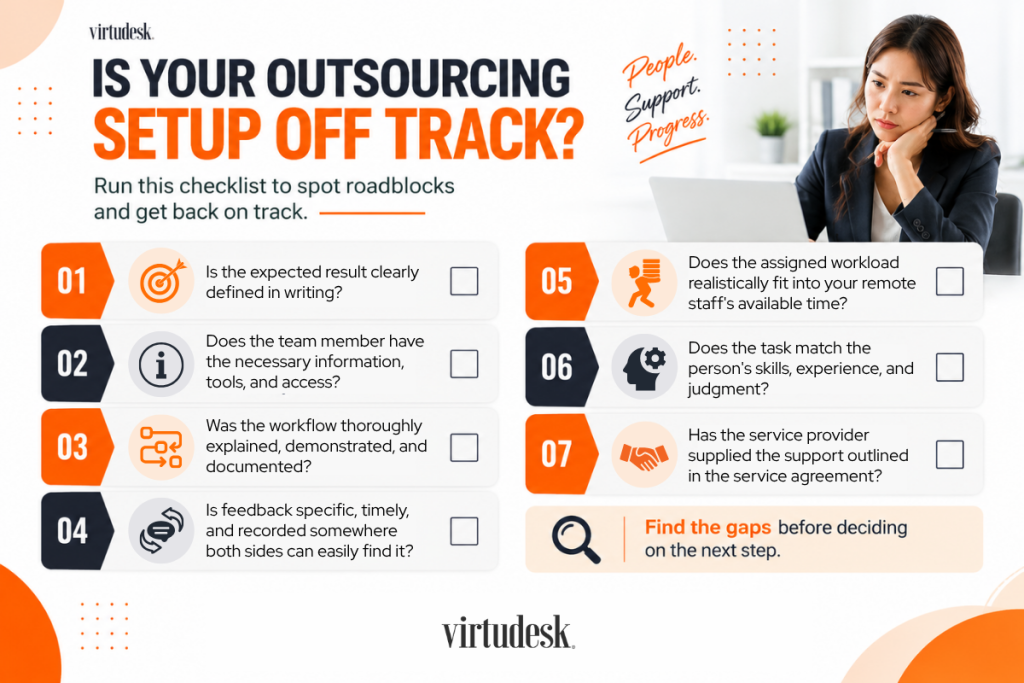
First, examine the working system, then assess capability and role fit without assuming either side caused every problem. Simply start by answering these questions in order:
- Is the expected result clearly defined in writing?
- Does the team member have the necessary information, tools, and access?
- Was the workflow thoroughly explained, demonstrated, and documented?
- Is feedback specific, timely, and recorded somewhere both sides can easily find it?
- Does the assigned workload realistically fit into your remote staff's available time?
- Does the task match the person's skills, experience, and judgment?
- Has the service provider supplied the support outlined in the service agreement?
Tailor your responses to what you find. You might need to clarify your expectations further, grant missing access, update a standard procedure, adjust how you communicate, retrain your remote staff, or momentarily reduce the scope. Involve your service provider if service coordination, performance, or role alignment needs attention.
Certainly, capability and suitability still matter. If the person continues to struggle with defined work after receiving proper instruction and support, reassignment may be the most responsible decision.
Don’t forget to review whether access or device practices contributed to the problem, and remove unused access promptly whenever responsibilities shift or an arrangement ends.
Recovery works best when the owner can name the cause and find the next corrective action. Repeating the same instructions without changing the system rarely produces different results.
What Support Should You Expect from an Outsourcing Partner? (And What Virtudesk Offers)
An outsourcing partner should support role alignment, preparation, visibility, and correction after the initial match. Always review the service agreement because the included support differs across providers and their packages.
The outsourcing process and what to expect during those first months can vary widely depending on the outsourcing model you choose. You can either outsource directly by recruiting a freelancer (or several of them), through a placement agency, or through a business service provider. What’s the difference for you? The difference is the degree of direct involvement and time required from you as owner or manager. Regardless of that decision, there are common things you can expect.
Before signing, ask who handles candidate selection, onboarding, reporting, performance control, payroll, system access, technology tools, and staff replacement. Confirm which services are included and which carry separate fees.
At Virtudesk, our virtual assistant prices include staff recruiting, background checks, skill testing, ongoing training, candidate interviews to help ensure the candidate matches the role, and your company’s work values. Regardless of whether you hire one virtual assistant or an entire team, you’ll have a dedicated manager. Our management services include task reporting, payroll management, HR compliance, and time-tracker access screenshots. These inclusions give our clients defined support beyond candidate selection.
We provide virtual assistant and call center services across a growing range of industries. Do you need administrative, executive, marketing, prospecting, customer service, design, healthcare, legal, or transaction coordination support? Do you need an AI-powered time-tracking and monitoring system? Or perhaps your priority is finding a reliable power dialer platform to support your lead-calling process?
Timedly (our proprietary tracking tool) gives our clients activity and task visibility, while our dedicated team structure provides a contact path for performance questions.
Do you already have a remote team you didn’t hire through us, but their performance and the results are insufficient? You may need management support to monitor your remote staff or hybrid team. If this is your situation, we invite you to visit our management services page.
Outsourcing through a business service provider that remains involved when the staff’s work needs correction, or any team member needs to be replaced, gives you added continuity. When you hire through a placement agency or a freelancing platform, you take the risk of being left alone dealing with a remote team. Since the support that you or the staff member receives after hiring varies, confirm what management and replacement assistance is included. Our ongoing involvement is one way we support our clients beyond the initial hire. And this is also just one of the reasons that makes Virtudesk different from other virtual assistant companies.
Frequently Asked Questions
How long should it take a virtual assistant to work independently?
There is no universal schedule for full independence. Timing depends on role scope, task difficulty, existing documentation, system access, training, and feedback. By Month 2, look for steadier execution and more ownership of established work. Do not require independent judgment in situations the virtual assistant has never seen or been authorized to handle. Expand decision limits when repeated work shows reliable judgment, quality, and escalation.
What if I did not establish a baseline before outsourcing?
Reconstruct a practical baseline from the previous four to eight weeks. Review calendars, task systems, inbox records, backlogs, response times, errors, overdue work, and time spent by the owner. Use only records related to the delegated role. Mark any estimate clearly. The baseline does not need to be perfect. It needs to be consistent enough to show whether workload, timeliness, accuracy, or owner involvement changed.
When should I retrain, redefine, or reassign the role?
Retrain when the person has the required ability but lacks process knowledge or practice. Redefine the role when responsibilities conflict, workload is unrealistic, or ownership remains unclear. Consider reassignment after the work, access, training, and feedback have been checked. Reassignment may be appropriate when capability or fit still prevents reliable performance. Ask the provider to review the evidence before making the final decision.
Final Thoughts
The first 90 days after outsourcing work best when expectations, role fit, training, feedback, and measurement evolve together. Each month should leave the working relationship clearer and the next decision easier to support.
A strong hire becomes dependable operating support when both sides understand ownership, working routines, and adjustment points.
Schedule a free discovery call or call us at +1 (800) 470-8136. Tell us which responsibilities keep returning to your calendar. We will help you identify the right role, outline your onboarding plan, and build the support structure for the first 90 days and beyond.
Share this article
Meet our Most Trusted
Partners & Clients

Byron Lazine
Co-Founding Chief-of-Operations at BAM (Broke Agent Media)I’ve been using Virtual Assistants for years throughout all of my companies. Once we found Virtudesk the process got even easier and allowed us to scale out our hiring. Highly skilled and accountable professionals. 100% recommend!

Rebecca Guy
Realtor / Content CreatorBefore getting started with Virtudesk I had my doubts that they would find what I was looking for. I needed a very particular person to add to my team and let me tell you I am highly pleased! My virtual assistant Myril is the best! I am excited to grow my socialmedia accounts with her. Thank you Virtudesk!

Chelsea Erickson
Realtor La Belle RE GroupI am very happy with the assistance Virtudesk is providing for my real estate business. This is a newer position for my company and we are working through the creation and efficiency.


