
How Virtudesk Is Different from Other VA Companies




Most companies selling virtual assistant (VA) services operate as placement companies. They find a candidate, make the match, and step back. The VA placement vs full business service provider distinction is not a marketing label. It’s a structural difference that determines whether you get a hire or a fully operational system.
We offer an integrated service stack that includes proprietary technology, integrated tools, and a management layer that placement models do not carry. For business owners who need their operations to run without them, that difference determines the success or failure of outsourcing.
Key Takeaways
- • Most VA companies place a candidate and step back, leaving you responsible for training, monitoring, accountability, and continuity.
- • The VA placement vs full business service provider distinction is structural: one gives you a hire, the other builds a system around it.
- • We deliver a stack of integrated services under one operational partner: virtual assistants, call center services, Timedly tracker, Tymbl Dialer, and management services.
- • Timedly is our proprietary monitoring software, and Tymbl Dialer is our owned VoIP platform. No placement company offers technologies of this kind because this requires maintaining an ongoing operational relationship to set up, support, and sustain.
- • Our call center model offers full services, from lead generation to customer follow-up, that VA-only placement models do not provide.
- • The management services layer means your remote team is accountable to a system, not just to you. You do not need to micromanage.
- • When the right infrastructure surrounds your team, the work gets done without you at the center of every decision.
- • Choosing between providers is about what operational infrastructure you want under your business, not just what you pay for it.
What Happens When the VA Industry Is Built Around a Placement Model
The virtual assistant industry grew quickly as demand did. Such growth has not stopped. The market reached $8,660.43 million in 2024 and is projected to reach $29,000.3 million by 2032, a compound annual growth rate (CAGR) of 28.44%, according to Verified Market Research. Business owners needed skilled remote support without the overhead of traditional hiring. In response, most companies entering the market built a connector service: find candidates, screen them, and match them to clients. That model solved one problem: understaffing. It left several others untouched.
What placement actually gives you
A placement model delivers a potential hire. Screening and matching processes vary by provider, but the outcomes are similar. The outsourcing company introduces you to a vetted candidate, and that is when the relationship between you and that person begins. What happens next is your responsibility. You define the role, build the onboarding and working processes, set the standards, provide the tools, and manage the output. The placement company's involvement generally ends when the hiring client and the virtual assistant sign the contract.
The core limitation of placement is that it treats the hire as the solution. The reality is that the hire is just the beginning of the work. A business owner or manager who receives a VA without monitoring, management, or structure from the placement company faces one of two outcomes:
- The VA underperforms because the placement company did not leave any accountability structure in place.
- Or the owner becomes the accountability system, which defeats the purpose of delegating.
Where placement models end
Three main structural gaps appear consistently across placement models:
- First, they typically carry no technology. In most cases, you need to source and configure the tracking and monitoring tools.
- Second, most provide no management layer. If performance drops, you have to manage it.
- Third, the majority of placement companies are limited to VA services. For example, if you need outbound call center support, you will need to outsource it separately, most likely through another company.

For a business owner, those are not minor inconveniences:
- Without monitoring, work quality drifts, and you have no idea why.
- Without a management layer, problems land back on you.
- And without call center capabilities, you’ll need a second vendor for your outbound and customer service operations.
A Client and a Costly Lesson Learned
Robert S., a client running a growing real estate brokerage, came to us after more than a year with a placement-model VA service. The VA was skilled. There was no problem with Mariah, the assistant. The problem was purely structural. Without a time-tracking system in place, the only way Robert could monitor her work was to interrupt her with calls and messages. That cost him time and seemed like signals of distrust to Mariah. There was no defined process for lead follow-up, so outreach depended on Mariah’s judgment. And since there was no management layer, every performance question landed on Robert’s desk.
When Mariah left for another role, Robert found himself with no continuity plan. Robert spent six weeks without coverage while searching for a replacement. During that gap, hundreds of leads went without follow-up.
When Robert finally contacted us, he was not looking for another VA. He was looking for a system that would not collapse the next time something changed.
We started with a discovery call to learn about his business operations, map every recurring task, and identify the highest-cost bottlenecks. We matched him with a real estate VA trained on Multiple Listing Service (MLS) systems, transaction coordination, and client communication. We configured Timedly so he could have real-time visibility into her activity without constant checking in by call or message. We added outbound calling capacity for lead engagement during peak prospecting times. His assigned manager diligently oversaw the new VA’s performance and was there to ensure continuity if anything changed.
Before he hired a real estate assistant through us, Robert had been losing leads due to slow follow-up. The response times were 24 to 48 hours, so when the call went out, half of the prospects had already gone with another real estate broker. Within 60 days of working with our VA, the average response time dropped to under three hours. Over the next quarter, he closed 11 additional transactions, which he attributed to faster outbound contact.
Robert needed an operational partner, not a placement.
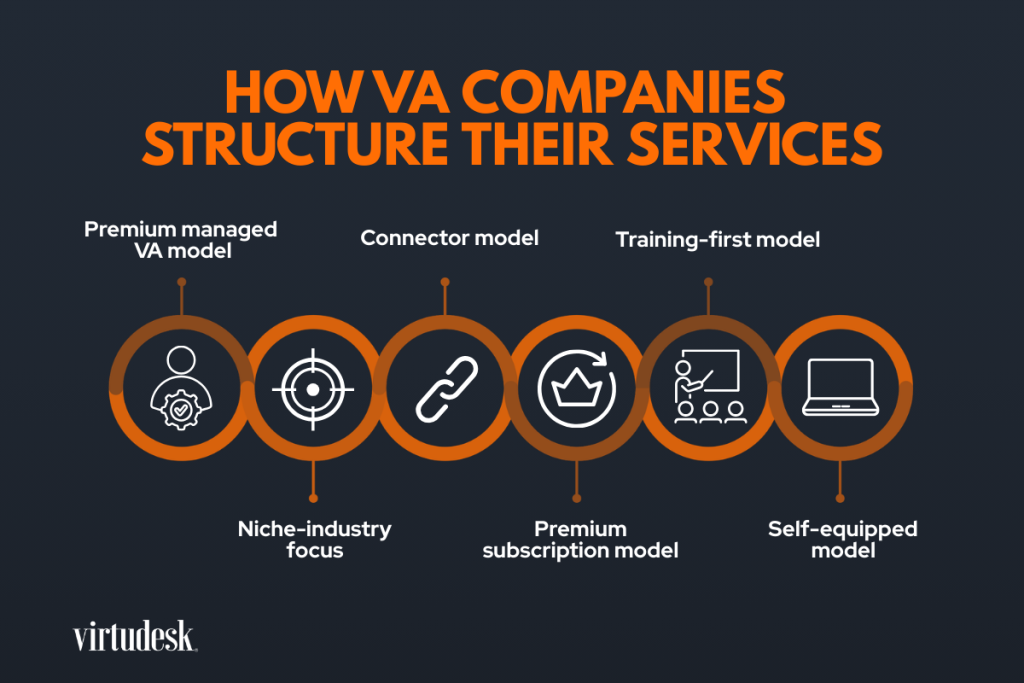
How VA Companies Structure Their Services
To understand where the placement models are, we should look at how major providers in this space actually operate. The information we share below comes from each company's public websites.
We are not making qualitative judgments here; we are describing different models through concrete examples. You can use them to evaluate the available options against your own operational needs.
1. The premium managed VA model: broad scope and no call center infrastructure
MyOutDesk describes itself as a managed VA service. The rates for a matched VA start at $1,988/month. This price includes a vetted VA, onboarding and training, and access to their tracking tool. The service is VA-centered and includes voice-capable roles such as virtual receptionists, customer support, and inside sales agents. This means that these are virtual assistants performing voice tasks within their defined roles.
This is not the same as a managed call center operation.
Managed in-house or remote call centers run outbound and inbound campaigns through specialized call center representatives, not generalist VAs assigned to calling responsibilities. They typically use interactive voice response (IVR), automatic call distribution (ACD), and customer relationship management (CRM) software.
At Virtudesk, our comprehensive call center services provide 24/7 support, cybersecurity insurance, dedicated account managers and our proprietary tools Tymblr Dialer and Timedly. As a business owner or manager, you’ll also appreciate another big differentiator: our affordable prices and transparency. Our pricing page provides you with detailed information on our hourly and monthly prices for the different services (you can browse through the service tabs).
2. The niche-industry focus and what it costs you
Let’s take REVA Global, for example. It focuses mainly on real estate and medical services. Their model combines placement with coaching for real estate agents and brokers, and healthcare professionals. A high niche specialization produces a well-prepared candidate for that one industry, or in REVA Global’s case, two.
Niche-industry focus is a clear structural limitation. A provider built around an industry has less to offer outside of it.
Committed to service quality, at Virtudesk, we recruit agents skilled in various roles and niches and keep updating their skill sets at our own academy. You can find which business fields we cover in our industries page.
We only offer services we know we can cover with the highest standards.
3. The connector model: unclear estimated costs and undefined accountability
Connector platforms link business owners directly with VAs.
Sphere Rocket, for example, works as a job-matching platform. Their pricing page publishes tier rates and a built-in calculator that gives you estimates, not a final number, as it outputs a range, not a price. The disclaimer below it confirms that their final pricing depends on role complexity and specific requirements.
As a business owner budgeting for a remote assistant, you’ll want to know the platform fees, the VA rate, and any consulting fees tied to ongoing support. In this case, none of them are published together.
You want to know what you are committing to beforehand; that’s why our pricing page publishes what each plan includes and what it costs.
4. The premium subscription model: senior staff, VA scope, and higher price point
Boldly operates at the top of the US market on a subscription basis. Their staff members are US and Europe-based senior professionals with experience in executive assistance, project management, marketing, and bookkeeping. Boldly’s assistants are direct employees, not independent contractors, based in the US and Europe. That employment structure and talent profile are directly reflected in the prices, which range from $2,600 to $6,500 per month for 40 to 100 hours of support.
Boldly offers VA and customer support services. There is no call center, and no owned technology, which is not a minor detail for those needing comprehensive call center operations. Their clients monitor the activity from a dashboard. This is a visibility tool rather than a management layer.
This model fits businesses seeking highly experienced virtual assistance. Yet, for businesses where budget is a constraint, the price range leaves the service out of the feasible option.
5. The training-first model: prepared candidates and limited post-placement support
Some providers invest heavily in pre-training their VAs before placing them. Cyberbacker, for instance, offers extensive training. Their program covers, for example, CRM systems, communication tools, business operations, and task management. Once they place the candidates, the remote employees must submit end-of-shift reports. A support team monitors attendance and performance.
The model addresses skill readiness and task visibility, but doesn’t include a management layer to handle performance issues or continuity if a staff member exits.
When outsourcing to remote staff, management is a decisive aspect of post-placement support, and it is included in our VA services without extra cost. You hire a VA through Virtudesk; the management layer is covered.
And if you did not hire with us, you can still hire our professional management service to handle your remote staff, regardless of the industry, to foster continued growth, monitor to increase performance, and help achieve your business goals.
6. The self-equipped model: the infrastructure risk is yours
This category includes platforms where the VA supplies their own equipment and Internet connection. Upwork is the most recognized version of this model that connects buyers with independent contractors. What happens after the connection is the client’s responsibility (and risk). Cyberbacker’s careers page confirms the same baseline: applicants work from their personal laptop on their own connections.
Most matching platforms operate similarly; the worker’s setup becomes the worker’s problem, which makes it the client’s problem.
Imagine the consequences of a hardware failure or an unstable domestic network, not to mention the uncertainty of what if the remote assistant has a personal issue, like a health issue and can’t log in to do their work.
These are some of the models that business owners frequently find when searching for remote staffing support.
Which Model Is Right for Your Business?
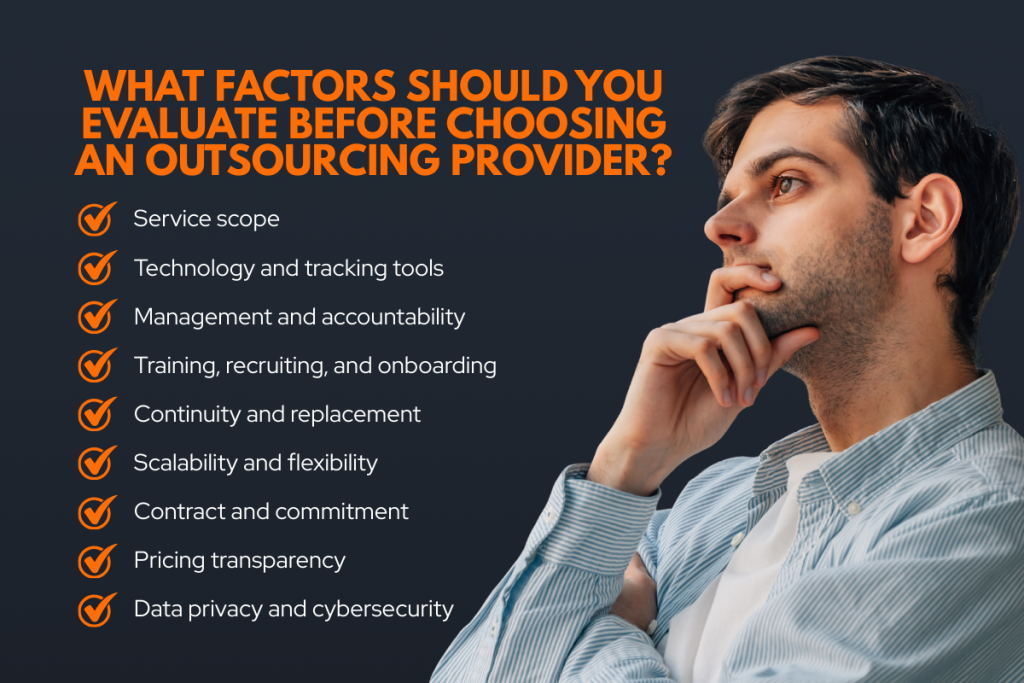
The right provider depends on what you are building. Not all businesses need a full operational layer, but every business owner evaluating a remote team should look for some major factors before signing a contract or choosing a service pack.
- Service scope: Does the provider offer only VA placement or does it also offer additional services, such as call center services? Which industries does it cover? Does it provide part-time or full-time coverage? Can you hire a VA only for short-term, one-time projects? What if you need flexible, on- demand support, only a couple of hours a day, such as Virtudesk Lite option? What about 24/7 support?
- Technology and tracking tools: Does the provider offer monitoring and productivity tracking options? Which technology does it use?
- Management and accountability: Who handles performance issues? What happens if a VA doesn’t show up? Is management included in the price or charged separately?
- Training, recruiting, and onboarding: How does the prospective provider screen, recruit, and prepare the candidates? Is training limited to pre-placement only, or does it continue after the VA is working within your systems?
- Continuity and replacement: What happens if your VA leaves and you need a replacement? What if you only need a temporary replacement during medical leave?
- Scalability and flexibility: What if you experience peak demand and need to grow your team only for a certain period?
- Contract and commitment: Do you need to sign a long-term contract with the service provider? Who is responsible for the assistant's salary and benefits?
- Pricing transparency: Can you see the full costs before committing? What does the price include? Are there any associated fees? What, when, and how do you pay your provider?
- Data privacy and cybersecurity: How is private data handled? Where is it stored? Is the VA signing a non-disclosure agreement (NDA)?
If you are evaluating your options and want to see how the described criteria work in practice, our resources page and services page are good places to start. They will give you concrete and thorough information on how we work.
Conclusion: The Difference Is the System, Not Just the Staff
The VA placement vs full business service provider distinction is not a question of candidate quality. Skilled professionals work within every model. The difference is in the work model. What happens after the placement?
A hire without monitoring, management, and infrastructure are responsibilities the client must absorb.
A system built around the remote employee is one that runs without the owner at the center of every decision.
And that’s what most business owners or managers look for and need: a system that provides them with solutions, frees their time, and helps their business move forward without adding responsibilities, work, and unnecessary costs.
The models and providers we reviewed here make different choices about what they include and what they leave to the client. Some stop at the match, some at the report, some leave the infrastructure to the worker and client, and some go further.
We don’t stop at the match. We create a system around each hire. We offer transparency and provide continuity. We alleviate the weight off your shoulders.
If you need to delegate work, scale your operations, launch a new marketing campaign, or offer broader customer support to your clients, schedule a free discovery call with us. We’ll match you with the right staff within a structured and transparent outsourcing system.
Share this article
Meet our Most Trusted
Partners & Clients

Byron Lazine
Co-Founding Chief-of-Operations at BAM (Broke Agent Media)I’ve been using Virtual Assistants for years throughout all of my companies. Once we found Virtudesk the process got even easier and allowed us to scale out our hiring. Highly skilled and accountable professionals. 100% recommend!

Rebecca Guy
Realtor / Content CreatorBefore getting started with Virtudesk I had my doubts that they would find what I was looking for. I needed a very particular person to add to my team and let me tell you I am highly pleased! My virtual assistant Myril is the best! I am excited to grow my socialmedia accounts with her. Thank you Virtudesk!

Chelsea Erickson
Realtor La Belle RE GroupI am very happy with the assistance Virtudesk is providing for my real estate business. This is a newer position for my company and we are working through the creation and efficiency.


