
Why Delegation Fails (and How to Fix It for Good)




Introduction
Hiring someone to alleviate your workload sounds straightforward. Owners do it; they delegate tasks. But then, a few weeks later, those same tasks are back on their to-do list.
So, delegation failure seldom has anything to do with the experience or skills of the newly hired person. The employee was capable and had a good attitude. Still, the owner ended up redoing the work, correcting it, or stepping in to do it faster. In such cases, the hire becomes extra work instead of a solution.
Part of the problem starts even earlier than the first task, when owners hire a virtual assistant without having a clear picture of the role, priorities, and ownership lines.
A survey by The Alternative Board found that business owners spend 68% of their time on daily tasks, leaving only 32% for growth and strategy. Most still consider themselves capable delegators. But there’s a gap between what owners think they are doing and what is really happening with the tasks they hand off. In that gap, growth stalls.

The root cause is hardly ever linked to the people involved. The culprit is usually the handoff itself. Expectations are unclear, context is missing, there are no output standards, and there’s no way to track progress without continuous check-ins.
Have you ever wondered what that costs in practice? Where do structural gaps show up, and what does a properly made handoff look like? If you’ve felt that cost, you’ll recognize some of the patterns below and why they repeat.
Key Takeaways
- Task dumping isn’t delegation.
- When delegation goes wrong, owners can lose a significant share of their week on tasks someone else should do.
- The problem is almost never the person you delegated to; it is the absence of a clear system around the tasks.
- Good delegation gives people the needed context to work properly without having to ask how (or doing things wrong).
- Delegating a task and delegating an outcome are two different things. Most owners only do the first.
- Failed delegation costs you hours you cannot recover, growth decisions you never make, and eroded team morale.
- Remote staff and virtual assistants (VAs) do not fix delegation issues on their own; structure does.
- Most frustrated delegation attempts fail due to three root causes: undocumented processes, unclear outcomes, and no visibility system.
- Visibility is seeing what is being done without having to ask constantly. That’s not micromanaging; you don’t need to be watching over anyone’s shoulder. A shared tracker, or a daily update note/email, can be enough.
- Delegation works when you define the acceptance criteria before work begins.
- CEOs who delegate effectively generate 33% more revenue than those who don’t according to Harvard Business Review research.
What You Think Delegation Is (and What It Actually Is)
Handing off a task and handing off ownership are two different actions. Most owners only do the first and then wonder why the second never happens.
Do you remember the last time you assigned work to any of your employees? Probably, you described the tasks to do, pointed them in the right direction, and moved on. That approach can work for one-time or simple tasks, but will fail for anything recurring or consequential.
When someone receives a task without context, they perform it using their own criteria. Eventually, that works. Frequently, however, their idea of what a finished output is differs from yours, and you later find yourself correcting the output or redoing the entire chore. You start to think that delegating increases your workload rather than alleviating.
However, most likely, you’re not delegating; you are task dumping. That is, offloading work you don’t want without context and support. The underlying “how” is what determines the difference between the two and what creates the path to successful delegation or its failure.
Task dumping vs. delegation
Task dumping means giving someone a task you dislike or don’t want to do without giving them the context and tools to complete it well.
Delegation means assigning tasks and providing the structure, resources, and support that make execution possible, reliable, and scalable.
You are task dumping instead of delegating if you:
- Only pass on tedious tasks just because you dislike them
- Hand off work as a “calendar-fixing” tool instead of as a productivity and growth solution
- Give a task without context, training, resources, or the needed authority to do it independently
- Don’t explain the why or objectives behind that work
- Don’t provide a description of the desired outcome
You are delegating when you:
- Select the tasks to reassign with a purpose
- Clarify the expected outcome or result
- Set the circumstances or actions that trigger a task’s delegation
- Assign the task to the right person
- Provide the structure, resources, supervision, and escalation rules
Not fully distinguishing the differences between delegating and dumping is a major reason why real delegation is not accomplished.
The concrete difference
“Handle customer emails” assigns an action.
“Respond to customer emails within 2 hours following our voice and tone guidelines, using the standard response template, and flag emails involving a complaint or reimbursement before replying. Escalate pricing questions to the sales department” sets an outcome with standards and boundaries.
In the first case, owners or managers retain accountability for the quality; in the second, they transfer it.
Writing the second set of instructions takes a few extra minutes once, but recovering from the first version takes hours, and happens repeatedly.
What Failed Delegation Actually Costs You
Understanding what delegation requires is the initial step. The motivation to fix it comes from realizing what broken delegation costs you.
The task came back wrong, it interrupted your workflow or chain of thought, or you missed the deadline. Those are real frustrations, but the costs are reflected in three measurable areas:
- The hours you cannot recover
- The decisions you never made
- The effect on your team
The time costs (hours you cannot recover)
A study conducted by Slack indicates that owners lose an average of 1.5 hours per workday to wasted time, with administrative overload and unscheduled communications being the top causes.
An analysis cited by Breeze suggests that business owners spend 7 hours a week on low-value tasks that could/should be delegated. Over a year, that adds to more than 350 hours. If your time is worth, for example, $150 per hour, this is over $54,000 in capacity you spend on work someone else should do.
Hiring a virtual assistant can liberate you from non-core tasks. Download our free eBook “Tasks to Delegate to an Administrative Virtual Assistant” for real examples of tasks you can take off your workload and recover time to focus on high-impact work.
The growth cost (and decisions you never make)
Leaders spend 36% of their time in reactive mode. Over one-third of their leadership capacity is occupied by unexpected tasks and issues, reducing their time for active, growth tasks such as decision making. Owners, managers, and leaders who delegate well save that time for higher-impact tasks. Furthermore, a survey by Gallup back in 2013 demonstrated that CEOs with delegation skills generate 33% greater revenue.

So, for most businesses, the growth ceiling is not the market or the product; it’s the attention of the owners. When the owners’ attention and time are absorbed by tasks someone else could do, they have no time for the work only they can do.
Decision fatigue is another less visible cost. Every small decision an owner makes, like approving a social media post or selecting a format for a template or report, drains the mental reserve they need for higher-stakes decisions.
When small choices keep landing back on the owner’s desk due to unsuccessful delegation, the quality of important decisions suffers.
The people cost (how it affects your team)
Poor delegation also affects your team’s morale. When your staff receive work to do with unclear expectations, when their tasks are redone without explaining why, or when team members need approval before each simple or tiniest step before moving on, their motivation drops.
For remote staff and virtual assistants (VAs), the consequence of unclear delegation structures becomes more rapidly obvious: they underperform despite the skills they may have.
Lack of autonomy is a primary source of stress for employees. Giving them a clear system to do their job with higher autonomy translates into better overall well-being and higher levels of satisfaction. Research by the University of Birmingham demonstrated this.
Common Delegation Failures: A Quick Reference Guide
Below is a quick reference guide based on delegation failure patterns we noticed with some clients and a prevention action for each.
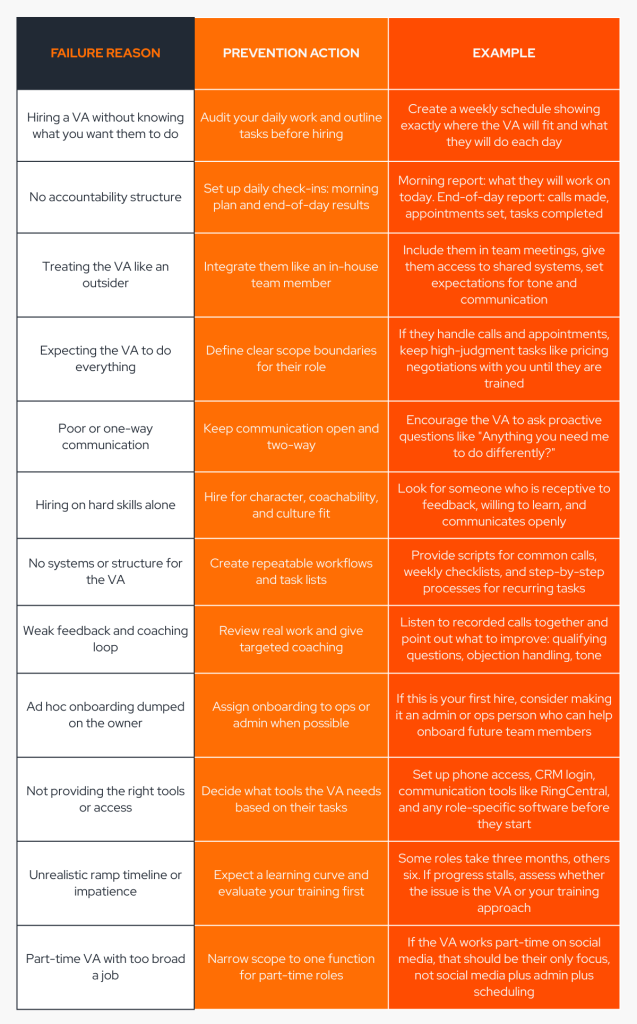
We believe in communication, collaboration, and feedback. That’s why at Virtudesk, we frequently hold webinars or sessions where real clients share their outsourcing experiences.
The points on the table above were extracted from a live conversation between us and Mark, a real estate agent who shared his working relationship with his VA, Francis, over six months. You can watch the full conversation here or read our article 10 Reasons Why You Might Fail With Your First Virtual Assistant to learn about 10 avoidable errors that show up repeatedly.
Why Delegation Keeps Failing: Three Root Causes Worth Understanding
We tend to blame the owner’s mindset as if it were the sole culprit: their perfectionism, control issues, and difficulty trusting others. And yes, those factors affect or prevent delegation; you can learn about them in our post Why Do I Find It So Hard to Delegate?, but mindset is rarely the only factor.
In most cases, the causes of handoff collapse are structural. These are three main problems that persist even long after the owner has decided to delegate (and has worked through the control and trust issues). Fixing them changes the outcome, as they are the ones preventing delegation from holding.
The uncomfortable question is: when delegation keeps failing with the same person, is the VA the problem, or is it the system you built around them? Owners who understand delegation ask themselves what they should have done differently, not just what their assistant misunderstood.
1. The process exists only in the owner’s memory
The owner knows how to do the task; they’ve done it countless times. From the order of steps, the standard procedure, the exception, to the judgment calls, all live in the owner’s head.
Then the owner passes the task and the name of the task, but not the knowledge behind it. The person receiving it designs the process from whatever they can infer. Thus, their output mirrors their personal inference and assumptions, not the owner’s standards. Then the owner notices the gap, reclaims the work or corrects it, and concludes that delegating that task doesn’t work.
The actual problem is that the task was never documented. A standard operating procedure (SOP) would have solved it. An SOP can be a short one-page document that explains what triggers the task, the steps to follow to complete it, and what the output should look like.
2. Assigning actions instead of outcomes
When an owner or manager delegates a task, they implicitly keep ownership of the result. Every doubt that arises, every edge case, every deviation from expectation goes back to them. Clearly, although someone else is doing the work, accountability has not moved.
Good leaders know that a key to delegation is delegating outcomes, not just tasks. Delegating an outcome means transferring accountability.
Effective delegation involves entrusting tasks and responsibilities. Your staff needs to be held responsible for the outcomes, take ownership, and deliver results. But accountability needs to go both ways; the delegee accepts accountability and its consequences, and the one who delegates has to provide a clear framework, provide resources, and specify expectations and consequences of failure and success.
3. Constant check-ins to track progress
Sometimes owners need to choose between two unpleasant options: hovering over their assistants' work with continuous check-ins, or stepping back and accepting whatever results show up at the end. Both options reflect the same issue: the absence of a visibility system.
In this context, visibility means being able to see what’s being done and when.
A functional delegation system needs a simple way to monitor progress without constant check-ins. This can be achieved, for example, through a time and task tracker.
At Virtudesk, we use and give our clients access to Timedly, our proprietary tool that improves productivity, increases accountability, and facilitates collaboration between owners and employees. Timedly, with its new AI-powered tracking feature, can help you improve visibility and transparency, increase trust and better employee experience.
With a delegation system in place, the owner knows how the work is progressing and the team members have a clear understanding of what is expected from them and how their output will be measured.
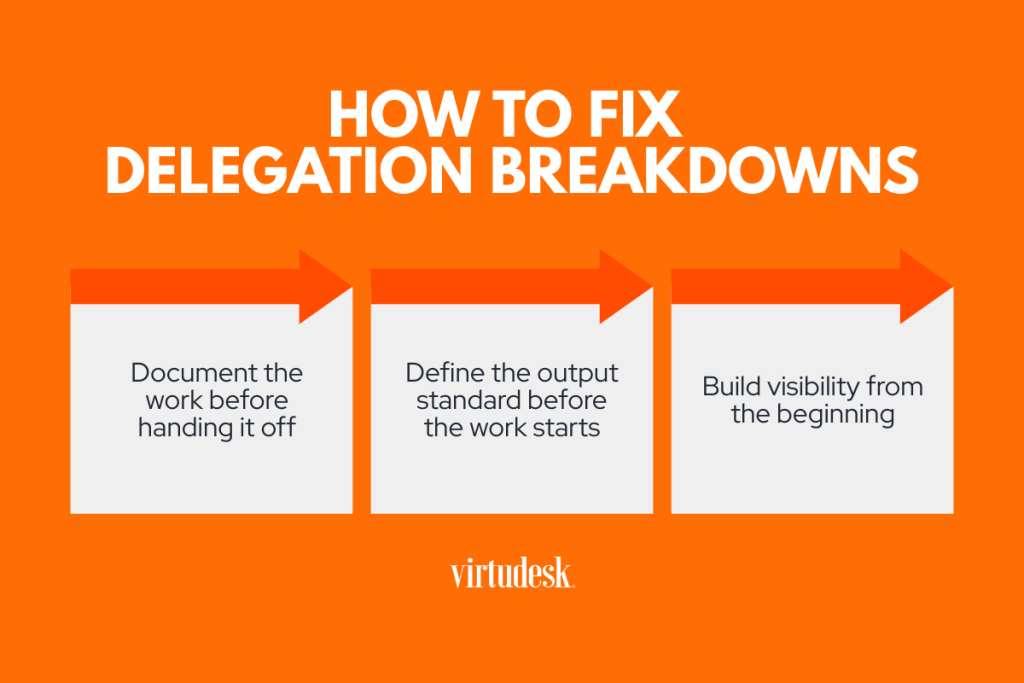
How to Fix Delegation Breakdowns
Delegation fails for a cluster of structural reasons. The solutions below don’t require drastic personality changes; they are adjustments that address the gaps we already described.
1. Document the work before handing it off
Before delegating a task, write down how you do it. The format doesn’t matter (a bullet or numbered list, a paragraph, a narrated screen recording), what matters is reflecting what triggers that task, what happens in each step, and what the finished result should include/look like. That document will become your standard operating procedure (SOP), and you’ll update it as needed. The idea is to move the knowledge from your head to a place and format that your staff can follow consistently.
Our team at Virtudesk can help with this right from the start. Our trained virtual assistants have helped business owners and managers to map routine, repetitive tasks, craft SOPs, and design business systems, including delegation frameworks that work without the owner’s constant input. In our post How a Virtual Assistant Can Help You Build Systems and SOPs you’ll find a closer look at how this process works.
2. Define the output standard before the work starts
Every task you delegate should include a concrete and complete description of the finished output. For example, instead of asking for a “good meeting summary”, ask for a “summary that covers the client’s main three questions from the last Friday meeting, formatted on one page, ready to send by Tuesday morning.”
The standard needs to be clear enough so that, looking at the output, anyone can easily tell if it meets the criteria or not.
This concept removes the ambiguity that causes most delegation problems.
3. Build visibility from the beginning
After you hand a task along with a documented process and a defined expected output, all you need to do is confirm that the work is progressing. For this, you don’t need approval steps or calls. For most remote teams, a brief end-of-day update is enough.
How Virtudesk Sets Up Delegation to Work From Day One
Hiring a virtual assistant or remote staff member doesn’t resolve delegation problems per se, by itself. What it does is compress the timeline. Work leaves the owner’s plate faster, systems are created faster, and the owner has support in documented processes.
Delegation with structure and defined expectations
Outsourcing to virtual assistants when the owner has done a minimum setup (has identified the tasks, written SOPs, and defined the output standard) delivers consistent results. Instead of filling gaps, the virtual assistant executes against a clear brief. At Virtudesk, we assist you through every step of this process.
Transparency comes first (and goes hand in hand with trust). If you hire a virtual assistant, expect a learning curve instead of a perfect performance from day one. We train all our VAs on how to perform different tasks or roles and develop skills. We also train them on the specifics of your company. Yet there will be an initial gap between where they are and where you need them to be. Planning for this short ramp-up period will build stronger relationships with your VAs and improve the process on the go if and when needed.
Our hiring and training process makes the difference
We hire differently. Of course, hard skills are mandatory, but they are not the only filter. We look at the character. We seek people who are receptive to feedback, willing to learn, and are flexible to adapt to working independently or within a team. We also evaluate their communication skills, and value those who can communicate openly when something is unclear. Through us, you’ll find a virtual assistant with good character and adequate hard and soft skills – all that’s needed to grow into such a role.
Our virtual assistants also count on our constant support, which is crucial mostly during onboarding and the first moments of delegation. Of course, you’ll always be able to contact us or reach your account manager to discuss any aspect of the process, clarify doubts, or simply support you.
How we set up the handoff from day one
We start every engagement by learning how your business works and what you expect from delegation. We ask you about your workflows, standards, preferences, and the tasks you need to get off your calendar. We help you identify what to delegate first and how to structure the handoff.
Whether you work in real estate, finance, health, e-commerce, or any other field, our outsourced staff can take on the workload that is keeping you away from your higher-value activity. See the industries we serve, or contact us for a custom solution if yours is not listed.
If you plan to add a virtual assistant to your team, download our free eBook, Client’s Virtual Assistant Onboarding Checklist. It will prepare you to get your systems ready and confidently and smoothly onboard your virtual hire.
Conclusion
Delegation involves several components that contribute to its success or failure. If we have to point out one common denominator, it’s the lack of structure. The process was never documented, the output standard was never agreed on, and there was no way to check progress without calling someone or looking over someone’s shoulder.
If you want to delegate with structure and support, we are here to help. Call us at 1 (800) 470-8136 or schedule a free discovery call. We’ll start by understanding how your business operates and help you build the framework for effective and sustainable delegation.
Share this article
Meet our Most Trusted
Partners & Clients

Byron Lazine
Co-Founding Chief-of-Operations at BAM (Broke Agent Media)I’ve been using Virtual Assistants for years throughout all of my companies. Once we found Virtudesk the process got even easier and allowed us to scale out our hiring. Highly skilled and accountable professionals. 100% recommend!

Rebecca Guy
Realtor / Content CreatorBefore getting started with Virtudesk I had my doubts that they would find what I was looking for. I needed a very particular person to add to my team and let me tell you I am highly pleased! My virtual assistant Myril is the best! I am excited to grow my socialmedia accounts with her. Thank you Virtudesk!

Chelsea Erickson
Realtor La Belle RE GroupI am very happy with the assistance Virtudesk is providing for my real estate business. This is a newer position for my company and we are working through the creation and efficiency.


