
Why Most New Year Business Plans Fail by February




It’s the second Monday of January. You open your laptop with a firm sense of purpose. On your screen, there’s a document named 2026 Growth Strategy. Revenue and expansion targets are defined. New processes look clean. Yes, this year feels different.
Then February arrives.
Your inbox quickly fills up again. Customer requests interrupt your strategy-planning time. Diverse small operational issues demand your immediate attention, while your scheduled meetings multiply. Your plan doesn’t fail; it just stops moving forward. There seems to be no progress, except for the passage of time.
This pattern repeats every year across different industries and business sizes.
Why do most New Year's business plans fail by February? It’s not a lack of discipline or ambition. The problem is that plans are crafted around intentions, not around how work is really done once regular operations resume.
In this article, we’ll examine why execution breaks down after January, how daily work silently overrides strategies, and what businesses that maintain momentum do differently.
Key Takeaways
- Most business plans fail because they ignore their real execution capacity, not because the goals are wrong.
- Motivation fades rapidly when execution depends on personal energy instead of structure.
- Urgency beats importance, and execution loses to daily tasks.
- When ownership is unclear, work goes back to the business owner by default.
- Strategic execution disappears when it’s not deliberately protected.
- Without regular review, progress drifts before anyone realizes.
- Growth exposes weak workflows instead of fixing them.
- AI adds value only inside clear processes.
- Delegation works best when you do it before pressure accumulates, not after.
Goals Ignore Time and Capacity Limits
When a new year starts, our motivation is at its peak. It even fills the gaps where systems, structure, and execution planning are missing. Motivation makes us believe that with focus and discipline, we’ll keep the plan moving.
- But motivation is not an execution strategy, and it can’t create time we don’t have.
- Assuming the wrong operational capacity or not planning adequately can lead to failure.
Sometimes motivation and biases make business owners set goals without a clear time limit. But deadlines are what allow you to make the most of your resources, ensure your actions are purposeful, and eliminate procrastination.
At Virtudesk, we adhere to the SMART goals methodology, which gives a structured framework for setting effective goals. To be considered “SMART,” goals need to be:
S – Specific
M - Measurable
A – Achievable
R – Relevant
T- Time-bound

Goals need to have a start and finish date; they need to have a deadline. Deadlines convert vague or unrealistic aspirations into actionable plans. They drive accountability, focus, and momentum. They help prioritize tasks and ensure the limited time is used to achieve the most important, impactful results.
(If you are interested in learning more about SMART Goals, click here to access a downloadable guide issued by the University of California.)
When business plans fail in capacity planning, revenue loss is generally the most impactful consequence.
Operational capacity is the maximum sustainable volume of products or services a business can produce within a specific timeframe using its current resources. It determines the maximum output level of a business, the aggregate amount of revenue it can generate within a period. It’s determined by several elements, including:
- Human resources (workforce)
- Infrastructure
- Material availability
- Process efficiency
Assuming higher operational capacity (overcapacity) triggers the “planning fallacy”. PwC defines planning fallacy as the tendency to wrongly estimate the time and resources to complete a project, which is frequently caused by biases, motivated reasoning, and adjustment heuristics.
Strategic growth is postponed since unbudgeted demands consume all available time and put the business at risk of not keeping up with the required workload and pace.
Assuming lower capacity (undercapacity) means the company won’t prepare for high-volume scenarios.
Wrong capacity planning results in profit loss. It can result in overstaffing or understaffing, both having detrimental effects on business efficiency and revenue.
Sometimes we need external, professional and unbiased help to create or improve our business plan. If you need help to create or polish your business plan, a plan that contemplates the real capacities of our businesses and sets clear and achievable time-bound goals, you can always reach out to us. We count on virtual assistants with formal education and experience in business planning and smart goal setting.
Execution Loses to Daily Tasks
Usual client requests, internal questions, and administrative tasks rarely stop. In January, this seems manageable, but in February, when the holiday season has ended, it becomes obvious that daily operational chores are again energy and time drainers. Daily tasks consume tangible and intangible resources, leaving little room for execution.
Within the context of our topic, execution is the work of building, changing, or scaling how the business operates. It involves converting strategic intent into repeatable actions, systems, and decisions that push the business forward beyond daily operations. This definition of execution intentionally excludes the concepts of “trying harder” or “staying busy”. A common conceptual error is confusing being busy with true execution.
Many business plans fail because daily operations start taking precedence over strategic work.
The harsh truth is that execution loses to daily tasks because most businesses are designed to keep things running. Paradoxically, it’s common to see their business plans drafted for a perfect version of the business (that doesn’t exist); their focus is on growth, forgetting the time it takes to manage daily operations.
To explain why execution loses to daily tasks, we should also take a quick look at the psychological and operational friction that takes place within an expanding business. This affects both business leaders and teams.
The conflict of “urgent” vs. “strategic”
The biological nature of stress is probably the primary reason why execution loses to daily tasks.
Daily tasks show up as urgent. They trigger a “fight or flight” response that demands an immediate fix. Sometimes, on the contrary, it can lead to procrastination, as psychologist and author Tim Pychyl explained to National Geographic.
The execution of a business plan is strategic. It is important, but doesn’t feel urgent.
What would you do, as a business owner, first on a Wednesday at 9:00 am? Would you put out the fire of your inbox or spend two hours elaborating long-term scaling strategies?
The good news is that you can avoid all this hustle and gain time and mental peace to focus on your business strategies. Delegating is the solution. You can easily delegate the repetitive chores to a virtual assistant, for example. If you’re hesitant about whether it’s time to outsource or not, we invite you to check our post When Should You Outsource. You’ll find useful hints.
Owners Hold Onto Too Much Work
A big shortage or weakness in business plans is describing what needs to be done, but not specifying ownership.
Think of a business plan that looks like a what-to-do list outlining goals, strategies, and projections without stating who owns, performs, or is accountable for each task or action. When responsibilities are shared informally, and decisions and duties are implied rather than assigned, if something fails or remains stalled, it defaults back to the business owner. It’s understandable; the business owner is the fastest problem-solver available.
This can work as a temporary or eventual fix; when this becomes the norm, it affects the owner's productivity, hence the business growth.
Daily tasks usually consist of “low-value” work, that is, repetitive actions that don’t require your unique expertise, but may consume a big percentage of your time. A survey indicates that average entrepreneurs spend more than a third of their work week on administrative tasks.
Have you ever estimated the time you spend on daily administrative tasks, for example?
The problem is not just the hours you spend on routine tasks. Think about when you spend that time. Usually, you’ll want to complete your admin maintenance tasks as soon as possible. As a result, you probably spend your highest-energy hours clearing them, and by the time you decide to focus on growth and strategy (execution), your “decision capital” is drained, you’re simply exhausted.
Exhaustion is another factor why business plans fail by February; owners are too drained to focus on high-value tasks and leadership.
Delegating daily tasks helps prevent owners from becoming the limiting factor in their own growth plans.
We understand that sometimes delegating is not easy. If you are among the many managers and owners who find it hard to delegate, read our Why Do I Find It So Hard to Delegate? 7 Barriers and Solutions. You’ll probably identify yourself in one or more points.
Progress Isn’t Measured
In January, progress seems apparent: the year just started, and your orders are increasing. By February, you already question how real and sustainable that progress is.
“You can’t improve what you don’t measure.” (Attributed to Peter Drucker).

This assertion conveys the importance of metrics and evaluation in nurturing progress and growth. Measurement brings direction and clarity, and lets you understand where you are in relation to your goals. And as we’ve seen, the SMART framework for goal setting states that they must be measurable.
Measuring performance against goals helps to:
- Track progress
- Align strategies
- Make data-driven decisions
- Drive improvement and growth
When business plans lack consistent review points, instead of tracking meaningful indicators, owners rely on impressions. There’s a good amount of work, everyone’s busy, but it’s unclear if the business is really moving forward.
How can you solve this? Setting measurable goals and Key Performance Indicators (KPIs) that show how your business is progressing toward your objectives in the different areas (for example, sales, finance, marketing, customer satisfaction).
Systems Aren’t in Place to Scale
Growth magnifies operational weaknesses, and new problems arise. As work volume increases, inconsistencies and deficiencies become more costly. The lack of a structured foundation, a clear plan, and consistent systems becomes more evident.
Clear workflows are essential for scaling. The more a business grows, the more it needs documented steps, Standard Operating Procedures (SOPs), templates, definitions of done, and clear task ownership. With these systems, it’s not necessary to rely on the founder’s memory and constant guidance. Businesses with workflows set early tend to progress faster than their competitors. Critical decisions are made once and then reused consistently.
When businesses scale, outsourcing tasks is a common practice, but without suitable systems in place, it also magnifies the chaos.
From our own experience, we recommend setting clear business systems right at the beginning, or creating and implementing them now if you haven’t done so yet, to better support future growth. Consider outsourcing to increase your team efficiently and fast, without big investments and without long-term commitments.
If you need assistance to create your business systems, KPIs, and SOPs, you can hire an assistant. A specialized virtual assistant can help you set your business plans and systems, after which you can decide whether you want to continue the partnership or not.
Introducing Artificial Intelligence (AI) Without Clear Processes
AI adds value only when it operates within clear processes.
Without agreed-upon rules, AI output quality varies, and review responsibilities become unclear. Teams either over-rely on automation or lose time correcting what should have been a shortcut.
It’s common to see businesses adopting AI tools at the start of the year, as a technological upgrade that will bring immediate efficiency gains. But the results can be different from what’s expected.
The World Economic Forum noted that many AI initiatives fail without streamlined business processes because these are not optimized to estimate and handle their potential.
Delegation Is Not Systematized or Comes Too Late
Delegation is frequently seen as a last resort, an urgent fix to manage increasing workloads. As such:
- There’s no delegation process to follow
- It’s implemented when business owners and teams are already overwhelmed by workload.
Business plans should include a clear process for the strategic transfer of specific tasks from business owners to local or remote team members. With a delegation framework, owners and leaders can focus on high-impact activities while empowering employees.
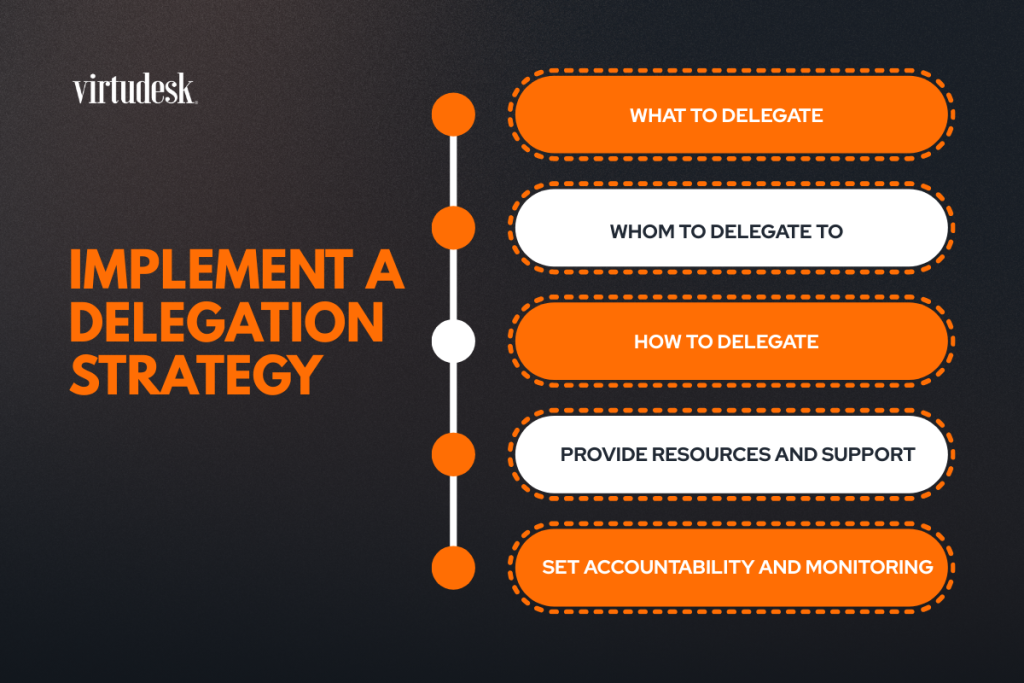
Implement a delegation strategy
If you plan to delegate, these are some basic things you need to determine previously:
What to delegate: Not all tasks should be delegated, and it’s wise to delegate incrementally.
Whom to delegate to: Delegate based on skills and capacity.
How to delegate: Set clear expectations and boundaries (what can be done independently and what requires approval).
Provide resources and support: Provide necessary tools and information for your staff to succeed.
Set accountability and monitoring: Without micromanaging, schedule regular reviews and provide feedback.
Delegate before it’s too late
When business owners start January handling everything themselves, when February arrives workload may have already increased, and the pressure is already overwhelming. This is another reason why new year business plans fail by February.
Delegation comes too late when:
- A leader passes on tasks after they are stressed or close to burnout.
- Business operations become inefficient because high-value work is left aside while the owner or leader handles minor tasks.
Is it time for you to delegate? Our practical guide When Is It Time to Delegate? can help you find the answer.
How Virtudesk Helps Business Plans Survive Past February
At Virtudesk, we see similar patterns repeat every year. Business owners have ideas and motivation, but many lack the capacity to execute and don’t have workflows to keep operating efficiently when the workload increases.
What we do is facilitate execution. For that, we pair trained virtual assistants with documented workflows, clear ownership, and visibility. For instance, through Timedly, our clients can monitor work without having to manage every task themselves.
All of our services aim to keep work advancing without adding pressure to the owner.
Conclusion
New Year business plans fail because of the fragility of their execution, not because they have the wrong goals.
Motivation fades, and work accelerates. Without systems, ownership, and timely delegation, even the apparently strongest plans collapse.
Do you want to make 2026 a different year? Redesign work.
Virtudesk can be your reliable partner to turn your intentions into execution. Call us at 1 (800) 470-8136 or schedule a discovery call, and let’s discuss how structured delegation can keep your business moving all year.
Share this article
Meet our Most Trusted
Partners & Clients

Byron Lazine
Co-Founding Chief-of-Operations at BAM (Broke Agent Media)I’ve been using Virtual Assistants for years throughout all of my companies. Once we found Virtudesk the process got even easier and allowed us to scale out our hiring. Highly skilled and accountable professionals. 100% recommend!

Rebecca Guy
Realtor / Content CreatorBefore getting started with Virtudesk I had my doubts that they would find what I was looking for. I needed a very particular person to add to my team and let me tell you I am highly pleased! My virtual assistant Myril is the best! I am excited to grow my socialmedia accounts with her. Thank you Virtudesk!

Chelsea Erickson
Realtor La Belle RE GroupI am very happy with the assistance Virtudesk is providing for my real estate business. This is a newer position for my company and we are working through the creation and efficiency.


