
2026 Business Trends Shaping the Way Companies Operate



Introduction
It's 8:50 a.m., and your phone starts buzzing insistently. You open your inbox and find 37 new messages. A supplier notified you that they won’t ship on time. Your bookkeeper needs some missing receipts. You wanted to review your pipeline, but operative and admin tasks keep getting in the way.
This is the reality for many business owners.
2026 business trends show that how you run your workday matters more than the workload of the day itself. What matters in 2026 is your operating model: the people, processes and tools you use to run your business. Basically, it is about how work gets done.
In this post, we'll review the main 2026 business trends and the actions you can take to align with them. You’ll see the importance of business systems, how lean and flexible teams can fuel growth, where and how AI (artificial intelligence) fits, and how outsourcing can remove bottlenecks without adding full-time headcount and upfront investments.
Key Takeaways
2026 business trends at a glance:
- In 2026 what matters the most is how you do things or get them done.
- Systems replace the hustle with clearly defined, organized, and repeatable work streams.
- Teams stay lean and flexible (and move faster with clear handoffs).
- AI supports daily operations, saves time, and increases productivity.
- Outsourcing drives growth, adding capacity without full-time or on-site hiring.
- Cybersecurity and data protection will be a priority in 2026 (set clear data handling rules and train your teams).
- Consumer polarization is increasing in 2026 (test different versions of your marketing messages and track which one converts better based on your target consumer goals).
Systems Replace the Hustle
Build business systems to have the necessary structure for organized, optimized, and sustainable growth.
This first trend is simple: systems replace the hustle.
Systems are the sets of processes, persons, and tools we use to reach our business goals. These include technology, information, and overall resources. Focused on strategic directions, smart resource allocation, and execution, a system’s purpose is to achieve the company’s vision and success through actionable steps.
In 2026, systems are indispensable not only for efficiency but also for survival, competitiveness, and navigating the changes brought about by AI, multifaceted regulations, and shifting customer expectations and behaviors.
Moreover, systems also bring owners and leads increased freedom to focus on their revenue-generating activities, and, why not, their personal life. Unsure of how to achieve this? Read our explanatory guide on how to build a business system that runs without you, where we also explain the benefits of business systems.
To build a system, you’ll need detailed written instructions to outline how to perform the routine tasks and processes within your system. For that, you’ll need to create SOPs (standard operating procedures), the step-by-step guides that specify what starts a task, what steps to follow next, and when the task is considered “done”.
This growing trend is inherently linked to the characteristics of current teams and the integration of AI technologies (which we discuss below), with AI-driven business models becoming a standard.
How Virtudesk can help you create and implement systems
Our Virtudesk remote staff can help you turn repetitive work into clear written systems you can implement without constant oversight. Mapping recurring tasks, documenting procedures, defining ownership and handoffs, our virtual assistants can build checklists your remote and on-site teams can follow.
So, don’t worry if you don’t know how to create SOPs; a trained virtual assistant can help you with that. In our article “How a Virtual Assistant Can Help You Build Systems and SOPs”, you’ll find deeper insights on the matter. Delegate SOPs creation and start building your system to be part of this 2026 business trend.
Teams Stay Lean and Flexible in 2026
The 2026 business trend towards lean and flexible teams is a response to economic uncertainty, fast technological progress (particularly AI), and changing workforce expectations.
But what do we mean by “lean and flexible teams”?
Lean and flexible teams are small, cross-functional groups that aim to achieve maximal efficiency, reduce waste (be lean), and adapt easily and quickly to market shifts, customer needs, project demands, and unexpected challenges (be flexible).
From a technical perspective, “Lean” is a way of working that focuses on removing waste within a process and prioritizes meeting customer needs. Waste is any activity that consumes resources without adding value for the customers, hence hindering efficiency and raising costs. The idea is to preserve value with less work.
How our VAs can contribute to a lean and flexible team
At Virtudesk, we allocate our virtual assistants within your workflow, monitor their work so you can review what they do and how, without having to make constant calls or micromanage. You can review our coverage options starting on our Services page.
The nature of VAs and the specific training give our virtual assistants staff the ability to adapt quickly and efficiently to the changing circumstances and client demands.
Our virtual assistants receive training in time management, resource usage optimization, and a customer-centric approach, all of which contribute to a lean work method and a streamlined workflow.
If you are interested in fully integrating the Lean methodology and are not sure where to start, get in touch with us. At Virtudesk, we count on staff members who hold Lean Practitioner Certifications. These certifications (issued by different associations and/or private institutes) validate their ability to apply Lean principles to any organization, making them drivers of continuous improvement.
Are you and your company prepared to adopt the “Lean” way of thinking and be part of the trend?
AI Supports Daily Operations (But Don’t Replace Humans)
Certainly, the surge of new technologies and the adoption of AI (artificial intelligence) at the workplace are among the most impactful trends in 2026. They redefine how we collaborate, do or get things done, and remain competitive.
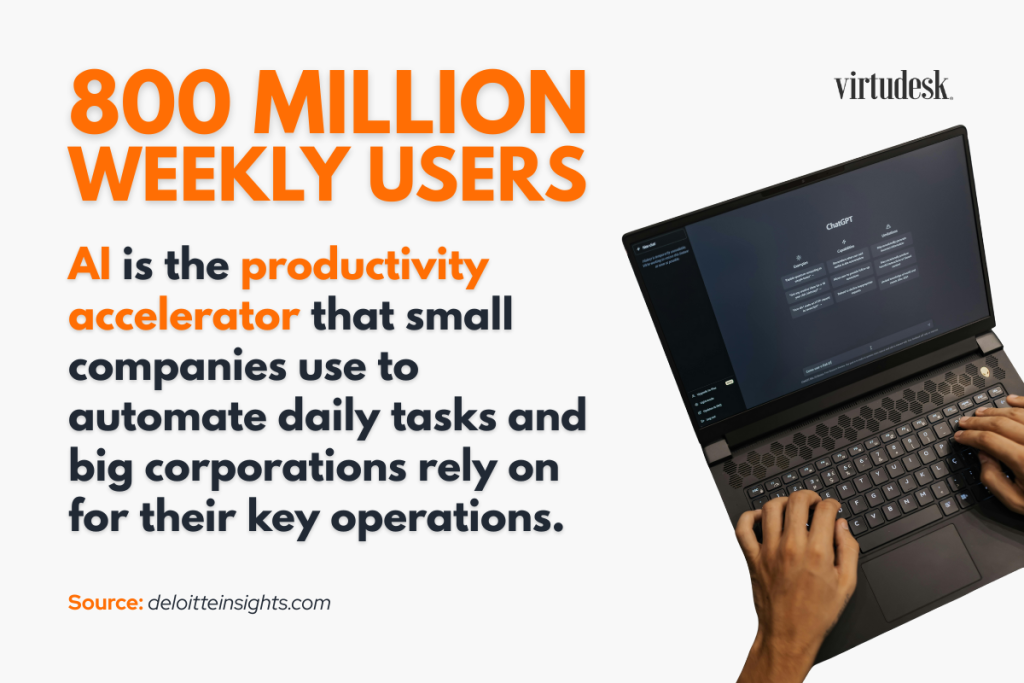
With 800 million weekly users, AI is the productivity accelerator that small companies use to automate daily tasks and big corporations rely on for their key operations. A survey by McKinsey revealed that employees are ready for AI, with leadership being the biggest barrier.
AI (artificial intelligence) is becoming the norm in many firms to increase performance and productivity. McKinsey’s survey on the state of AI (November 2025) shows that high performers use AI for growth, innovation, and cost-benefits, with 88% of the respondents reporting they use AI in at least one business function.
An important consideration is that AI is not a decision-maker; it’s an assistant. You set the rules, review AI's outputs, approve final actions, and make decisions.
Similarly, AI is an efficiency tool that virtual assistants use, but it can’t replace them. Some skills are inherent to humans only, for instance, the empathy required when communicating with clients in problematic situations that need understanding and support. An interesting and explanatory article on the topic is our “AI and Virtual Assistants: Efficiency and Human Touch”.
Human judgment will remain crucial to make decisions, and evaluate and double-check AI outcomes. The reasons are simple:
- AI models lack human-like judgment capabilities and experience (critical to make decisions). Click here to see what Harvard Business School explains about this topic, aligned with the findings of the paper published by the Journal of Electronics and Communication Engineering Research.
- Only humans can identify and mitigate the biases often contained in the historical data AI models were trained on.
- Many AI models’ databases are not updated (what was true yesterday may not be today).
- Generative AI models easily hallucinate, providing false outputs. The MIT Sloan Teaching Learning Technologies gives the example of a legal case (Mata vs. Avianca) where the attorney, on behalf of a client's injury claim, used ChatGPT for his legal research, and the judge realized that the quotes and citations he presented were nonexistent.
AI enhances the performance of employees and managers, but it doesn’t replace their unique skills.
Virtudesk and AI integration
Virtudesk is prepared to help you integrate AI into your daily work without losing control over quality. Our experienced VAs receive training in the use of AI tools and can professionally handle AI-supported tasks both in automation and AI-fueled content generation.
Our AI-powered tracking and managing tool, Timedly, is an unrivalled example of how AI can work for you and give you the information and analysis needed to make the best (human) decision.
Outsourcing to Drive Growth
Outsourcing is another 2026 business trend to follow to stay competitive throughout this year and over time.
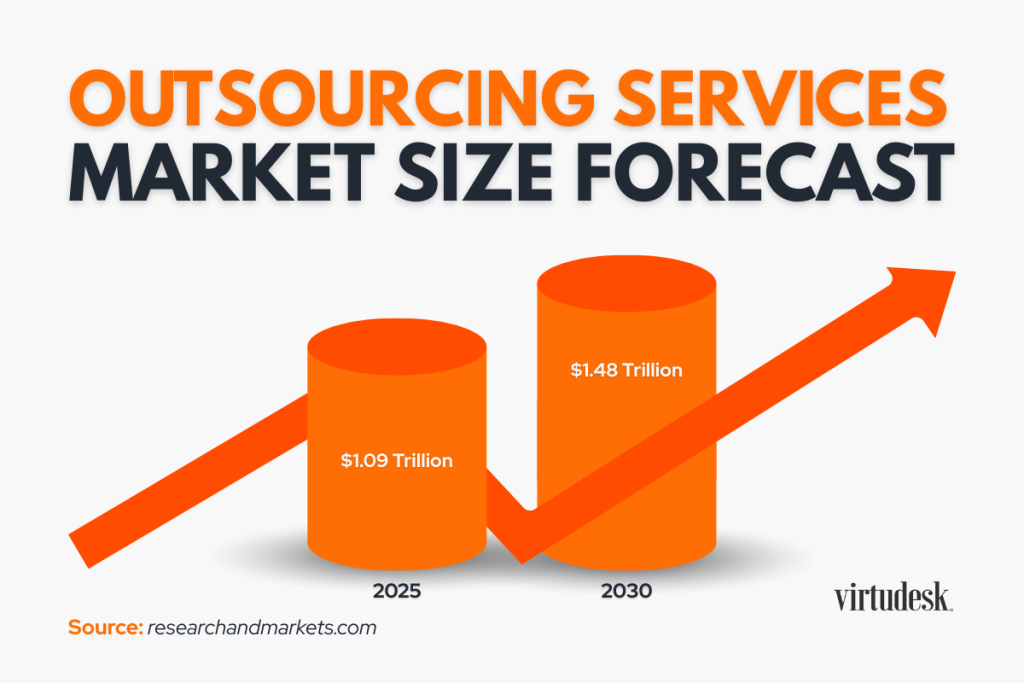
In 2025, the outsourcing market reached USD 1.09 trillion, and is expected to reach USD 1.48 trillion by 2030. As outsourcing rises, technology advances, and commercial innovation accelerates, business service providers need to evolve as well. Service providers shall transition from being simple vendors to becoming tactical partners who deliver measurable value.
As stated by KPMG in a publication about the future of outsourcing, the basis of such evolution requires the development of healthy provider-client relationships based on:
- Trust
- Flexibility and adaptability
- Innovation
- Collaboration
- Service quality and performance
Outsourcing keeps being the chosen method to drive growth, adding capacity without full-time or on-site hiring. Why? Because it’s not only a cost decision, it’s also a decision about speed, about adding capacity without undergoing a long hiring cycle, and long-term commitments to the new staff members.
Outsourcing is a 2026 business trend you can apply without totally changing how your company works.
Outsourcing through Virtudesk
As a reputable and experienced business service provider, at Virtudesk, we can help you have an optimal outsourcing experience.
We'll start by learning how you work and then match you with the right virtual assistants for your task list. Whenever you may need extra coverage, our outsourced team can handle your overflow based on your own rules.
Regardless of your business field, count on us for a fruitful collaboration. Many roles can be outsourced (we describe some of them in our post “What Are the Roles That Could Be Outsourced”, and numerous tasks can be delegated to a virtual assistant. Check some of the industries we serve, and if you don’t find yours listed here, contact us for a customized solution.
Cybersecurity and Data Protection as an Increasing 2026 Business Trend (and Why Businesses Must Evolve)
In 2026, businesses can no longer treat security as a mere compliance issue or an isolated IT function.
Cyber danger used to be episodic, but has now become systemic. This affects businesses on their long-term competitiveness, consumers' trust, and organizational resilience. Cybersecurity is experiencing a transformation with high-profile attacks, AI-enhanced malware, and increased exploitation of “zero-day vulnerabilities” (flaws that haven’t been discovered by the software or hardware vendor).
Cybersecurity has turned into a business requisite and a central component of operational resilience and risk management.
Besides the strict new regulations on cybersecurity and the related accountability, cybersecurity is mandatory for ensuring business continuity and maintaining customer trust.
Virtudesk and cybersecurity
Cybersecurity is a pillar for us. All our virtual assistants undergo strict background checks before onboarding our staff and receive constant training on cybersecurity, data-handling, and regulations compliance.
Furthermore, all our remote assistants work by logging into Timedly, our proprietary monitoring tracker that logs all the activities performed, so you and our management experts can have constant access to what’s being done and how.
Increasing Consumer Polarization
Consumer polarization gravitates mainly toward two extremes: “premium” or “value”. But that’s not all. Several other factors contribute to this polarization, the following being the main ones:
Widening gaps in income
These gaps lead to a split between buyers seeking affordability and those pursuing luxury and premium experiences. A consequence of this is the erosion of brand loyalty as consumers are willing to switch brands for a better price or for a higher value proposition.
Experiences over material products
Higher-income buyers and millennials prioritize experiences (such as dining, travel, or entertainment) over the accumulation of physical goods.
Channel polarization
The rise of social media commerce, e-commerce platforms, and quick delivery services has split consumers across diverse platforms. Buyers expect seamless experiences across the different platforms. To cope with the market demands, retailers need to cater for the different channels.
Generational divides
The different generations show distinct consumer behaviors.
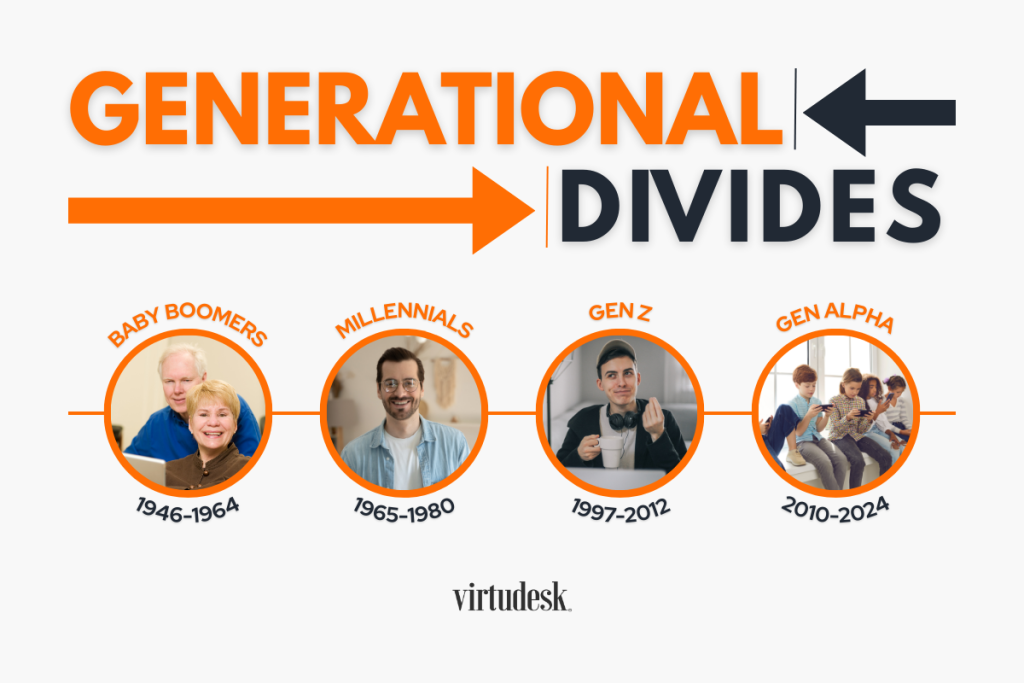
- Baby boomers (born 1946-1964) mostly prioritize travel, healthcare, experiences, and luxury goods.
- Gen X (born 1965-1980) shows increased brand loyalty and appreciates customer service.
- Millennials (born 1981-1996) are tech savvy, focus on experiences, and lead online shopping trends.
- Gen Z (born 1997-2012) is mostly value-conscious, basing their decisions on emotional and social value along with discounts or best-value deals. It prioritizes experiences, digital products, and sustainable brands, frequently relying on peer reviews and influences when making purchase decisions.
- Gen Alpha (turning 16 in 2026) will be 24% of the global population. The fragmented consumer behaviors of these 2 billion digital natives, whose early brand exposure is shaping their consumption patterns, make brands take action now. Creator partnerships, intelligent storytelling help build trust and stay relevant with this generation. They impact household purchases, influencing their parents. Despite being digital natives, most Alphas prefer a physical shopping experience, and instead of niche tween-focused brands, they prefer established “adult” brands.
Social and political factors
Deeper socio-political divides mean more buyers are more likely to let their political, social, or ethical identity influence their purchase decisions. Brands that take a public stance on sociopolitical issues risk alienating part of their customer base, leading either to boycotts or active support.
Businesses need to adapt their strategies to target their current consumers’ polarized preferences and avoid marketing errors that can lead to sales losses.
The following examples are pretty illustrative of the importance of being flexible and open to adapting to consumer shifts:
- McDonald’s partnered with Minecraft to launch themed meals, aiming to attract Gen Alpha and millennials through a cross-industry collaboration and gaming partnership.
- Chinese brand Pop Mart is another example of a successful adaptive and data-driven brand strategy that meets the digital natives' longing for individuality and community.
- One of our clients, a skincare brand, noticed their buyers split into “lowest price” and “ingredient proof”. To target both, our VA helped them create and run two different ads and two landing pages.
- Bud Light launched a promotion featuring Dylan Mulvaney, a transgender influencer. After this campaign, the brand faced boycott calls and sales decline as a result of the reaction of conservative groups.
Conclusion
The biggest shift beyond the headlines is simple: working systems are evolving, and the market and circumstances are changing. But you have to keep up with your operational routines. If you build systems, set clear outcomes, use AI with rules while maintaining the human touch as a differentiator while you delegate routine work, you can run a successful and growing business that fully embraces 2026 business trends.
The future of your business starts now. Let us be part of it, widen your horizons with efficacy, professionalism, and hustle-free. Either call us at +1 (800) 470-8136 now, or schedule a free discovery call at your earliest convenience to reinvent your business towards a prolific future.
Share this article
Meet our Most Trusted
Partners & Clients

Byron Lazine
Co-Founding Chief-of-Operations at BAM (Broke Agent Media)I’ve been using Virtual Assistants for years throughout all of my companies. Once we found Virtudesk the process got even easier and allowed us to scale out our hiring. Highly skilled and accountable professionals. 100% recommend!

Rebecca Guy
Realtor / Content CreatorBefore getting started with Virtudesk I had my doubts that they would find what I was looking for. I needed a very particular person to add to my team and let me tell you I am highly pleased! My virtual assistant Myril is the best! I am excited to grow my socialmedia accounts with her. Thank you Virtudesk!

Chelsea Erickson
Realtor La Belle RE GroupI am very happy with the assistance Virtudesk is providing for my real estate business. This is a newer position for my company and we are working through the creation and efficiency.


