
End of Q1 Review: What to Fix Before Q2 Starts




If someone asked you now how your business performed last fiscal quarter, how long would it take to give a confident answer? Could you give a clear account of where time went, what moved, and what stalled?
Most business owners can't do it in under five minutes. That's why quarter 2 (Q2) planning so often repeats the same mistakes from quarter 1 (Q1).
A quarterly business review covers a lot of aspects: financials, team performance, pipeline, and strategy. What owners tend to skip is the operational review inside it.
The operational side is what tells you why a quarter went wrong.
Key Takeaways
- The operational review inside your Q1 is a planning tool, not a performance report.
- Most Q1 bottlenecks are caused by delegation problems, not capacity problems.
- Business owners spend 68% of their time on operational tasks and only 32% on growth, according to The Alternative Board.
- Tasks that kept returning to you in Q1 are system gaps, not performance gaps.
- A Gallup study of 143 Inc. 500 CEOs found that high delegators generate 33% more revenue than low delegators.
- A VA hire in Q2 works best when it’s done after a completed operational audit.
- Q2 targets set without reference to real capacity will repeat the same mistakes Q1 revealed.
What Your Q1 Operational Review Actually Measures
The operational review is the part of your quarterly business review that assesses how time was spent, how tasks were owned, which processes worked and which didn’t, and where decisions kept going back to the owner. The output is a prioritized action list for the next quarter, not a summary.
Time shows you where your hours and your team's hours went. The results tell you if the outcome was proportional to the work. Looking at who owned each task indicates where delegation failed, and work returned to you.
Why the operational review matters (same as or more than a revenue number)
If your business closed fewer deals than you projected in Q1, you could have a sales problem, a capacity problem, or a delegation problem. Without an operational review, you guess the causes and shape your Q2 strategy on that guess.
Operational indicators reveal more than financial ones. The Q1 operational review shows you what got you there and what went wrong; it shows you the 9:00 AM decision that took 45 minutes because three people needed sign-off, or the client follow-up that never happened because no one owned it. It shows you the things you can improve.
The three questions every Q1 review should answer
These are the three questions a quarterly business review should answer.
First: Where did your time go last quarter, and how much of it could have been handled by someone else?
Second: Which recurring tasks really contributed to revenue or growth, and which ones simply kept it running? This separates maintenance work from growth work.
Third: Which processes required you to step in to keep things working?
These three answers will tell you more about your Q1 than any revenue report.

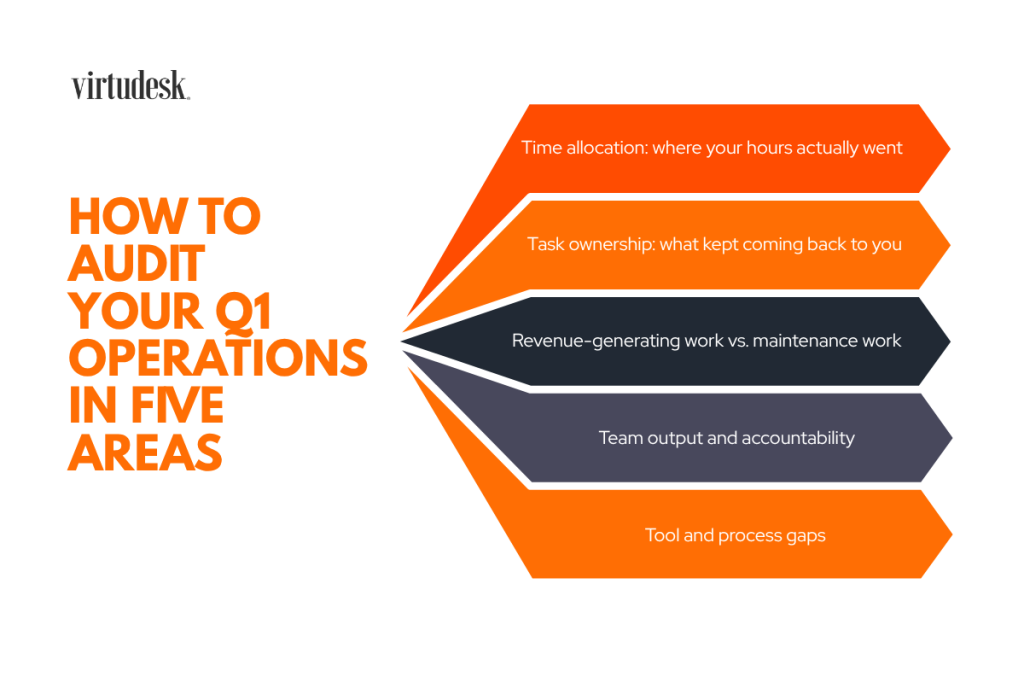
How to Audit Your Q1 Operations in Five Areas
Most Q1 reviews produce a long list of observations that don’t indicate a next step. Here’s what to do to get the most out of your Q1 review.
1. Time allocation: where your hours actually went
Time allocation is how people distribute their working hours across different activities. Within the context of a Q1 operational review, it means looking back at how time was spent over the past 90 days.
Start with a time audit. Recreate the last 12 weeks as precisely as your records allow. If you didn’t track time formally, use your calendar, inbox, and memory of repeated tasks as a starting point.
Divide the activities into three columns: work only you can do, work someone else could do following clear instructions, and work someone else could own entirely. In most cases, the second and third columns hold more hours than expected.
Here is where Timedly changes the picture for remote teams. Rather than trying to reconstruct how time was spent, our AI-powered activity tracker records what your team is doing in real time. If your team used Timedly in Q1, you already have the data. Pull the report, sort it into those three columns. Keep those resulting numbers handy. You will need them to calculate how much your undelegated tasks cost you.
2. Task ownership: what kept coming back to you
Task ownership means assigning responsibility for completing certain tasks to a specific person.
In your Q1 operational review, list all recurring tasks that landed back on your plate, including those that were assigned to someone else and returned to you and those that never had an owner.
The items on that list point to the same underlying problem. The tasks went back to you, not because the person assigned to them failed; what failed was the handoff that lacked context, expected output standard or escalation procedures.
Tasks that returned to you in Q1 are system gaps, not performance gaps.
3. Revenue-generating work vs. maintenance work
Revenue-generating work is any activity that contributes to bringing in new income, for example, sales calls, client prospecting, deal negotiations, partnership conversations, and proposals. Basically, it includes the tasks and strategies that produce income or foster business growth.
Maintenance work is the work that keeps the business running without directly adding to revenue. It includes inbox sorting, scheduling, invoicing, data entry, reporting, and operational administration.
Any business needs both. The problem is when maintenance work starts consuming the hours that revenue-generating work needs.
If you separate the two, you’ll differentiate where your time actually went versus where it should have gone. That gap is usually where Q2 planning needs to start.
Estimate the approximate split from Q1. If maintenance work occupied more than 40% of the spent time, address that before setting Q2 revenue targets.
4. Team output and accountability
Check whether your team performed against defined expectations or against implied ones, as both produce very different results, and it's easy to confuse them.
Implied expectations leave the team members in the position of figuring that out by themselves.
Defined expectations spell out what “good” (or “done”) looks like and include deliverables, standards to meet, deadlines, and escalation rules.
When the results don’t meet the implied expectations, managers or owners tend to instinctively blame the employee. But when they don’t meet the defined ones, you know exactly where to look to find why that happened and take corrective and preventive measures.
Most Q1 accountability issues we see trace back to missing definitions, not to a lack of skills or willingness.
At Virtudesk, our Management Services layer provides the oversight structure that makes this distinction concrete. Rather than relying on your availability to detect problems before they grow, our managers monitor performance, keep accountability consistent, and handle continuity so there is no gap in coverage between quarters.
5. Tool and process gaps
Identify when, during Q1, a missing tool, an undocumented process, or an unclear standard caused friction, delay, or rework. These issues point to existing gaps that Q2 volume will increase. If you detect them now, it will cost you less than having to fix them later under pressure.
For example, some usual signals are: a question asked more than twice, a task that was completed differently each time, or a deadline missed because no one knew what triggered it.
Each signal points to a process that needs to be written down before Q2 scales the problem.
A skilled virtual assistant will detect the unwritten processes your business already runs on and convert the recurring decisions you make daily or weekly into written instructions your team can follow without coming back to you. Those instructions become your SOPs (standard operating procedures), the building blocks of a business system.
What Q1 Slowdowns Are Really Telling You
Recurring slowdowns feel like operational problems. They are actually diagnostic data.
Every repeated sticking point in Q1 points to one of three things:
- A task that was never formally delegated
- A process that was never documented
- A decision (or action) that defaults to the owner because no one else holds the authority or the context to act on it.
A 2025 Business.com study of 550 small- and medium-sized business leaders found that operational inefficiencies consume an average of 6.6 hours of leadership time per week. Over a year, that totals more than 340 hours, time you could use for business growth instead.
The difference between a capacity problem and a delegation problem
Treating a delegation problem as if it were a capacity problem is one of the most expensive planning mistakes owners can make facing Q2.
Most Q1 bottlenecks are delegation problems. For example:
- The owner was doing work a trained virtual assistant could handle.
- The team waited for approvals that a documented escalation rule within an SOP could have resolved.
- Work that should have followed a defined process sat in someone's inbox until it became urgent.
Expert Tip: Before you hire, spend more, or add another tool, ask one question: Is the work assigned to the right person? Reassigning sometimes solves issues faster and more cheaply.
Adding more resources solves a capacity problem. A better handoff solves a delegation problem. They look similar, but their fix is absolutely different. Make a wrong diagnosis, and your Q2 will be a repetition of Q1.
How to Spot Delegation Gaps Before Q2 Starts
One of the most useful outputs of a quarterly business review is a list of the tasks that should not be on your plate. Q1 left a trail of every one of them: the tasks that came back to you, the handoffs that failed, the decisions that were never made.
The fastest way to bring those gaps to the surface is to work backward from your time audit. Every hour you spent in Q1 on work that didn’t need your specific judgment or expertise is a potential delegation gap.
Tasks that belong to a VA, not you
Certain task categories appear consistently on owners' desks. They share one characteristic: they require reliability and attention to detail, not actual owner-level judgment.
Administrative tasks, customer support, lead generation, CRM management, marketing, and sales prospecting are all recurring, time-consuming responsibilities you could delegate to an assistant.
For example, when handling sales prospecting, our VAs manage inbound calls through our Tymbl Dialer platform, research leads, manage CRM data, or set appointments for sales representatives.
If you're not sure where to start, in our free eBook, Tasks to Delegate to an Administrative Virtual Assistant, you’ll find the most common categories in detail.
How to calculate the real cost of not delegating
Start by totaling the hours you spent on delegatable tasks in Q1. If you worked through the time audit in the Time allocation section, you already have this number. Pull out everything from the second and third columns (work someone else could handle with clear instructions, and work someone else could own entirely). Add those for a typical week and multiply by 50 (or 52 minus your vacation weeks) to obtain an annual figure.
A business owner spending five hours a week on low-value tasks they could delegate loses more than 250 hours a year. At ten hours a week, that doubles. Those are hours taken away from the decisions, clients, and growth work.
To put a number on it: at $125 per hour, seven hours a week, it adds up to around $44,000 a year. And we are not including the growth decisions that never got made because there was no time.
A Gallup study of 143 Inc. 500 CEOs found that those who delegated well generated 33% more revenue than those who did not. That difference comes from working on the right things, not from working harder.
The revenue difference between owners who delegate and those who don’t starts with how they spend their time.

Building Your Q2 Plan Around What Q1 Revealed
When Q1 ends, the optimism of January has faded and reality has had three months to push back. What you have left is an honest picture of how your business actually runs. That is the right foundation for Q2 planning.
Most owners skip that step. They set Q2 targets with the same energy they had in January, against a version of the business that doesn't quite exist. The quarter then unfolds repeating the same gaps as the one before.
The alternative is easier than it sounds. Instead of starting Q2 with new targets, start with what Q1 actually revealed. The sections below show you how.
1. Turn your audit findings into Q2 delegation decisions
Each of the five audit areas produces a specific delegation action for Q2.
- Time allocation findings indicate which task categories to remove from your calendar first. Start with the highest-frequency, lowest-judgment items. Those are the fastest wins and the ones that free up the most consistent time.
- Task ownership findings tell you which recurring handoffs need a documented process before they move to a new owner. Write at least a simple instructions list before delegating, a virtual assistant can then turn it into an SOP.
- Revenue versus maintenance findings show you which functions to move to a virtual assistant so your peak-energy hours are protected for growth work.
- Team output findings show where accountability structure needs to be rebuilt before Q2 volume tests it again. A process that broke once in Q1 under current load will break faster in Q2 when volume increases.
- Tool and process gap findings point to which SOPs to build, which tools to configure, and which escalation rules to define before the quarter starts.
The gaps the Q1 revealed do not need a new plan; they need an owner, a deadline, and a process. That is your Q2.
2. Set Q2 targets that your operations can really support
Revenue targets set without reference to operational capacity produce one predictable outcome: the owner absorbs the gap personally, working longer hours to compensate for systems that were never built.
Before locking in Q2 targets, answer two questions. What's your realistic operational capacity once the delegation gaps identified in Q1 are closed, and what will you do in the first 30 days of Q2 to close those gaps?
The answers set a floor under your Q2 targets. Growth projections above that floor need a corresponding increase in delegation, team capacity, or both.
3. Decide what to delegate before you decide who to hire
The most common mistake owners make going into Q2 is hiring before they know what the role should actually own. They feel the pressure of a busy quarter coming, bring someone in, and then spend the first month figuring out what to give them. That process costs time that it should save.
The audit changes that. By the time you finish the five areas, you have a list: which tasks to move off your plate, how often they occur, what good output looks like, and what tools the person will need. That list is the job description.
4. Reserve time for growth work before Q2 begins
A consistent finding in Q1 operational reviews is the little time owners reserve for growth work. When not properly set aside deliberately, their calendars fill with operational demands and growth-oriented work gets pushed to whenever a gap appears. It rarely does.
Reserve time for revenue-generating and growth work before Q2, as you would do for an important client meeting. Decide which hours you’ll use for decisions, client relationships, and the work only you can do, and treat them as non-negotiable. Then ensure the work you are stepping back from has a defined owner; if it doesn’t, assign as needed.
5. Set a 30-day checkpoint, not just a quarterly target
A quarter is a long time to wait before finding out if a plan is working. Most Q2 plans that fail start drifting in April, before anyone has formally reviewed progress.
Set a 30-day checkpoint at the start of Q2 and treat it as a “mini” version of the operational review you just ran. Are the delegated tasks staying delegated? Are the time blocks holding? Are the processes that broke in Q1 running more cleanly now?
Thirty days is enough to detect drift before it turns into a pattern, and gives you time to correct it before the quarter ends.
While the quarterly targets indicate where you are heading, the suggested 30-day checkpoint shows you if you are on the right track or not.
Why Q2 Is the Right Time to Hire a Virtual Assistant
Q1 left you with something most business owners don't have when they hire: real data.
You know which tasks consumed disproportionate time, which handoffs failed, and which functions went back to you. This means you’re not guessing what to delegate. You built a plan around evidence.
Q2 is the right time to hire a virtual assistant since it has three things you hardly find simultaneously: fresh data from Q1, an entire quarter to act on that data, and time to build and test a delegation framework before the second half of the year. If you hire in Q3 or Q4, you’ll have little time to settle into the role properly before the end of the fiscal year.
Diana M., one of our clients, owns a growing online pet supply store. By the end of Q1, she felt something was off, but she couldn't tell exactly what. Customer inquiries, order follow-up, shipments, inventory updates, and social media were consuming most of her working days. None of these really required her judgment, but all had to be done.
When we ran a discovery call at the start of Q2, the numbers revealed what was going on. Diana was spending around 26 hours a week on tasks that a VA could have been handling. New product sourcing, supplier negotiations, and business development, the work that only Diana, as owner and manager, could do, was receiving whatever time was left, which was rarely enough.
That discovery call became, in fact, the Q1 operational review Diana had never carried out. We mapped where her time was actually going, identified the tasks with no clear owner, and used those findings to define the VA's role before we made the match.
We paired her with a VA experienced in e-commerce and customer service. We configured Timedly so Diana could monitor her VA's activity without constantly checking in with calls or messages.
Within 45 days, Diana reclaimed around 20 hours a week. In the following quarter, she launched two new product lines and grew her customer base by 34%. She credited this growth to finally having the time to focus on it. The hire was built on evidence.
Your Q1 data is also there. The gaps are identifiable, and Q2 is when you close them.
Conclusion
The quarterly business review and the operational review don't change your business. What changes it is what you do with what they show you.
Q1 gave you data.
Business owners who use that data, those Q1 findings, to build a delegation plan for Q2 aren't working more. They're doing different work, and less of the wrong kind. To help you build a system that enables a permanent shift towards sustainable growth and scalability, we published our guide on how to build a business system that runs without you.
Schedule a free discovery call, or call us at 1 (800) 470-8136 and tell us what your Q1 audit surfaced. Together, we’ll identify what to delegate first, which services fit your gaps, and what a structured Q2 looks like when the right people handle the right work.
See how our virtual assistants, call center services, Timedly, Tymbl Dialer, and Management Services can work together for your business success.
Share this article
Meet our Most Trusted
Partners & Clients

Byron Lazine
Co-Founding Chief-of-Operations at BAM (Broke Agent Media)I’ve been using Virtual Assistants for years throughout all of my companies. Once we found Virtudesk the process got even easier and allowed us to scale out our hiring. Highly skilled and accountable professionals. 100% recommend!

Rebecca Guy
Realtor / Content CreatorBefore getting started with Virtudesk I had my doubts that they would find what I was looking for. I needed a very particular person to add to my team and let me tell you I am highly pleased! My virtual assistant Myril is the best! I am excited to grow my socialmedia accounts with her. Thank you Virtudesk!

Chelsea Erickson
Realtor La Belle RE GroupI am very happy with the assistance Virtudesk is providing for my real estate business. This is a newer position for my company and we are working through the creation and efficiency.


