
Freelancers vs. VA Companies: The Hidden Costs




Hiring a freelancer looks cheaper at first glance and, yes, it may cost less to start. A lower hourly quoted rate may seem an easy win when you need support quickly. Yet, this is only one line in a much longer final invoice. The hourly rate rarely reflects the full cost of hiring a virtual assistant (VA).
The hourly rate is just part of the total cost. You need to consider the time you’ll have to spend onboarding, training, managing, and replacing that freelancer if they don’t meet your expectations or anything happens and they can’t continue working.
Now, add the compliance risk, the potential security gaps, and the continuity that hiring freelancers can’t guarantee.
It’s true that working with a virtual assistant company seems to cost you more upfront, because you are hiring a VA, and also a whole system. That system is what gives you peace of mind and frees up your time.
Something important to clarify is that we are talking about freelancing vs VA companies as full business service providers. Today, we won’t discuss VA placement agencies which is a halfway category where they mostly match businesses with a VA and then step aside. In our article How Virtudesk Is Different from Other VA Companies we explain this in detail.
So, instead of comparing just the hourly rates, let’s compare the operational burden attached to each option.
Key Takeaways
- A low freelancer rate can become expensive, when you include management time, onboarding, and training.
- When you hire a freelancer, you become the recruiting and onboarding department.
- Freelancer platforms usually offer ratings based on client reviews, not background checks, no NDA infrastructure, and no device or data handling policies.
- Direct hiring generally means you handle payroll documentation and contractor compliance yourself. Misclassifying workers exposes you to back payroll taxes, unpaid FICA contributions, and civil penalties.
- SHRM states the cost of hiring a new employee is around $4,700. Replacing a freelancer is comparable to re-sourcing and re-onboarding.
- If you hire freelancers, you have no coverage system, no backup. This means your operations will be delayed.
- Total Assure found a 46% cyberattack rate among small businesses in 2025. Average losses reached $120,000 per breach. A freelancer with access to your systems and no security protocol brings a cybersecurity risk.
- A virtual assistant company typically handles payroll, background vetting, onboarding, time tracking, management, and continuity. You pay for a whole service fee, for a system. You do not absorb employer obligations.
Hiring freelancers vs working with a virtual assistant company is about deciding how much operational risk you are willing to carry yourself.
Why Hiring Freelancers Looks Cheaper at First
When compared to VA companies, freelancers often win on hourly price on a first instance. (Although our research showed that this is more a myth than a true fact.)
On freelancing platforms virtual assistants’ hourly rates vary a lot, and you can actually find very low starting rates. Here are some examples based on the information published by three of the most used freelancing platforms.
- Upwork lists virtual assistant rates starting at $10 per hour, while the average ranges from $18 to $35.
- Another well-known platform, Fiverr, states that hourly rates for VAs can range from $15 to $240 (or more).
- Finally, to give you another example, on Freelancer.com, hourly rates for entry-level VAs can start at $5 while experienced executive assistants can charge up to $100 per hour.
These rates exclude:
- Recruiting time
- Interviewing
- Skills testing
- Onboarding and training
- Performance monitoring and management
- Replacement
- Paperwork
The average cost per hire, in traditional hiring, is about $4,700, and shows how expensive recruitment can become when an internal team does the work.
And something that most business owners don’t calculate is the value of their time.
When you hire a freelancer directly, instead of buying a service, you are buying access to an individual. Everything required to make that individual productive, compliant, and accountable falls on you.
Calculating the true cost means adding up time, compliance exposure, security risk, and operational continuity. The hourly figure is only the starting point.
Let’s see the main hidden costs of hiring freelancers vs working with a virtual assistant company.
1. Who Is Actually on the Other End? The Vetting Process
When you hire freelancers, vetting candidates is on you. Reviewing portfolios or checking references and experience. Sometimes running a short test.
But, what about hiring through a platform or through a business service provider?
What freelancer platforms (and direct hiring) leave out
Freelancer platforms use rating systems, as any marketplace. A profile with four-and-a-half stars and 46 completed projects shows that the previous clients were satisfied. But it doesn’t tell you who that person is.
Freelancer platforms don’t do criminal background checks, although some offer this as an on-demand paid service. Beyond some identity verification at the moment of registration, most don’t verify anything else. They don’t require candidates to sign a non-disclosure agreement (NDA) before accessing your systems, or data. If you don’t demand it to the VA, once you give them access to your workflow and data, it becomes a matter of trust.
There’s usually no built-in protection.
According to StrongDM, 80% of hacking incidents involve compromised credentials or passwords. An unvetted freelancer with unsupervised access to your accounts is a silent risk.
How we vet every professional before placement
Usually, virtual assistant companies have a set vetting process. Since it varies from one to another, this is something you should investigate before committing. Here’s how we do it.
At Virtudesk, every professional goes through a structured pre-placement vetting process. Besides conducting an identity verification, background checks are standard. Additionally, every professional signs an NDA before starting to work. It covers your client data, your business processes, and your confidential communications (and any other aspect you might want to include).
Our access and offboarding procedures close all the credentials the moment an engagement ends. You don’t need to build that protocol yourself or remember to implement it when they leave.
2. Onboarding and Training: Who Pays That Cost?
When you hire a freelancer, you start from scratch. The candidates have no knowledge of your workflow, your tools, or your standards. Doing all that takes time you are currently spending on other things, on revenue generating tasks.
SHRM puts the average cost of a new traditional hire at around $4,700.
Although a freelancer is not a formal employee, the ramp-up is almost identical. Your time spent writing briefings, recording walkthroughs, correcting tasks, and answering repeated questions has a financial cost.
Let’s do some math. Let’s suppose you, as business owner, calculate your hourly rate at $ 100 per hour. 15 hours spent on onboarding over three weeks costs $1,500. And the freelancer has not yet completed a single task at their full efficiency.

Our onboarding and training process
Our onboarding process at Virtudesk begins before the virtual assistant's starting day. We begin with the discovery call with you to spot your recurring tasks and identify your highest-priority ones. We also confirm what completed looks like for each role. This means that when your VAs start, we have already matched them to your role, trained them on your workflow, and briefed them on your standards.
Download our free Client’s Virtual Assistant Onboarding Checklist to learn how to smoothly and confidently onboard a new VA.
No matter how skilled a freelancer may be, they’ll be unfamiliar with your software, and operations. We constantly train our VAs on their skill set and those the market demand across the different roles and industries. And when we match them with you, we also train them on your specific systems and processes.
That preparation saves you time and removes common early-stage failures: unclear expectations, missed handoffs, and the trust erosion that follows repeated corrections.
The ramp-up load still exists; but it lands on our system, not on your calendar.
Our guide on why delegation fails and how to fix it for good covers the setup behind reliable remote handoffs.
3. Management Without a System Is a Second Job
If you hire a freelancer, you’ll have to take the managing role.
You need to check whether work was completed, if deadlines are met, and also review output quality and decide if any performance issues are worth addressing or if doing the task yourself is faster. And redoing delegated work, is one of the most expensive habits a business owner can develop.
Supposing your time is worth $100 per hour, if you spend barely two to three hours per week on it, this adds another 100 to 150 hours per year. That adds up from $ 10,000 to $ 15,000 annually.
VAs management when working with Virtudesk
With Virtudesk, management is part of the service you get when you hire a VA. And even if you didn’t hire through us, you can still access our Management Services for a small fraction of what it costs doing it yourself or hiring an onsite manager.
4. Accountability: A Hidden (and Underrated) Cost
Accountability is owing the work results. It’s the ability to track, measure, and take responsibility for the outcomes. It’s a framework that lets you see who does what, how they’re doing it, and if the work meets the expectations.
Although accountability falls within management’s umbrella, it deserves a special section. Management involves other areas that compromise your time, the value of your hours, while accountability focuses on the results.
For a business to scale, execution needs to be predictable. When you can clearly see performance, you can spot errors or areas of improvement early and keep your quality standards without micromanaging.
If you’re hiring freelancers, that accountability usually falls on your shoulders. You need to build your systems and enforce the rules. Hiring through a business service provider (a comprehensive virtual assistant company, not a simple placement agency) liberates you from that weight. Our article How Virtudesk Is Different from Other VA Companies explains the differences of VA companies working models.
Accountability as a component of Virtudesk’s services
At Virtudesk, accountability is not a feature you request. It’s part of the engagement.
Timedly, our proprietary AI-powered time-tracking and monitoring software, gives you real-time visibility into your remote team's activity without constant check-ins. You can see how work is flowing, review productivity, and pull reports without interrupting the workflow.
With the help of our tracking software, your assigned manager easily and accurately monitors output quality, tracks performance against agreed benchmarks, and handles issues before they reach you.
5. Payroll, Taxes, and the Compliance Trap
A common belief is that hiring freelancers liberates business owners from responsibilities. This is a misconception we need to debunk because it brings costly consequences.
What hiring a freelancer actually requires
Hiring a freelancer does not eliminate payroll obligations.
In the U.S. if you hire a freelancer, through a platform (or directly), tax responsibilities usually fall on the freelancer, while you, as the hiring business, must focus on compliance reporting, such as 1099 forms.
Although you don’t withhold taxes or pay payroll taxes (FICA), if you paid more than $600 in a fiscal year, you had to report it to the IRS filing Form 1099-NEC. The One Big Beautiful Bill Act raised that threshold to $2,000 starting in 2026.
If you hire someone as an independent contractor (self-employed) you have to be very careful that the conditions apply so you don’t mistake categorizing an employee. If you are in the U.S., make sure to check the IRS requirements for each category. The IRS and most state agencies apply three tests: behavioral control, financial control, and the nature of the relationship. Combined, they determine if a worker is an independent contractor or employee. So, it's not your contract that gives the answers. It's the working relationship.
For international freelancers, U.S. companies may have to withhold 30% for taxes if the freelancer doesn’t provide the valid form. And there might be country-specific requirements too.
Be careful on this, misclassifying an employee as a freelancer will produce costly penalties.
According to Playroll's analysis of IRS penalty structures, unintentional misclassification can trigger a $50 fine per unfiled Form W-2. Back payment of 1.5% of wages and 40% of unpaid FICA taxes also apply, plus 100% of the employer’s matching FICA contribution. For intentional misclassification, penalties are sharper, including up to $500,000 in fines and potential criminal liability.
And we are not discussing state-level rules. Those add further complexity, vary by jurisdiction, and change frequently.
Beyond classifying employees and contractors, payroll administration involves tracking payments, generating forms at year-end, and retaining records in case of audit. Across multiple freelancers, it becomes an administrative burden with real error risk.
Hiring through Virtudesk payroll and compliance are on us
When you work with Virtudesk, we manage all compensation, compliance documentation, and administrative obligations for our professionals. You only pay a service fee. You don’t take on employer obligations, file forms, manage FICA calculations, or carry misclassification risk.
We handle all the compliance work that would otherwise cost you hours of work and constant legal attention.
6. When a Freelancer Leaves: The Replacement Cost No One Calculates
Sooner or later, freelancers leave. They take on a better-paying client, shift career, get sick, or simply stop responding. And you don’t have a notice period nor a transition plan.
SHRM data shows it takes an average of 36 days to fill a vacancy in traditional hiring. For freelancer replacement, this can take from days to over a month depending on your screening process (before actual onboarding and training).
During that period, you’ll have an empty role, and a productivity gap landing on you.
How we handle replacement and continuity at Virtudesk
When a team member leaves, or you request a replacement, we immediately initiate the replacement process. Based on your needs and preferences, we handpick the best profiles from our talent pool. We present you only with individuals that match the role, and the final decision is yours.
Ours is a structured transition aimed to preserve your operational continuity. Once you choose a candidate, we brief the incoming professional on your workflow before their first day, using the documented processes already in place.
You don’t re-onboard from zero since your institutional knowledge is in the system: the task context, the communication standards, the output expectations. The next professional inherits it all.
Operational continuity is not an accident of good timing. We cover this in our post on what a 92.45% client retention rate tells you about Virtudesk.
Continuity is a result of having a managed system behind every engagement.
7. Cybersecurity and Data: The Risk You Cannot See
Even if you found a reliable freelancer, cybersecurity and data risks are still there.
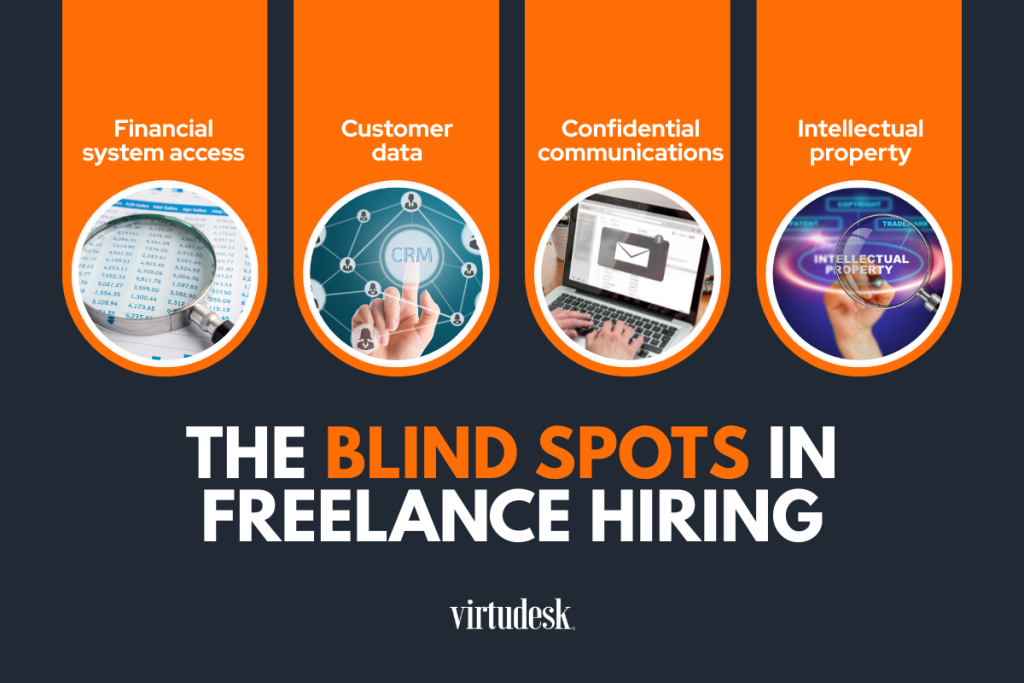
The blind spots in freelance hiring
You can’t see what a freelancer does with your data after business hours. But even if they don’t intentionally misuse it, you can’t see what device they use and if it has updated security software. Even worse, it can even be a shared device. You can’t see if your files are stored on a shared drive others might access. And you don’t know what happens to your credentials when the relationship ends and you forget to change the passwords.
This invisible exposure is measurable. Total Assure's 2025 analysis found a 46% cyberattack rate among small businesses and 60 % of the companies that suffered a breach closed within six months.
The risk categories are concrete. The most sensitive ones are:
- Financial system access: a freelancer managing invoices or bookkeeping may hold credentials for your payment platforms or accounting software.
- Customer data: a freelancer handling inquiries or order management holds names, addresses, purchase histories, and potentially payment records.
- Confidential communications: a freelancer supporting executive functions may have access to pricing strategies, vendor agreements, or unreleased product plans.
- Intellectual property: a freelancer working on content, design, or product copy holds assets. Those assets may be difficult to recover after the engagement ends.
These risks don’t require malicious intent to become a problem. According to the World Economic Forum, 95% of cybersecurity breaches are attributed to human error. For instance, a freelancer who reuses passwords, works on an unsecured network or stores your files in a personal cloud account is another.
There is no formal protocol in place to manage this risk.
Security processes as part of our service
At Virtudesk, we govern data security following strict protocols and processes.
All our trained professionals sign an NDA before placement. We grant them access through our structured onboarding and revoke them likewise. Our operational model enforces clear device use and data handling at the highest security standards.
Timedly adds to cybersecurity providing an ongoing visibility layer. You can observe all activity and tasks in real time. That creates a deterrent against misuse and a clear record in the event of any dispute.
As part of their constant learning, our VAs receive specific training in cybersecurity and data handling on a regular basis, accompanying the technology evolution (and threats) on these matters.
With us, you do not need to write a security policy for your virtual assistant, enforce it, or audit compliance. That infrastructure is part of what you pay for when you choose a full business service provider.
8. Benefits Your Freelancer Does Not Have and How That Is Another Cost
A freelancer has no employment benefits, no medical coverage, no paid time off (PTO), no sick leave, and no protections at all when any other personal circumstances interrupt their availability.
From a financial cost perspective, that can look like an advantage. But only at first glance. Without those protections, you have a predictable stability problem that can ultimately affect your business.
When your freelancer gets sick, they may have no coverage unless personally paying for it. They go on holidays, work stops, and they simply don’t earn during that period, and your tasks queue up.
About our remote professionals at Virtudesk
At Virtudesk, all our professionals receive HMO health coverage, paid time off, and sick leave, or any other benefits and rules that may apply depending on where they are based.
From a client's perspective, this is important to you for three main reasons:
- First, our team members are stable. Professionals with health coverage and structured leave are less likely to experience the sudden, unplanned unavailability that disrupts freelancer arrangements.
- Second, you carry none of the cost or administration of those benefits. Our professionals' benefits are part of how we manage our team. They are not an invoice item on yours.
- Third, quality. For the remote team members, our management ensures every professional meets our conduct and working standards and handles their compliance requirements. For you as business owner, a team working in a supported structure produces better output and work more consistently. That structure includes career development and team accountability.
And, not a minor aspect, happy workers are more productive.
What Does Hiring a Freelancer Really Cost?
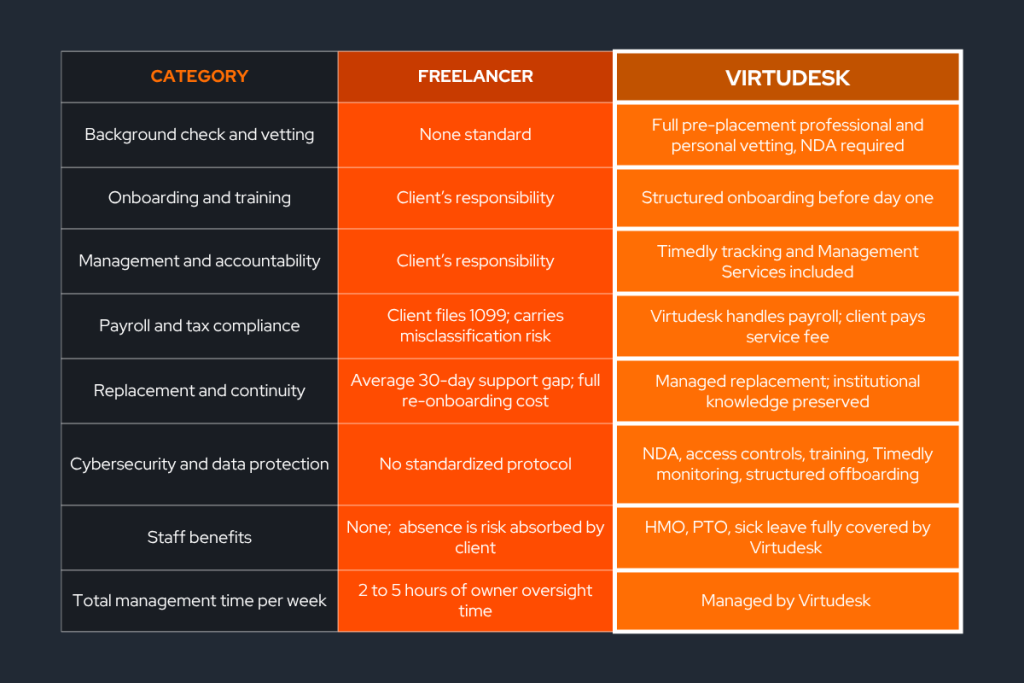
Below, you have a side-by-side comparison of the eight cost categories we covered in this article. The exact figures will vary by role, scope, and engagement terms, so we won’t give you numbers. Use it as a guide for running your own numbers.
Final Thoughts
The lower upfront rate of a freelancer doesn’t reflect the final costs.
At Virtudesk, as a Stevie Award-winning business service provider, we have placed, supported, and managed trained professionals across multiple industries. Partnering with us always comes backed by the vetting, management, accountability, and continuity infrastructure that freelancer arrangements don’t include.
Call us at 1 (800) 470-8136 or schedule a free discovery call with our team and we’ll help you stop running uncertain numbers.
Now that you are about to leave, and know why hiring freelancers costs far more than hourly rates suggest, we have a surprising fact we left for last moment. Hiring freelancers vs through a VA company usually costs less if we focus on the hourly rate. That doesn’t apply to us.
Visit our pricing page. Yes, at Virtudesk even our hourly rates for the full-service packages are lower than hiring freelancers.
Share this article
Meet our Most Trusted
Partners & Clients

Byron Lazine
Co-Founding Chief-of-Operations at BAM (Broke Agent Media)I’ve been using Virtual Assistants for years throughout all of my companies. Once we found Virtudesk the process got even easier and allowed us to scale out our hiring. Highly skilled and accountable professionals. 100% recommend!

Rebecca Guy
Realtor / Content CreatorBefore getting started with Virtudesk I had my doubts that they would find what I was looking for. I needed a very particular person to add to my team and let me tell you I am highly pleased! My virtual assistant Myril is the best! I am excited to grow my socialmedia accounts with her. Thank you Virtudesk!

Chelsea Erickson
Realtor La Belle RE GroupI am very happy with the assistance Virtudesk is providing for my real estate business. This is a newer position for my company and we are working through the creation and efficiency.


