
Inside Virtudesk: Top Virtual Assistant Tasks




From January through June 2026, our most requested virtual assistant tasks were social media management and CRM/database management. They represented 18.9% and 18.6% of the task requests, followed by lead follow-up, nurturing, cold calling, prospecting, and lead generation. Together, the top four accounted for 57.4%.
Typically, businesses start delegating recurring tasks when their teams lack the capacity to complete them consistently. Many of the leading requests involve ongoing, time-sensitive work that can follow documented processes without constant owner approval or involvement. The ranking we are sharing comes from our own client records, not a survey among business owners.
When we talk about virtual assistant tasks, we refer to remote responsibilities assigned to a trained remote team member for regular execution, reporting, and follow-through.
If you are not delegating yet, this data can help you identify work that no longer needs your direct attention.
Key Takeaways
- Social media management ranked first at 18.9% of all task requests.
- CRM and database management followed closely at 18.6%, only 0.3 points behind.
- The four leading task categories accounted for 57.4% of all requests.
- Marketing and content execution represented 39.8% under our workstream grouping.
- Sales and pipeline represented 38.5%, close to marketing and content work.
- Administrative coordination and real estate operations together represented the remaining 21.8% of the requested tasks.
- Most top-ten requests involve recurring work that loses effectiveness when delayed and does not require constant owner involvement.
- The frequency of a task request does not correlate with its priority or its business impact.
- The tasks that are the strongest candidates for delegation have predictable steps, clear ownership, and produce measurable results.
Why Businesses Are Delegating More Work
Outsourcing business processes is a growing trend. In fact, Grand View Research projects the outsourcing market will grow from $358.6 billion in 2026 to $695.8 billion by 2033.
Businesses often delegate recurring work when internal capacity cannot support timely, consistent execution. Deloitte’s 2024 Global Outsourcing Survey found that 80% of executives plan to keep or increase their investment in third-party outsourcing. Some of their main reasons? Access to skilled talent, increased customer demands, service quality, agility, and a desire for partner-enabled innovation and transformation. Surprisingly, although cost savings is a remarkable benefit, it’s no longer the main reason why companies outsource.
The combination of tasks signals three pain points: more digital channels, faster response expectations, and crowded owner calendars. Each pressure point creates recurring work that consumes time and needs consistent ownership.
The same capacity pressure appears in sales. According to Salesforce’s 2026 State of Sales report, the average seller now spends only 40% of working time actually selling. That means they spend most of the workday on other responsibilities around the sales process. If sellers delegated these secondary tasks, they could use their time and skills in money-making activities: sales.
Something similar happens with marketing. HubSpot’s 2026 social media research ranks producing enough strong content consistently as marketers’ leading difficulty. Creating one asset can be manageable, but maintaining a publishing schedule requires ongoing production capacity.
Businesses delegate work because recurring tasks can absorb costly owner time. Not only that, but managers and owners can fall into micromanagement. It consumes their time, puts them at risk of burnout, decreases productivity, and erodes team morale and trust.
Delegation keeps execution moving forward without the owner having to handle every step.
That pressure shapes every one of the virtual assistant tasks our clients request most. The ranking below shows where it lands first.
The Most Requested Virtual Assistant Tasks
Our internal data details the tasks our clients asked us to support during the first half of 2026. It covers both new sign-ups and additional services requested by existing clients. Our ranking shows task requests, not unique clients, so one client may contribute several requests across several business functions.
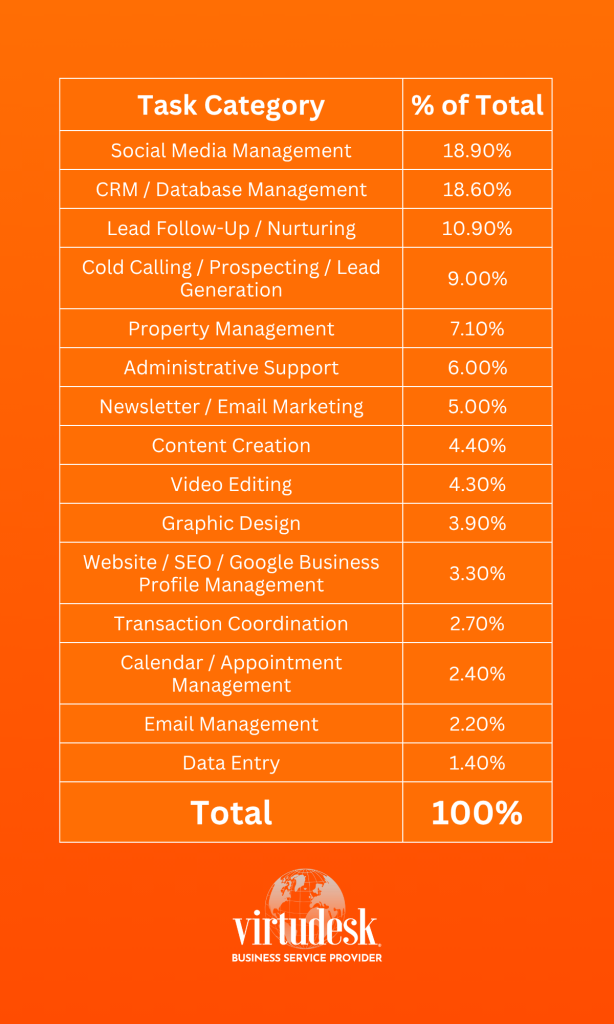
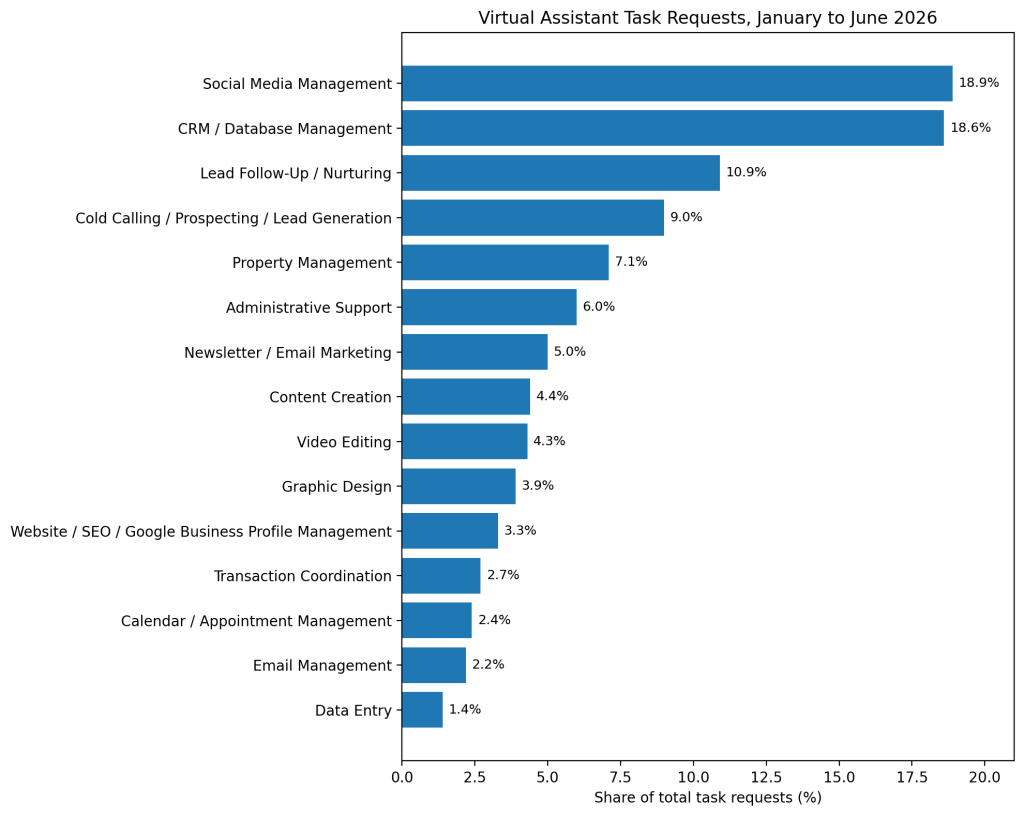
More than half of all requests fall within the four leading categories. Still, that task frequency doesn’t reflect its business impact. A lower-ranked function may carry greater financial or compliance risk to one business than to another.
The business impact of a task varies from one business to another.
Social media management and CRM lead the ranking
Both categories lose effectiveness when ownership and execution are inconsistent.
- Social media management ranked first at 18.9%. The work includes, for example, scheduling posts, interacting with followers, preparing captions, monitoring comments, organizing publishing calendars, and reporting results. Social media channels require regular activity across several formats, and consistency is key for increasing brand awareness and customer loyalty.
- CRM and database management ranked second at 18.6%. A customer relationship management (CRM) system stores lead, client, and activity records. When the records are incomplete, duplicated, or outdated, the system loses usefulness.
Salesforce’s 2026 State of Sales research also reported that 74% of sales teams using AI are focusing on data cleansing. A virtual assistant can take care of such responsibilities. For instance, a virtual assistant can standardize formats, merge duplicates, correct errors, update contact details, and record any new activity.
Clean records contribute to reliable forecasting, follow-up, reporting, and customer communication.
Lead follow-up and prospecting support the sales pipeline
Sales work appears twice in the top four. Effective lead follow-up and prospecting support involve consistent outreach, accurate records, and timely follow-through.
- Lead follow-up/nurturing represented 10.9%. Businesses delegate this work because potential clients’ interest fades when messages, calls, and reminders are inconsistent. A virtual assistant can apply follow-up schedules, update outcomes, and alert a salesperson when a lead becomes ready.
AI-powered sales automation can handle lead routing, follow-up sequences, pipeline updates, and activity logging. But it cannot replace human judgment. Human support is irreplaceable when a message needs context or a client needs a personalized response outside the automated sequence.
- Cold calling/prospecting/lead generation represented 9.0%. These functions require list preparation, call volume, accurate notes, and repeated outreach. Tymbl Dialer, our proprietary dialing platform, supports high-volume calling. Our call center services cover qualification, appointment setting, and inbound responses.
Salesforce’s Tenth Edition State of Marketing report revealed that 83% of marketers say customers now expect two-way conversations. It also found that 69% struggle to respond quickly because they lack the necessary context. Despite the fact that these findings concern marketing teams, they describe a wider contact problem. A dedicated follow-up assistant can manage prompt responses, maintain accurate records, and escalate conversations only when they require professional sales judgment.

Property and administrative support keep work moving
This group covers operational work that must be done accurately, although it does not require owner judgment. Each category solves a different coordination problem.
- Property management represented 7.1%. This work category may include tenant messages, maintenance routing, listing updates, vendor scheduling, and generating owner reports. Businesses delegate these repeating tasks because delayed communication can affect vendors, tenants, and property owners. There’s more to this role, and our property management service page describes the wider range of tasks a specialized VA can do for you.
- Administrative support represented 6.0%. This category covers a broad range of activities. Among the administrative virtual assistant tasks are document drafting, file organization, research, reports, forms, inventory updates, and routine coordination across teams. Businesses delegate them because they follow repeatable processes, but can consume valuable team and owner time.
- Transaction coordination represented 2.7%. Coordinators track documents, deadlines, and communication from contract to close. Businesses delegate this role because document tracking, deadlines, and contract-to-close communication require constant attention but don’t usually need the agent’s intervention or approval. The National Association of REALTORS explains that assistants can coordinate transactions, documents, deadlines, and communication among involved parties.
- Calendar/appointment management represented 2.4%. Businesses delegate scheduling, confirmations, rescheduling, time-zone checks, and preparation notes because these recurring coordination tasks seldom require owner-level approval.
- Email management represented 2.2%. A virtual assistant can sort messages, apply labels, draft routine replies, and flag items that require the owner’s decision, preventing routine communication from disrupting their higher-level work.
- Data entry represented 1.4%. Companies delegate it because this work follows defined rules, requires accuracy, and can spread errors through reports, invoices, and client communications when done in a hurry.
These tasks sit in different systems, but they share one trait: when not done on time, they create more work for someone else later.
Marketing production extends beyond social media
Five lower-ranked categories show that clients also request hands-on marketing production, with each task requiring a distinct skill set.
- Newsletter/email marketing represented 5.0%. Businesses delegate list hygiene, campaign setup, testing, scheduling, and reporting because campaigns need repeated execution before and after each send. Mailchimp’s email benchmarks show why teams track results by industry rather than treating every campaign alike.
- Content creation represented 4.4%. A virtual assistant may research topics, draft materials, repurpose approved content, manage editorial calendars, and upload final assets. Teams often delegate the recurring production work that moves approved ideas into published assets.
- Video editing represented 4.3%. Businesses delegate editing because each video demands repeatable production work, such as trimming, adding captions, applying branding, and exporting files.
- Graphic design represented 3.9%. Delegation helps teams produce recurring social graphics, presentation assets, email images, and branded templates without delaying each campaign.
- Website/SEO/Google Business Profile management represented 3.3%. Work may include page updates, content uploads, profile edits, manager access, review monitoring, and search checks. Businesses delegate it because outdated public information can affect visibility and customer response.
The ranking covers far more than office administration. Clients request support across publishing, sales activity, records, customer contact, and operational coordination.
What These Trends Tell Us
Four patterns run through the whole ranking of tasks, regardless of their category.
- Most leading categories involve recurring work. Content, design, video, and website support may also include defined projects. Social posts, CRM records, follow-up calls, and tenant messages often return each week. They return even when no one handled them.
- Second, many tasks lose effectiveness when delayed. A late follow-up can lose a lead. A stale CRM field can distort reporting. An unanswered tenant message may become a complaint. Delay can reduce the effectiveness of follow-up, records, communication, and operational coordination.
- Most tasks can follow documented processes without constant owner judgment. Yet, some tasks still may require approval, confidentiality controls, licensed judgment, or strategic direction.
- The highest demand sits close to customer acquisition and visibility. Marketing content, CRM management, follow-up, and prospecting dominate our editorial grouping.. This “concentration” suggests that clients most often ask for support for those tasks that keep their brands visible, pipelines active, and prospect responses on time.
Grouped by business function, related virtual assistant tasks fall into four workstreams. These are our editorial groupings, not original reporting categories in the dataset.
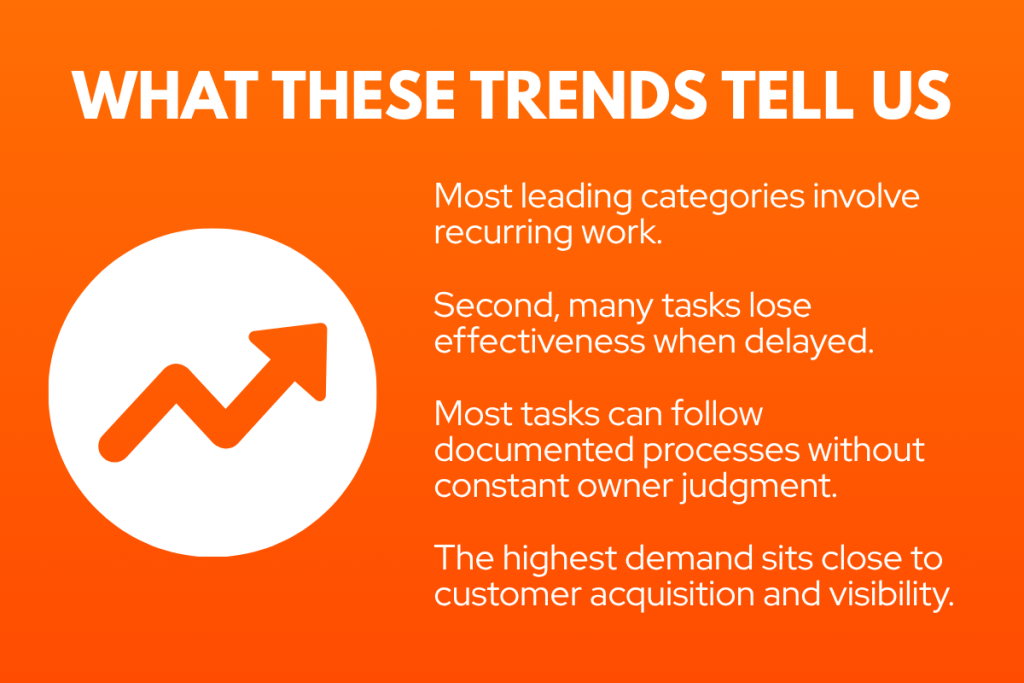
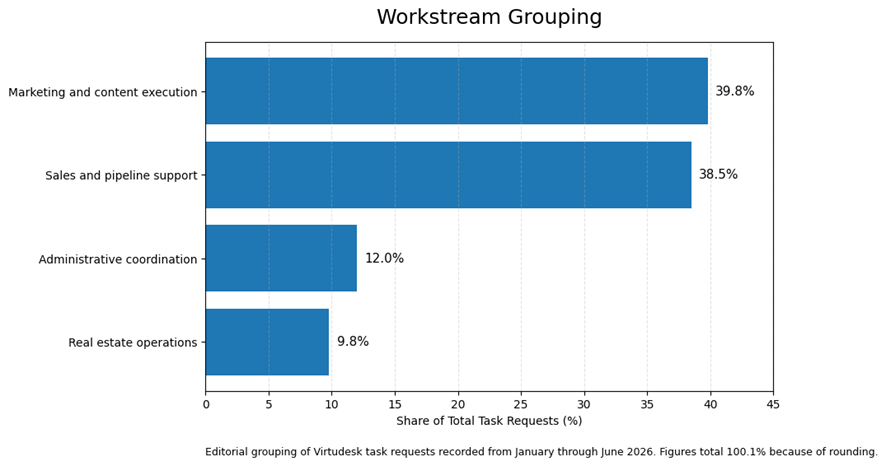
Figure 2. The 15 categories grouped into four editorial workstreams.
What the workstream grouping shows
Under our editorial grouping, marketing and content execution lead at 39.8%, followed closely by sales and pipeline support at 38.5%. Together, they account for 78.3% of requests, showing that clients frequently need help keeping campaigns, records, outreach, and follow-up moving on.
The practical takeaway is that clients most often need help keeping campaigns, records, outreach, and follow-up moving.
Administrative and real estate tasks are less frequent, but they may deserve earlier delegation when delays affect clients, tenants, or transactions. These workstreams have smaller shares, but their deadlines and accuracy requirements can still affect clients, tenants, and transactions.
What makes a task suitable for delegation?
A task becomes a strong delegation candidate when it recurs, follows a process (ideally, clearly documented), and produces an observable result. It should not require the owner’s judgment.
- Does the task recur every day or week?
- Can the expected result be described and checked?
- Does delay affect leads, customers, deadlines, or public information?
- Can another trained person complete it without your judgment each time?
Four yes answers make the task a strong delegation candidate. Before assigning it, review access, confidentiality, compliance, licensing, and approval requirements. Our guide on when to delegate describes a practical method for running that review.
How Delegation Saves Time and Improves Productivity
Delegation improves productivity through time reallocation, better task-role fit, parallel execution, and more consistent follow-through. Instead of disappearing, work moves to a trained assistant who can complete it while owners and specialists continue work that really needs their judgment or expertise. Today, we’ll focus on three main reasons why delegation saves time and improves productivity, ones that are sometimes overlooked.
1. First, delegation returns owner-level hours
Those returned hours increase productivity only when they are reassigned to work that requires the owner’s or specialist’s skills.
For illustration, picture a seller who works 40 hours and spends 16 hours selling. Delegating five hours of suitable support work could return more than half a day for prospecting, client conversations, or closing, provided the seller intentionally reassigns that time.
2. The second gain is improved focus
Microsoft’s data showed that the top 20% of Microsoft 365 users by notification volume received a meeting invitation, email, or chat notification every two minutes during the core work hours. Distractions affect focus. Did you know that workplace research found that it takes around 23 minutes to resume an interrupted task? As a business owner or manager, you reduce these interruptions with a dedicated support layer that can resolve routine issues or route only those that actually require your decision. But it’s not just you who benefits. When you distribute the workload realistically, you reduce task switching and also the loss of efficiency that happens when an employee carries too many unrelated responsibilities.
3. The third gain is greater throughput due to predictable execution.
Structured delegation distributes the workload to the right person, allows different functions to proceed in parallel, and reduces bottlenecks by waiting for one person’s attention. By delegating virtual assistant tasks to specialized staff and crafting repeatable systems, businesses replace person-dependent execution with a structure that can finish more work during the same timeframe. Delegation success is about delegating with purpose.
Why Businesses Choose Virtudesk
Clients need more than a person who can complete a “to-do” list. They need role fit, operating structure, visibility, and support when responsibilities expand or shift.
We match experienced virtual assistants to the specific role
Social media management, database upkeep, prospecting, and transaction coordination require different skills. Our Virtual Assistant Services cover administrative, marketing, prospecting, customer service, executive, and transaction functions.
Our matching process focuses on the systems, workload, and outputs tied to the role. Support needs also differ by sector. Our virtual assistant services by industry guide breaks down how we match each one.
Byron Lazine, Co-Founding Chief of Operations at BAM, put it plainly in a testimonial on our services page. He wrote that once his companies found us, the process got easier and allowed them to scale out their hiring. He described our team as “Highly skilled and accountable professionals.”
Skill gets the task done. Accountability keeps it done. Both are required, and only one of them comes from a résumé.
Ongoing support, management, and visibility
Delegation creates capacity only when the work remains visible and managed. Our Management Services provide staff support and performance follow-through beyond the initial match.
Timedly, our tracking and monitoring tool adds time records, attendance data, activity visibility, and reporting. These records let managers discuss output using documented activity rather than memory or repeated check-ins.
This operating layer keeps delegated work visible, measurable, and connected to agreed expectations. Social schedules, CRM updates, outreach, and administrative work all produce activity that can be reviewed against defined expectations.
Flexible staffing, scalability, and connected service options
Some clients begin with one function and later add related support as their needs expand. The dataset includes those later additions, which is why one client may appear across several categories.
Our service range allows support to connect across roles. Tymbl Dialer and call center support can extend prospecting. Timedly and Management Services add visibility around the work.
Still defining your needs? Our free business guides break down what tasks our virtual assistants can do in each industry or field.
Our model connects trained staff with management and operating tools. That structure allows delegation to function as a business system, rather than a loose list of assignments.
Frequently Asked Questions
What virtual assistant tasks should a business delegate first?
Start with work that regularly returns, can be handed off through clear instructions, and produces a result you can verify. Common starting points include calendar updates, inbox sorting, CRM maintenance, follow-up schedules, and social publishing. Request frequency should guide your review, not dictate it. A lower-ranked task may deserve earlier delegation when delay creates financial, customer, or compliance risk. Keep decisions, approvals, and work requiring licensed judgment with the appropriate owner or specialist.
Can one virtual assistant handle several task categories?
One virtual assistant may cover related categories when the skills, hours, and systems fit the workload. Administrative support pairs naturally with calendar, email, and data work. Marketing support may combine social scheduling, newsletters, content uploads, and basic design. Prospecting and CRM work may also fit into one coordinated role. Combining unrelated specialist duties weakens output. First, identify the main function, then once the core workflow is stable, add the compatible responsibilities.
How does Virtudesk monitor virtual assistant performance?
We combine management support with Timedly, our remote work tracking platform. Timedly records work time, attendance, and activity information. Managers compare that record with assigned tasks, deadlines, and agreed results. Monitoring should support accountability and coaching, not replace direct communication. Clients still need documented processes, access rules, and regular feedback. The combination creates clearer expectations for both the client and the remote team member.
What is the difference between virtual assistant support and call center support?
A virtual assistant usually supports a defined role across ongoing business tasks. That role may include administration, marketing, prospecting, customer service, or transaction work. Call center support is designed around contact volume, coverage, qualification, appointment setting, or inbound service. Some businesses need both. A virtual assistant may maintain CRM records and follow-up plans. A call center team handles a larger flow of calls and messages.
Conclusion
Our first-half 2026 data shows a clear concentration. Clients most often request help with recurring marketing, CRM, follow-up, prospecting, and operational work. Those functions depend on steady execution, yet they rarely require an owner’s direct involvement.
Compare the ranking with your calendar. Look for work that recurs, delays client response, interrupts focused time, or depends on routine follow-through. Those recurring, delay-sensitive tasks form the strongest starting list for delegation.
The right virtual assistant tasks return time for decisions that still require your judgment.
Schedule a free discovery call and tell us what tasks keep returning to your to-do list. We will identify the first functions to move into a managed support system.
Share this article
Meet our Most Trusted
Partners & Clients

Byron Lazine
Co-Founding Chief-of-Operations at BAM (Broke Agent Media)I’ve been using Virtual Assistants for years throughout all of my companies. Once we found Virtudesk the process got even easier and allowed us to scale out our hiring. Highly skilled and accountable professionals. 100% recommend!

Rebecca Guy
Realtor / Content CreatorBefore getting started with Virtudesk I had my doubts that they would find what I was looking for. I needed a very particular person to add to my team and let me tell you I am highly pleased! My virtual assistant Myril is the best! I am excited to grow my socialmedia accounts with her. Thank you Virtudesk!

Chelsea Erickson
Realtor La Belle RE GroupI am very happy with the assistance Virtudesk is providing for my real estate business. This is a newer position for my company and we are working through the creation and efficiency.


