
How to Choose the Right Virtual Assistant for Your Business




When managers or owners ask themselves how to choose a virtual assistant, they may start creating a list of skills to look for before defining the work they need to delegate. Yet, a virtual assistant hire can go wrong before the interview: when nobody wrote down what the work actually is.
That’s where the simple answer to how to choose a virtual assistant really starts: with the tasks you’re handing over, the hours you need support, and the decisions you’re willing to delegate. A VA who’s excellent for one business can be a poor fit for another. Availability isn’t fit. Neither is liking someone on a call.
Define the work first, and everything downstream gets easier. Set a selection process, and you’ll have something concrete to compare candidates against. You’ll also know what you’re looking at when two of them seem equally good.
Key Takeaways
- Write the role brief (what it requires) before you start looking at candidates. This is your first tool in the selection process, and it helps you screen candidates against the work you need done.
- Technical skills are entry requirements, not always the main differentiators. Once candidates meet those requirements, evaluate what else differentiates them.
- Industry experience is a must-have when the work requires specialized knowledge or when an early mistake would be costly for your business. Everywhere else, weigh it against learning speed.
- Ask all candidates the same core questions. Otherwise, you’re comparing conversations, not people.
- Choose the engagement model that matches the workload you actually have.
Understand Your Business Needs
Wondering how to choose a virtual assistant? You need to start by determining the work. According to the U.S. Office of Personnel Management’s job analysis, selection is a process that begins with the tasks a role contains and the competencies those tasks demand. When talking about remote staff, the importance of that process increases because there’s no hallway to catch the ambiguity in.
Your first action, then, should be to write down the outcome you need, then the activities that produce it. Just saying you need “marketing support” is not enough. Specificity is crucial. For example, under “marketing support,” list your precise needs: “Schedule three approved posts a week, keep the content calendar current, and send a Friday performance summary.” This is the kind of information a candidate can read and use to determine whether they can do the work.
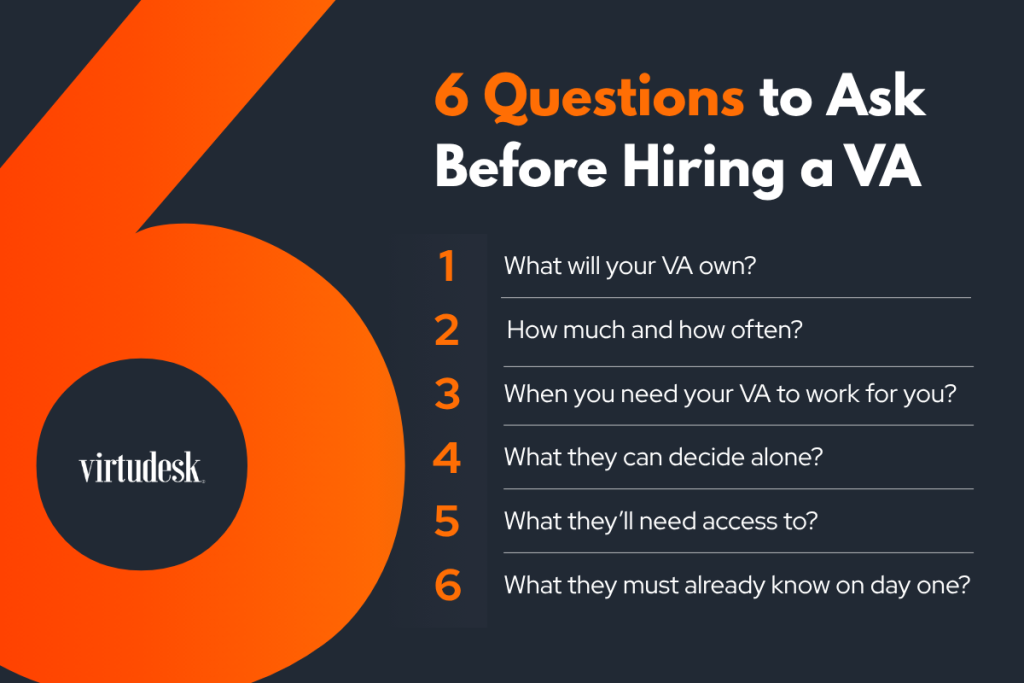
Your brief should answer, at least, these six questions:
- What will your VA own: Which tasks, and what does a good week look like?
- How much and how often: How many requests occur per day or week, and does the workload spike seasonally?
- When you need your VA to work for you: Do you need live coverage, a daily handoff, or just deadlines met?
- What they can decide alone: What can they handle independently, and what needs your approval or someone else’s?
- What they’ll need access to: Which inboxes, CRM records, customer information, or files will they use?
- What they must already know on day one: What do they already need to know when starting to work, and what can they learn during the first month (or any other timeframe depending on the complexity)?
Your brief should define your future VA’s access. Put access in the brief and avoid panicking a few weeks later. The Federal Trade Commission recommends giving each person access strictly to the systems and files needed to complete the job. Deciding that upfront is much easier than clawing permissions back.
Bottom line: A clear role brief is your first selection tool. It lets qualified candidates realize if they have the skills needed for the position and gives you a fair basis for comparing candidates.
What clarity feels like from a VA’s side
“My first long-term client gave me a clear brief from day one,” recalls Anita, one of our virtual assistants. “It included submitting an end-of-day report, a weekly report, a shared calendar, a daily CRM update, a weekly meeting, and a mandatory Monday call. Once I understood their tools and shorthand, I could spot scheduling conflicts before they asked.”
Look Beyond Technical Skills
Undeniably, having technical abilities is essential for being a virtual assistant. In fact, it is the threshold. For instance, a bookkeeper must understand the accounting workflow; a social media VA must know how to use publishing and reporting tools; and a prospecting VA must be comfortable with the approved scripts, CRM, and calling process. Once the candidates clear that threshold, the next differentiators are typically how they communicate, respond to change, and exercise judgment.
For administrative work, the U.S. Bureau of Labor Statistics lists decision-making, interpersonal, organizational, and writing skills under its Important Qualities for Secretaries and Administrative Assistants. Although the article doesn’t specifically target remote support, those same qualities translate to remote VAs since they generally also need to organize information, communicate clearly (whether writing or speaking), and decide what needs attention first.
So, it’s clear that technical skills are important, but there’s much more you need to look at.
When candidates apply for a role, they describe their hard skills and their soft skills as well. They describe themselves using different adjectives. But adjectives do not prove anything. If someone describes themselves as “reliable,” “proactive,” and “detail-oriented,” treat those qualifications as starting points for follow-up questions.
You need to seek evidence. Here are some examples of questions to evaluate how they handle work:
- How quickly did they catch an error before it affected a customer or deadline?
- Ask and evaluate how they reorganized their work when priorities changed suddenly.
- Can they give you an example of a clarifying question they asked that improved an outcome?
- Ask about a sound decision they made without waiting for approval and how they stayed within scope.
- Did they document a process or improve something after noticing repeated friction?
Selection principle: Skills show whether a candidate can perform the task, while how they face challenges or respond to unusual situations shows how their work is likely to move through your business.
What we assess when selecting candidates at Virtudesk
Here’s a summary of our hiring process and how we assess candidates for our clients so they can choose the right virtual assistant.
Before admitting a VA to our mandatory training, which they must complete before being introduced to a client, we do a thorough evaluation that goes beyond the technical skills. Let’s review the main aspects we check or require.
We do background checks and compliance document verifications. In a first video call interview, we do some aptitude tests, of course. We also evaluate their cognitive ability and communication style. For example, we test their ability to handle mock calls or role-play scenarios. Likewise, we conduct personality assessments. We also carry out a DISC Personality Assessment, which gives invaluable insights into a candidate’s behaviors and communication style, as you can read in our article on the topic.
Consider Experience and Industry Knowledge
Sometimes clients ask for industry experience more often than the role requires it, and, when that’s the case, it can cost them money. Insisting on it narrows the pool, may raise the rate, and rules out candidates who could learn the workflow during onboarding. It is a real requirement when the assigned work depends on regulated procedures, specialized terminology, or judgment that cannot be taught safely during ramp-up. In many other cases, it is an unnecessary requirement.
The Job Knowledge Tests publication by the U.S. Office of Personnel Management draws a line worth considering: assess job knowledge when someone must arrive with specialized knowledge that takes substantial time to acquire. For a VA role, that usually means:
- The work involves regulated or confidential records that need specialized knowledge from the first working day.
- The role relies on industry-specific software or terminology that cannot be taught quickly.
- An early mistake could cost a client, compromise a filing deadline, or create a licensing problem.
Calendar coordination, inbox triage, and routine customer follow-up depend more on organization and accuracy than on years in one vertical. If the workflow is documented, the tools are common, and training time is available, transferable skills paired with strong onboarding can often close that gap.
So, ask one question: How long would a capable assistant need to close the gap between what they know and what this role requires? If the answer is days or a few weeks, their learning ability may matter more. If it would take months, or one early mistake would be expensive to undo, prior experience should be a strict “must-have.”
Required certifications, privacy training, and familiarity with applicable procedures should be evaluated separately. For example, a healthcare role involving protected information may require prior privacy training and experience with compliant workflows. Those requirements should be defined according to the VA’s actual responsibilities.
Assess Cultural and Working-Style Fit
Outside a business environment, “culture fit” sounds like familiarity wearing a similar suit. But if you ask what it really means, it is how well an employee’s values, behaviors, and working style align with the company’s culture, including communication, alignment with the brand’s voice, and operating practices. These are observable working habits like how they respond, communicate, and interact with the clients and colleagues as well.
An article published by business.com on the importance of cultural fit when hiring explains that job descriptions typically focus on the roles and responsibilities of the position, listing the mandatory skills and experience. Yet, even though two job positions within the same industry may seem almost identical at first glance, they may even share goals. And both work on achieving those objectives through different methods.
Besides supporting positive teamwork through a shared company culture, when people feel comfortable in their working environment and aligned with the values and goals, their productivity increases. Moreover, if someone doesn’t fit with your business and work style, the relationship has a higher chance of not succeeding. And for you as a business owner, it translates into costs. You’ll probably have to find a replacement and go through the onboarding process again. That includes, for example, training the new employee in your work, brand style, and procedures.
Discuss the working relationship directly
When interviewing a potential team member, be direct. Explain your company’s values and mission, and your concept of a job well done. This includes different aspects that may seem like small details, but that actually determine how work is done and how your business communicates both internally and externally.
- Which communication channel is for urgent matters, and what is a fair response window?
- What feedback style works for both sides, and how frequently will it be given?
- Does the VA ask before making a decision or follow an agreed boundary and tell you afterward?
- Where do you write any important decisions so they don’t dissolve into a chat thread?
Instead of being abstract culture, these factors shape what working together will actually feel like.
Treat time-zone overlap: should it be a role requirement?
A study summarized by Rice Business analyzed communication data from more than 12,000 employees. It found that each additional hour of time difference reduced synchronous communication by 11%. This study involved only one company but shows why you should consider how much time-zone overlap the role needs.
If the work you’ll delegate to your VA moves asynchronously and the deadlines are clear, limited time-zone overlap may be sufficient, or overlap may not be necessary at all. But if your VA will be answering customers, joining the morning virtual meetings, or running a live calendar, make sure to include the required coverage time in the brief. Do it before starting with the interviews.
How we manage our clients’ time-zone coverage requirements at Virtudesk
Our pre-vetted pool of virtual assistants includes professionals willing to work different shifts. If you want a VA working during your work hours, we’ll match you with someone skilled for the role and willing to work simultaneously with you or your team. Yet, if you prefer someone doing their work while you sleep so you can open your laptop in the morning and find your emails sorted, documents drafted, or CRM updated, we’ll provide that shift support. Does your business require round-the-clock support? We have you covered as well.
Ask the Right Questions
The CIPD’s 2024 Resourcing and Talent Planning Report found that 90% of surveyed organizations do interviews. But just holding interviews isn’t enough. Make a standardized system to start with. You need to ask everyone the same core questions so that, at the end, you have comparable answers instead of five pleasant conversations. Naturally, during the interviews you’ll also ask spontaneous personalized questions to the candidates.
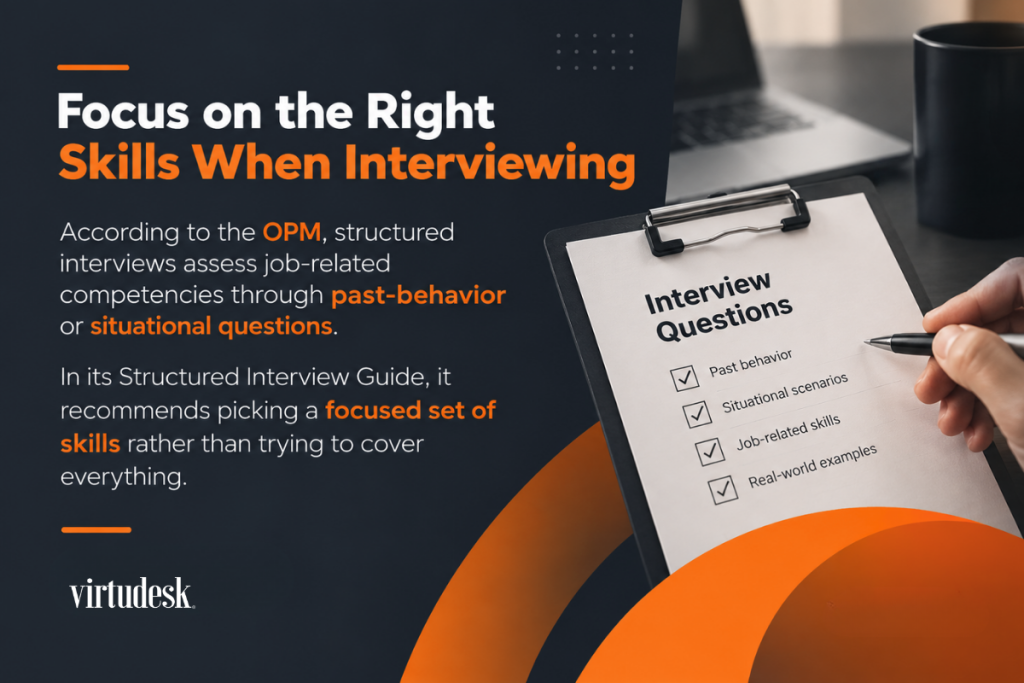
According to the OPM, structured interviews assess job-related competencies through past-behavior or situational questions. In its Structured Interview Guide, it recommends picking a focused set of skills rather than trying to cover everything. Use the same questions, the same order, and the same standards.
Six questions that earn their place could be:
- Walk me through one recurring task from this role, and tell me what you’d need to know first.
- Tell me about a time when the instructions were unclear and put a task at risk. What and whom did you ask, and what happened?
- A customer wants something completely outside the documented process you should follow, and your manager is offline. What do you do?
- Describe a week when your priorities changed suddenly.
- What system do you use to track commitments and deadlines? Show me.
- What schedule, feedback style, and level of autonomy do you actually feel comfortable with at work?
That last question is too frequently neglected. It’s also one that can surface a mismatch before it ends the working relationship.
Use a short, role-relevant work sample
OPM says that work samples are like tasks that mirror the real job, and the CIPD’s selection-methods factsheet makes the same point about matching the assessment method to the role.
Give your candidates something small and real to work on: sort a sample inbox, clean a messy spreadsheet, or draft a reply to an annoyed customer.
Keep it short, give every candidate the same exercise, and if it produces output you would actually use, pay for it. You’re watching their process and their questions, not collecting free work.
How to choose a virtual assistant with a fit scorecard
When it comes to how to choose a virtual assistant, a scorecard adds discipline without pretending that every role has the same formula. Use it in two stages:
- Stage 1: Screen non-negotiables. Mark each one Pass, Needs Clarification, or Does Not Meet. Include only requirements that would prevent the person from doing the job safely or consistently: core task ability, required coverage hours, mandatory industry or software knowledge, communication baseline, and data-access requirements. Your personal preference is not within the non-negotiable category.
- Stage 2: Compare qualified candidates. Before the interviews, assign each criterion an importance score of 1 to 3. After reviewing the interview and work sample, rate the candidate from 1 to 5. Multiply the rating by its importance.
Note: Apply the same weights and standards to all candidates, with 3 as the highest importance, and 5 the strongest evidence of capability. Then add the five scores to get each candidate’s total.
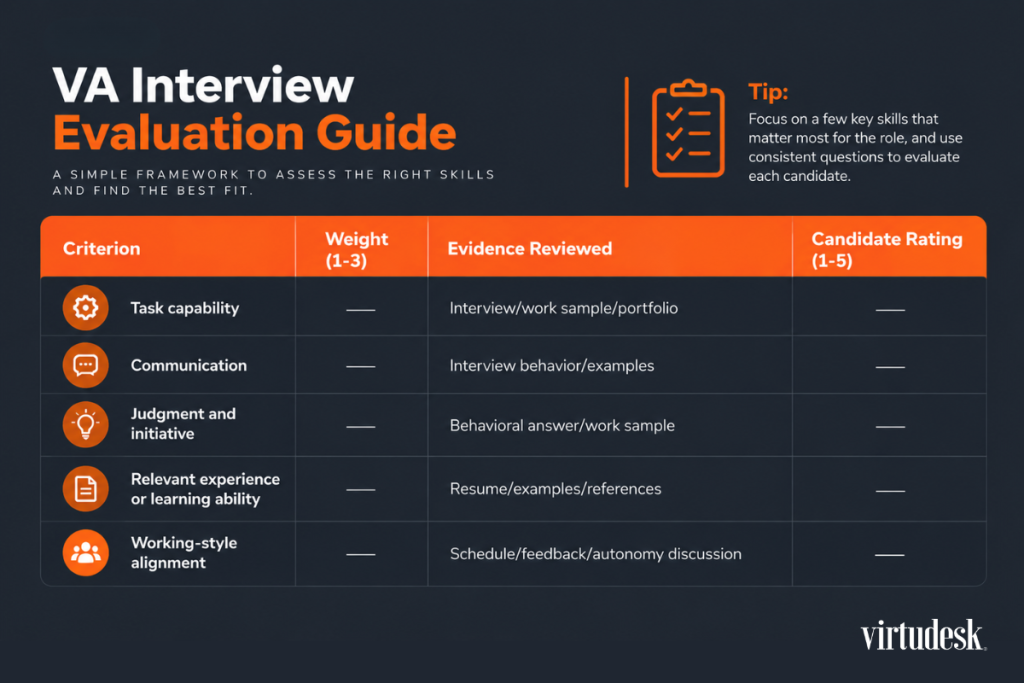
There’s no universal passing score. First, confirm that every candidate passes the non-negotiables. Then use the weighted total to compare the rest. Investigate any high rating that rests only on self-report, and don’t let strong scores in minor criteria paper over a weakness in one that matters. If two candidates end up close, run a focused follow-up rather than inventing a cutoff.
Watch for the gaps: claims that can’t be explained, answers that contradict each other, or no clarifying question when you hand over a task brief you intentionally left incomplete. Then evaluate yourself too. If three candidates missed the same thing or did it wrong, check whether your brief contributed to the problem.
When you have appropriate references that are also lawful for the position, use them to confirm work patterns rather than ask for generic praise.
Choose the Right Support Model
To come up with the final decision, you must decide which person to choose and also which support structure fits the work. An established business service provider can narrow the candidate pool, coordinate onboarding, and provide ongoing support, while you still have the responsibility for defining the role, thoughtfully interviewing a narrowed list of candidates, and setting expectations.
In a public review on our site, our client Rebecca Guy, realtor and content creator, captures the value of a specific match. She wrote that she needed “a very particular person” and had doubts that we could find her what she was looking for. She soon found herself highly pleased with Myril, the virtual assistant we matched to her social media needs. That is the standard you should aim for: a professional aligned with the work and you or the team.
Match the engagement type to the workload you identified at the beginning.
At Virtudesk, we offer different models:
| Support Option | Best Fit | Workload | Operating Model |
| Full-Time | A steady role with daily ownership | 40 hours per week | Dedicated VA, dedicated team manager, time tracking, and VoIP dialer if needed |
| Part-Time | A consistent role that does not fill a full week | 20 hours per week | Dedicated VA with the same core support structure |
| Virtudesk Lite | Recurring support without a fixed daily schedule | 10 hours per week | Flexible, service-based VA support with logged hours |
| Virtudesk NOW | One-off or clearly scoped tasks | Credit-based; no weekly commitment | Managed task team, no dedicated VA, no client recruiting or onboarding, and no subscription |
- Our full-time and part-time VA plans are designed to provide our clients with dedicated virtual assistants, and both include a dedicated manager and time and performance tracking through our platform Timedly (and a VoIP dialer, if the function requires it).
- Virtudesk Lite is our flexible, service-based solution that provides 10 hours of weekly support but without a fixed daily schedule.
- Virtudesk NOW is different. You buy credits, submit defined tasks, and receive managed execution without hiring a dedicated VA or buying a subscription. Learn more about this new service in our post on Virtudesk NOW, our project-based outsourcing option.
The tools you choose should follow the role.
When working with Virtudesk, you have Timedly, the platform that shows you hours and attendance. So, if on Friday you wonder where the week went, you’ll find the answer. If the role involves high-volume outbound calls, Tymbl Dialer offers power dialing, SMS, and a U.S. or Canadian phone number.
With a dedicated VA, plan for a ramp-up period. With Virtudesk NOW, you won’t onboard a dedicated assistant, but you’ll still have to provide the instructions and materials or access for completing each task. Our guide to the first 90 days after outsourcing explains how expectations, feedback, and documented workflows develop after selection.
Frequently Asked Questions
Do I need a dedicated VA or on-demand task support?
If you have recurring tasks and/or you need someone who learns your systems, choose a dedicated VA. If your requirements are discrete, easy to brief, and a professional with the relevant skills could perform them without previous training on your systems and processes, on-demand support can be your best fit. If you only need a few weekly hours but not necessarily daily coverage, a flexible weekly model seems a suitable option.
Does a VA need experience in my industry?
Not always. It is necessary when the role depends on regulated procedures, technical terminology, or knowledge that would take significant time for a VA to acquire. Otherwise, you might end up paying a higher fee for an experienced assistant and narrowing your candidate pool.
What if my first VA hire isn’t working out?
Before deciding to seek a replacement, find out which problem you have. Your VA can lack some skills and need training. If the role was poorly defined, it can cause a scope problem. You might need to rewrite it. A communication problem may improve with clearer channels and regular feedback. If there’s a persistent reliability or conduct issue, you might need to replace the person.
When you work with Virtudesk, your account manager can help assess the problem to discover whether additional guidance, revised expectations, or a replacement is appropriate.
Final Thoughts
Sometimes candidates look great in interviews but, afterward, they aren’t always the ones who work out. When you clearly define the role or task list before candidates apply, you have a stronger basis for assessing their fit. Write the brief, check the technical baseline, then ask the right questions and test the work where it’s practical.
Before choosing a VA or VAs to delegate your tasks to, pick the engagement model that fits your workload and processes, not the one that most businesses seem to pick.
So the core of how to choose a virtual assistant involves a few stages: defining the role, comparing evidence rather than impressions, and choosing someone whose capabilities and working style match the work you and your business actually need and support your long-term goals.
Schedule a free discovery call and tell us what you’re trying to hand off. We’ll help you scope it, pick a model, and meet candidates who match the role and your business’ operations. If you prefer, you can also call us at +1 (800) 470-8136.
Share this article
Meet our Most Trusted
Partners & Clients

Byron Lazine
Co-Founding Chief-of-Operations at BAM (Broke Agent Media)I’ve been using Virtual Assistants for years throughout all of my companies. Once we found Virtudesk the process got even easier and allowed us to scale out our hiring. Highly skilled and accountable professionals. 100% recommend!

Rebecca Guy
Realtor / Content CreatorBefore getting started with Virtudesk I had my doubts that they would find what I was looking for. I needed a very particular person to add to my team and let me tell you I am highly pleased! My virtual assistant Myril is the best! I am excited to grow my socialmedia accounts with her. Thank you Virtudesk!

Chelsea Erickson
Realtor La Belle RE GroupI am very happy with the assistance Virtudesk is providing for my real estate business. This is a newer position for my company and we are working through the creation and efficiency.


