
How a Healthcare Virtual Assistant Can Help Your Practice




A healthcare virtual assistant (VA) is a remote professional who handles the non-clinical administrative work of a medical practice or clinic. The role can involve diverse tasks, from scheduling and patient follow-ups to records management, inbox sorting, billing support, secure travel arrangements, and human resources.
Administrative work occupies a significant part of a physician’s time. In 2024, the American Medical Association surveyed about 18,000 physicians. The results showed that the respondents reported having a 57.8-hour workweek. What is surprising is that they reported spending 27.2 hours on direct patient care, 13 hours on indirect patient care (such as interpreting test results and referrals, or completing documentation), and 7.3 weekly hours on administrative tasks. Can you imagine delegating admin responsibilities so you and other health professionals on your team can have more time for your patients? That’s what you could achieve by hiring a healthcare virtual assistant.
Your medical practice requires a lot of admin, invoicing, marketing, and other operational procedures. The point is to differentiate which work really needs a clinician’s skills and which tasks could be handled by a specialized VA.
Today, we’ll cover what healthcare virtual assistants do, the importance of clear limits, what patient privacy involves, and how to choose support that fits the needs of your healthcare practice.
Key Takeaways
- A healthcare virtual assistant handles non-clinical administrative work, including scheduling, follow-ups, records, and billing support.
- Healthcare VAs support clinical teams. They do not diagnose, triage symptoms, give medical advice, or make clinical decisions. Their boundaries are and must be clear.
- Healthcare virtual assistants' tasks may include scheduling, billing, and records management, or other activities that involve protected health information. Thus, following HIPAA requirements is a must.
- Healthcare VAs should only work within their assigned administrative responsibilities and access only the patient information they do need to perform their authorized tasks.
- If you delegate recurring administrative tasks, you can improve follow-through and give yourself and your in-office team more time for patients and core responsibilities.
- There are skills you should always look for in a healthcare VA: healthcare experience, attention to detail, HIPAA training, and strong communication and organizational skills.
- Choose healthcare VA help based on both your workload and the hours when you need support. For updating records for a few hours a week, part-time support may suffice, while answering patient calls throughout office hours may require full-time coverage.
What Is a Healthcare Virtual Assistant?
Since the term " virtual " can create confusion, we need to clarify that we are referring to virtual human support, not an Artificial Intelligence (AI) chatbot or automated voice assistant that helps patients schedule, change, or cancel an appointment.
That said, a healthcare virtual assistant, sometimes also called a “medical virtual assistant,” is a professional who works remotely for a medical, dental, therapy, specialty practice, or a clinic. They do the non-clinical administrative tasks of patient care. A healthcare VA is a person who works inside your systems and follows your procedures.
What Can a Healthcare VA Do?
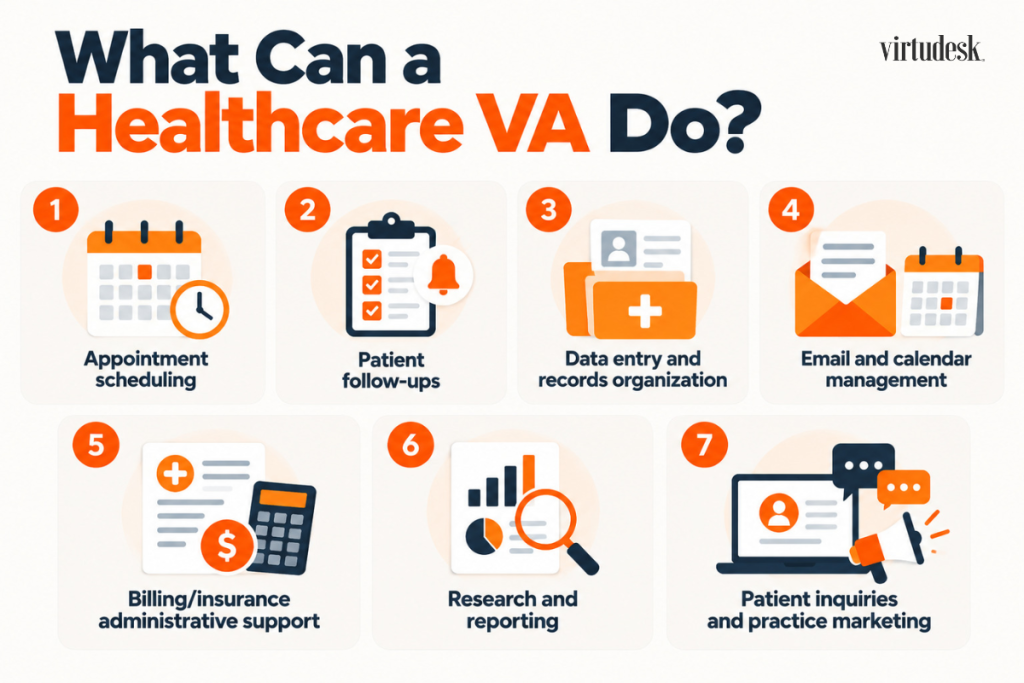
A healthcare virtual assistant can handle numerous administrative tasks that keep your practice running and improve service quality. What’s more, they can even help your practice grow through prospecting and marketing.
On our healthcare industry page, you’ll find a list of some of the tasks they can do for you. But now, we’ll focus on the most recurring ones.
- Appointment scheduling
Your VA can book new appointments, reschedule, or make cancellations, and when a slot opens, they contact patients on the waitlist. VAs also collect intake forms and insurance details before the visit. For telehealth appointments, they can coordinate bookings and help patients with routine scheduling questions.
It is worth taking a look at the relationship between timely follow-ups and missed appointments. In a Medical Group Management Association (MGMA) Stat poll from August 2026, 32% of the surveyed medical groups reported higher no-show rates than in 2025. Here, healthcare virtual assistants can make a difference. They can send your patients a reminder or contact them for rebooking; they can help fill openings that your practice has time to fill.
- Patient follow-ups
Besides sending appointment reminders or scheduling recall visits, a VA can follow up on unresolved forms or referral appointments. After a treatment or procedure, administrative patient follow-up might be arranging the next visit. Any questions about symptoms, test results, or treatment belong with your clinical staff.
As MGMA’s poll also noted, although reminders help, they won’t fix every no-show. Your VA can keep a record of the reasons patients give for missed visits and keep track of rebooking. Use that information to find the underlying cause, whether it is that your patients keep forgetting, have scheduling issues, or any other difficulty. With that info, you can think of strategies to help your patients make it to the appointment.
- Data entry and records organization
Keeping records clean and organized is a time saver. Your VA can enter intake information, update demographic data, fill in insurance details, and manage and store scanned documents. They can also file referral letters and outside lab reports in the appropriate records, without interpreting the results.
Part of this work happens within the electronic health records (EHRs), which are the electronic version of a patient’s medical history. If your VA performs tasks that involve handling EHRs, grant them access only to the functions their tasks require.
- Email and calendar management
Keeping shared inboxes and provider calendars up-to-date is a necessity. Otherwise, they fill up fast. A VA can sort incoming email and respond to routine administrative questions, always within the responsibilities you assign them. They can also manage meeting requests, coordinate team schedules, and keep correspondence with vendors and referring offices organized.
But this support, and other admin support tasks, have limits. In 2024, 22.5% of physicians in the AMA data reported spending over eight hours a week on after-hours electronic health record work. Some of that work needs clinical judgment a healthcare virtual assistant cannot handle. The solution is simple. Just separate routine administrative messages from those requiring a clinician’s judgment before deciding what to delegate.
- Billing/insurance administrative support
Billing support covers the administrative steps you need to take to get paid. Your VA can help you in many ways; for example, they can verify patient eligibility and benefits, track claim status, post payments, and send patient statements. They can also follow up with payers on delayed or denied claims.
Prior authorization is the approval from the health insurer that may be obligatory for a plan to cover a service, treatment, or prescription. And this prior approval process can add substantially to the workload. The AMA’s 2025 prior authorization survey showed that physicians complete an average of 40 prior authorizations (or precertifications) each week. 94% of them said that this adds to burnout. It devours about 13 weekly hours of physician and staff time. Think of it in financial terms. How much does a physician’s or therapist's hour cost? Does it make sense spending that valuable time on these admin tasks? Within their assigned role, a VA can gather existing documents, enter approved information into payer systems, and track request status.
You need to be careful here and assign coding, clinical documentation, and medical-necessity decisions only to the appropriate qualified personnel. Your VA can support the administrative billing workflow while your practice retains responsibility for the information and decisions behind each claim.
- Research and reporting
One role of reports is to show you what’s working or what’s slipping. A VA can pull weekly or monthly numbers on any info that’s relevant to your medical practice. Think of no-shows, open appointment slots, outstanding claims, or administrative response times. They can also research vendors, compare medical software, track inventory, or organize information about payer policy updates. An experienced healthcare VA can even help you research the latest white papers, discoveries, or case studies on topics that matter to your practice or clinic. Even what your competitors are doing and the results they are getting.
When asking your VA for reports, pick those that help you find room for improvement or make a decision. For instance, knowing how many referrals still need an appointment is more useful when the report also shows who will do the follow-up. A VA can keep the list current; your team decides how to address the outstanding work.
- Patient inquiries and practice marketing
Commonly, some practices or clinics also delegate patient-facing administration responsibilities. A customer service virtual assistant can answer routine inquiries about opening hours, bookings, and practice services. A marketing virtual assistant can help prepare promotional material or schedule and update social posts. Among our staff, you’ll find medical assistants with marketing expertise.
Health-related content and patient-specific requests should be reviewed before they are published or answered.
HIPAA-Compliant Virtual Assistants
HIPAA compliance is crucial when the administrative work involves protected health information (PHI). PHI includes identifiable information about a person’s health, healthcare, or payment for care, as the US Department of Health and Human Services (HHS) summary of the Privacy Rule explains.
Even a task that feels routine can involve patients’ health information. For example, appointment details, insurance information, and billing records may contain info that might identify a patient and relate to their care.
Keeping a VA’s role non-clinical does not remove the need to protect that information.
For a HIPAA-covered practice, support involving health information needs proper training, secure systems, access controls, and fixed procedures. To learn about the safeguards required for electronic PHI, you can head to the HHS Security Rule summary. Your practice’s specific requirements and setup determine how those safeguards apply to the work you delegate.
A healthcare VA should handle only tasks appropriate to their role, training, and authorized access. When a patient asks a clinical question, the VA should pass it to the appropriate clinical staff.
We offer HIPAA-compliant healthcare virtual assistants. Discuss your practice’s requirements with our team so the proposed role fits the administrative support you need. For task examples, see our guide to HIPAA-compliant virtual assistant tasks.
Main Benefits of a Healthcare Virtual Assistant
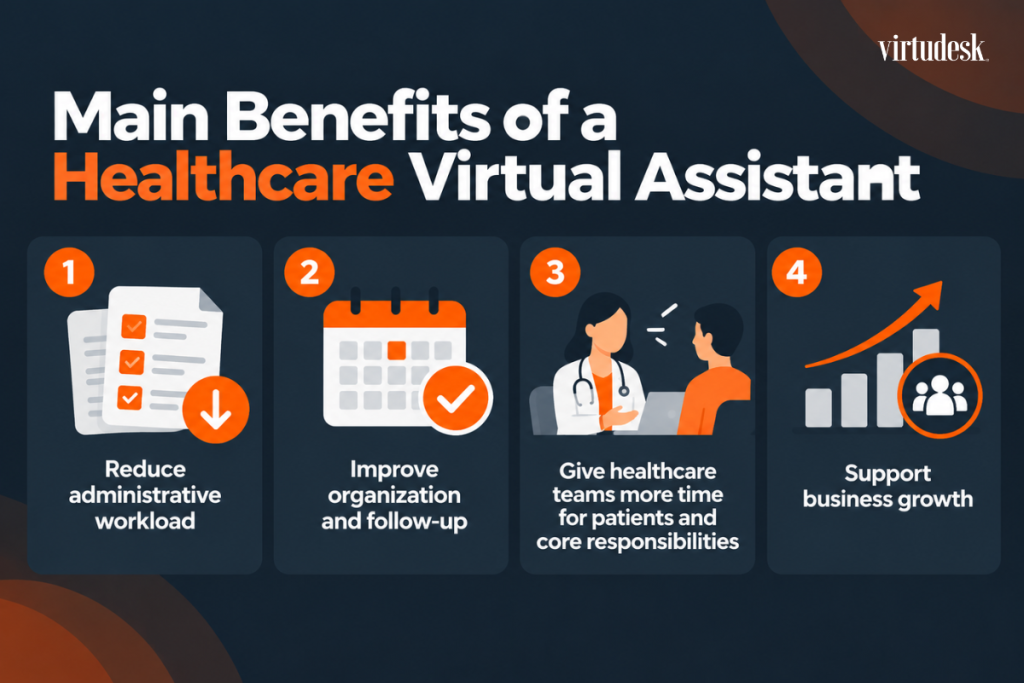
A healthcare VA adds administrative capacity. To maximize the benefits of hiring healthcare VAs, your responsibility is assigning suitable work, preparing the handoff, and checking whether the arrangement improves your practice’s daily operations. Below are four main areas where that support can help you.
- Reduce administrative workload
Administrative work is a recognized source of stress in healthcare. In AMA’s 2025 burnout data, participants identified ineffective electronic health record systems, inadequate staffing, and excessive administrative tasks among their job stress triggers.
A VA can take responsibility for recurring tasks like scheduling, data entry, and claim follow-up. Your front desk will then receive fewer routine calls and unfinished administrative tasks while patients keep arriving at reception. The idea is to redistribute work your team can reasonably hand over.
- Improve organization and follow-up
When several people share a task, it can get lost between shifts or competing priorities. Giving a VA responsibility for a defined list makes it easier to see what is complete and what still needs their attention.
This makes it easier for you too. You have a defined point of contact, and instead of checking with several people about an unresolved item, you and your team know whom to ask. That is the person responsible for that workflow. This can also prevent duplicated follow-up and make unfinished work easier to review.
- Give healthcare teams more time for patients and core responsibilities
When you delegate administrative work, you free your clinical team for responsibilities that really require their professional expertise.
The time you recover will depend on the work transferred and how much guidance or checking it needs.
When you have a VA handling admin tasks, your healthcare specialists can focus on patient care, and your reception staff have more room to greet patients and manage the waiting room. And this can significantly improve your patients’ experience. They seek the best health care, but also the best experience.
Before choosing a support model, think about whether the changes reduce interruptions to your on-site staff without leaving your remote staff overloaded.
- Support business growth
A new provider, more appointments, or opening another location increases scheduling, records, and overall administrative work. Remote support can help cover that additional burden. Estimate the workload before arranging the support hours and review our virtual assistant pricing for plan details, setup fees, and commitment terms.
Virtudesk Lite provides 10 hours of weekly flexible support without a fixed schedule. This may suit you if you have a defined administrative task list. Yet, when you need regular live coverage, fixed part-time or full-time support may solve your support needs.
Before selecting a support plan, evaluate healthcare-specific requirements and availability.
What to Look for in a Healthcare VA
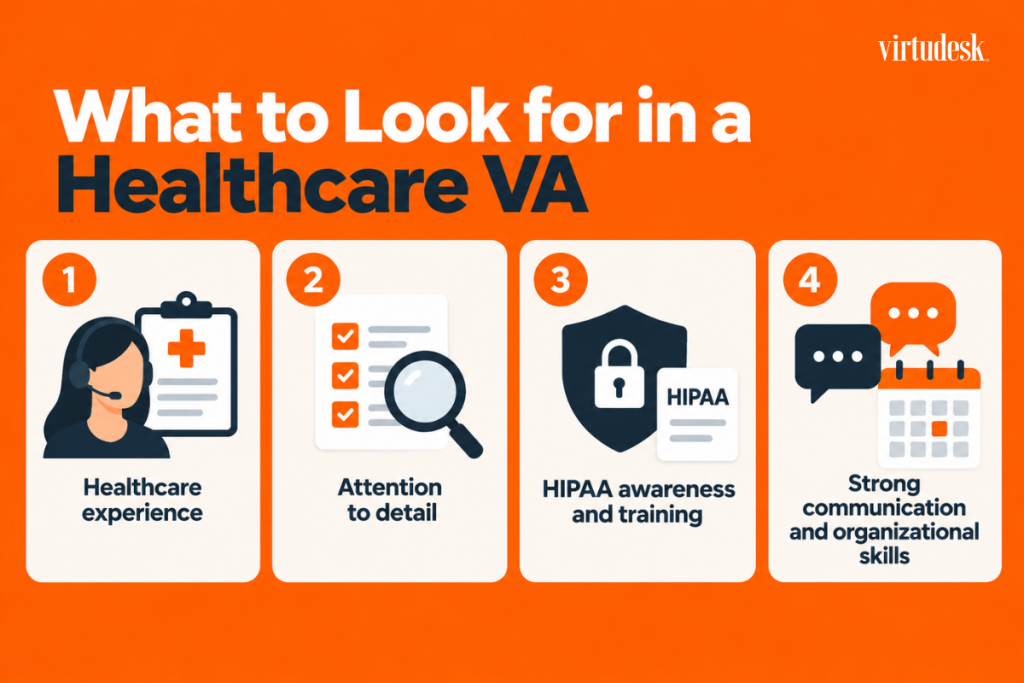
A good healthcare VA combines administrative skills with an understanding of their responsibilities, including medical terminology. Look for the following four key qualities.
Healthcare experience
Experience with medical terminology, scheduling templates, and payer portals shortens the learning curve. Right after onboarding, an experienced VA is better prepared to handle their responsibilities efficiently without delay. Ask them which electronic health record and practice management systems they used before, and how they handled a caller who described symptoms during a scheduling call. Look for answers that show they recognize the limits of their administrative role.
Attention to detail
Small errors can have negative consequences. A wrong date of birth may delay a claim, and a misfiled document can create confusion in a chart. Test accuracy with a short work sample, like entering mock intake forms or reviewing a sample claims list. Use fictional information for the exercise and look at how the candidate checks their work.
HIPAA awareness and training
Ask about HIPAA training and how the applicant applies it in administrative work. A good answer should show their awareness of confidentiality, the limits of authorized access, and the need to follow the practice’s internal processes and guidance. General training still needs to connect with the responsibilities you assign.
Strong communication and organizational skills
Your VA may have to talk with patients, payers, medical suppliers, and your staff during the same day. Look for clear writing, a calm voice tone, good manners, empathy, and a reliable system for tracking open tasks. Ask the candidate to walk you through how they would organize a full day and note how they prioritize their to-do list. Evaluate how they handle unfinished work and when or whom they would ask for help when priorities conflict or when something seems to go beyond their admin role.
At Virtudesk, we screen candidates through background checks, skills testing, and interviews.
We train them on general skills, technology, and on specialized abilities for the industry. Our dedicated VA plans include a team manager who monitors their performance and accountability. Our guide to how Virtudesk is different from other VA companies explains the support around the role.
How Should Your Practice Start Delegating to a Healthcare VA?
Start with one recurring workflow that your team can explain and review. Look at what is overdue, how much time it takes, and who handles it now. Then decide whether the problem is a lack of available hours or something else, like missing information or an unclear responsibility.
Imagine a small practice where a receptionist answers calls and checks in patients while recall appointments are waiting to be booked. Hiring a VA to take responsibility for the recall list and routine scheduling follow-ups frees the receptionist to continue receiving the patients.
Before handing over the admin work, define the tasks as clearly as possible, such as the appointment types the VA can book, their working hours, and who will answer their questions in case of doubt. If patients keep calling throughout the day, confirm that the proposed schedule covers those hours. A few weekly hours of task support will not provide continuous availability.
After an agreed review period, check the current figures of overdue recalls and completed follow-ups. Compare them with your starting figures. Check accuracy and how much staff time went into correcting or explaining the work. If the list is current but your team still spends too much time rechecking it, review the instructions or any training gaps before adding more tasks to your VA.
Frequently Asked Questions
Is a healthcare virtual assistant HIPAA compliant?
They must follow applicable HIPAA requirements if they manage, access, receive, or transmit Protected Health Information, so ask the service provider in advance. At Virtudesk, we offer HIPAA-compliant healthcare virtual assistants. For work involving PHI, the practice needs to define appropriate responsibilities and provide appropriate systems, access, and guidance on their work style, ethics, and internal rules.
How much does a healthcare virtual assistant cost?
The cost varies depending on the complexity of the role, the hours you need, and the particular support arrangement. The total cost may include setup fees, management support, and any system licenses or equipment. At Virtudesk, we offer competitive prices since our medical VAs are mostly based in the Philippines, where labor costs are lower. We include free management support when you hire one or several VAs. You can check our rates and terms on our pricing page.
How long does it take to onboard a healthcare virtual assistant?
This varies and depends on the tasks you are delegating, the assistant’s experience, and your practice’s systems. Someone who is familiar with scheduling still needs to learn your own appointment types and procedures. Plan to spend some time on training and initial practice sessions, and review their performance before expanding their responsibilities. Our guide to the first 90 days after outsourcing explains how expectations, feedback, and documented workflows develop after you add support.
Conclusion
Healthcare practices need reliable administration alongside clinical care. A healthcare virtual assistant can help with your administrative work by doing a wide range of tasks. Choose the tasks, define the VA’s responsibilities and limits, and review whether the support reduces the delays and interruptions you identified, or how it helps your practice scale.
A healthcare VA becomes an extension of your administrative team, helping your clinicians and in-office staff focus on their core responsibilities.
Schedule a free discovery call or call us at +1 (800) 470-8136. Tell us which administrative tasks take the most time at your practice. We’ll help you scope the role and identify suitable support. On our healthcare virtual assistant services page, you’ll see many ways our VAs can help your practice or clinic.
Share this article
Meet our Most Trusted
Partners & Clients

Byron Lazine
Co-Founding Chief-of-Operations at BAM (Broke Agent Media)I’ve been using Virtual Assistants for years throughout all of my companies. Once we found Virtudesk the process got even easier and allowed us to scale out our hiring. Highly skilled and accountable professionals. 100% recommend!

Rebecca Guy
Realtor / Content CreatorBefore getting started with Virtudesk I had my doubts that they would find what I was looking for. I needed a very particular person to add to my team and let me tell you I am highly pleased! My virtual assistant Myril is the best! I am excited to grow my socialmedia accounts with her. Thank you Virtudesk!

Chelsea Erickson
Realtor La Belle RE GroupI am very happy with the assistance Virtudesk is providing for my real estate business. This is a newer position for my company and we are working through the creation and efficiency.


