
What a 92.45 % Client Retention Rate Tells You About Virtudesk




There are two ends of the outsourcing range. One is the relationship that starts with a promising pitch and collapses within the first two or three months. The other is the opposite: it is stable because the outsourced team learns your workflows, anticipates problems, and is still delivering spotless work over time (without weekly corrective calls).
A client retention rate (CRR), or customer retention rate, is the percentage of clients that a business retains over a predefined period.
At Virtudesk, our client retention is 92.45%, over 90 days, with a client turnover rate of 7.55%. This number is not a marketing figure chosen for its appeal. It shows the percentage of clients who, after this evaluation timeframe, under real working conditions, chose to continue working with us.
For any business owner considering working with an outsourcing partner, client retention is one of the clearest and most significant indicators available.
Key Takeaways
- Our client retention rate of 92.45% is measured across a structured 90-day period, not derived from satisfaction surveys.
- A Harvard Business Review concludes that acquiring a new client costs 5 to 25 times more than retaining a current one, making a stable outsourcing partnership a financial advantage.
- First Page Sage reports an average client retention rate of 83% for IT and managed services and up to 85% for business consulting. Our 92.45% exceeds both.
- As opposed to placement companies, business service providers do more than just find and place a candidate. Management support, solid technology, and account oversight help the relationship last.
- Timedly gives our clients real-time visibility into their remote team activity without demanding frequent check-ins.
- A structured onboarding process before the first day of work eliminates the most common early failures: unclear expectations, missed handoffs, and the trust erosion that comes after recurring corrections.
- Our 7.55% turnover rate includes all clients who preferred not to continue working with us. The remaining 92.45% chose to continue the relationship after evaluating our service under real working conditions. They stayed because our staff’s work delivered results.
- Your remote team keeps the knowledge it has gained about your business; nothing gets lost. This continuity gives you a stable base for growth.
- High client retention is a direct consequence of the operational model behind every provider-client engagement. It is not gained through client satisfaction surveys sent at the end of the month.
Introduction
Retention is the differentiator between a work partnership that works well and one that only looked good on paper at the proposal stage. Before jumping into the numbers and the systems behind them, it is important to understand why this metric carries more weight for a scaling business than any single acquisition number.
Why client retention matters more than acquisition in scaling a business
Most growing businesses focus on getting new clients, something logical and totally understandable. Yet, client retention is a pillar of sustainable scaling as it changes the focus from acquiring new customers to maximizing the lifetime value of the existing ones.
Harvard Business Review reports that acquiring a new client costs 5 to 25 times more than retaining an existing one. In that same review, Bain and Company found that a 5% rise in client retention can lift profits by 25% to 95%. Those gains represent the compounding financial value of relationships that don’t restart from zero each quarter.
If you are a business owner or CEO evaluating different service providers, look at their retention rate. A provider's retention rate becomes a direct indicator of what your own experience will probably look like. A provider with high turnover produces repeated onboarding cycles, inconsistent output quality, and escalating management demands on your time. A provider with high retention does the opposite. The team gets better at your business, not just at the tasks.
The financial case for retention is concrete. A stable outsourcing relationship eliminates re-onboarding costs, maintains institutional knowledge, and keeps operational output consistent as your business grows.
The Numbers Behind Our Client Retention Rate
Two figures define our client retention rate story: 92.45% retained, 7.55% turned over, both measured across a structured 90-day evaluation window. Interpreting what they mean requires some context on what the measurement captures and where it sits relative to the industry.
What a 92.45% client retention rate indicates
A client retention rate is the percentage of clients a business retains over a defined period. To calculate it, subtract the new clients from the total client count at period end, then divide the resulting number by the starting client count and multiply by 100.
Our 92.45% figure is drawn from a 90-day evaluation period. That window is not arbitrary. Ninety days is long enough to move past the enthusiasm of the initial onboarding phase and into the actual working conditions of the relationship. It includes clients who have evaluated our service under real operational pressure and made a deliberate, informed decision to continue.
To give you more context, a 2026 benchmarks report by First Page Sage, compared retention data across 16 sectors. Their results show that the average client retention rate for IT and managed services is 83%, and for business consulting, 85%.
Our 92.45% client retention surpasses both categories by a meaningful margin.
Our turnover rate reflects an honest measurement process that counts outcomes without curation. Not every client relationship is the right structural match, and not every scope of work stays constant over time. What the 7.55% confirms is that the measurement is real.
How Virtudesk measures and tracks retention
The 90-day period is a structured assessment phase.
- Our account managers track output quality, client communication, and key performance indicator (KPI) alignment against the benchmarks agreed.
- Timedly, our proprietary AI-powered time-tracking and monitoring software, provides the visibility layer that makes this measurement credible and usable.
Clients access real-time activity data without interrupting their team. Our account managers can also see spot friction points early and correct small issues before they grow and become a reason for a client to leave.
This infrastructure converts the 90-day period into a data-backed evaluation. Both sides of the relationship have the same operational picture throughout. This shared visibility allows making fast adjustments and building trust.
And when both parts of a service relationship can see the same data, retention becomes a decision made on evidence. Trust comes from transparency, not from vague promises.
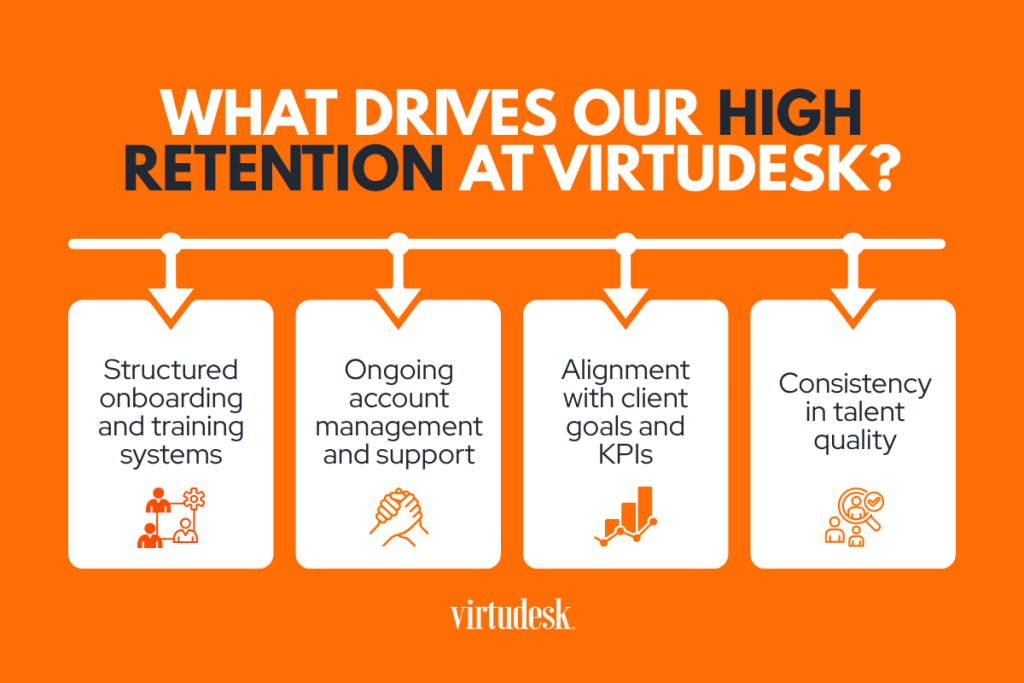
What Drives Our High Retention at Virtudesk?
A retention rate above 92% isn’t accidental, and it’s not explained by a single factor. Several structural elements work together across every client engagement to drive such results:
Structured onboarding and training systems
In most cases, outsourcing relationships don’t fail because the employees lack skills, but because their entry was unstructured. A new team member who begins without a documented process, clear standards, and a clear picture of how your business actually functions becomes a cost before they become a contribution.
Our onboarding process starts before our staff starts working. We begin with a discovery call that identifies the recurring tasks, the highest-cost bottlenecks, and clarifies what completed output looks like for each function or task. When a virtual assistant or call center representative actually starts to work, we have already thoroughly matched them to the specific role, trained them on the precise client’s workflow, and set performance standards.
This preparation removes the most commonly seen early-stage failures from the equation. A client who doesn’t need to spend their first month correcting the onboarding is a client who evaluates the service on the actual work. You can read more about this process in our guide on why delegation fails and how to fix it, in which we explain the setup that makes a remote handoff successful from day one.
Ongoing account management and support
Sometimes owners treat placement and partnership as the same thing, but placement doesn’t imply partnership, as we are about to see. A provider that sends a candidate and then steps back leaves the client responsible for monitoring performance, managing output quality, and handling continuity. That structure works until it doesn't. When it breaks, the cost lands entirely on the business owner.
Our Management Services layer is between the client and the remote team. Account managers monitor results, address performance questions, and ensure service continuity without requiring the client to solve every issue themselves. When a problem appears, we resolve inside our system instead of escalating it to you.
This management service is not a premium add-on. When you hire a virtual assistant through us, this service is included at no additional cost. And if you already have a remote team, we can still manage it for you for a fraction of the costs you would pay for an on-site manager.
Alignment with client goals and KPIs
Task completion is not the same as goal alignment. A team that completes the daily to-do list without moving the business toward its targets will eventually be replaced, regardless of how reliably it operates day to day.
We establish KPI alignment from the beginning and revisit it at structured intervals throughout the engagement. If your priorities change, the scope of work shifts with you. Timedly supports this by tracking the results against agreed benchmarks, making it simple to assess if the work our staff does is meeting your set goals.
With our system, we ensure our team is effectively contributing to measurable outcomes, not just filling billable hours.
Consistency in talent quality
For us, consistency in talent quality means maintaining our work quality throughout the full engagement, including transitions. Placing the right person, with the needed hard and soft skills, at the start of an engagement isn’t enough.
We recruit our staff across several different industries and train them through our own academy. We also evaluate receptiveness to feedback, communication clarity, and the ability to work independently within defined systems. When a team member leaves for whatever reason, we have a documented replacement process that preserves the client's operational continuity. As a client, you won’t absorb the costs of re-onboarding (neither in financial nor in time terms).
This continuity standard is what makes our 92.45% client retention rate a structural result, not an accidental coincidence of good matching.
A Holistic Approach vs. Traditional VA Services
The virtual assistant industry grew fast, and most providers who entered this business field followed a similar model: find a candidate, screen them, make the match, and step back. This model actually delivers a potential hire, and everything that comes next (onboarding, monitoring, managing, and offering continuity) becomes the owner’s problem.
We explain this structural difference in our post on how Virtudesk is different from other VA companies. You’ll see that the gap is not subtle at all. A placement model considers a hire as an accomplished task.
For us, the hire is the start of the work, not the end of it.
We deliver virtual assistants across real estate, healthcare, legal, marketing, property management, and general business roles, among others. Besides typical Call Center Services, we cover lead generation, appointment setting, customer service, and outbound follow-up campaigns. Tymbl Dialer, our owned VoIP platform, supports high-volume outbound calling with connection rates that generalist VA tools can’t replicate. And, of course, our Management Services give the oversight and accountability structure that keeps the system running.
Typical placement models don’t offer this combination, because sustaining it requires an ongoing operational relationship, not a one-time transaction. If you are considering an outsourcing partnership and want to understand our full scope, our pricing page covers what each plan includes. And if you are thinking about building your virtual office but are still a bit hesitant about what it involves, download our free guide, "How to Start Your Virtual Office”, for a practical starting point.
Our 92.45% client retention rate is the consequence of our integrated model and the customer-centric approach that inspired us to design our processes around clients’ satisfaction first. When monitoring, management, continuity, and technology work together, clients don’t need to start over. They stay and build.
Business Impact
Retention has a direct, quantifiable effect on three areas every business owner tracks:
- How efficiently the work runs
- What it costs to sustain the team
- How confidently the business can grow
The longer the relationship lasts, the more value each of those three areas brings.
How high retention translates to operational efficiency, cost savings, and scalability
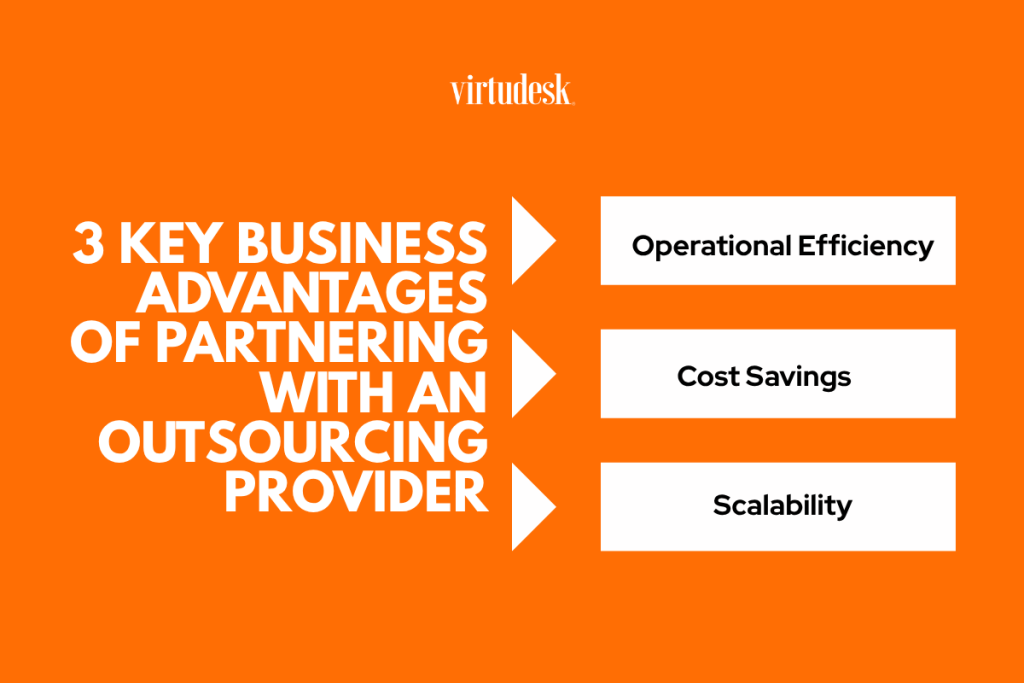
An outsourcing partner brings three main business advantages.
- The first is operational efficiency. When a remote team member has been working for six months or more, they know the escalation rules, the output standards, the communications style, and the workflow. Every month retained is a month where the work begins at full speed.
- The second is cost savings. According to the Society for Human Resource Management (SHRM), replacing a team member can cost between 50% and 200% of that person's annual salary. Each replacement you don’t do, inside an outsourcing relationship, is money you save.
- The third is scalability. Growth requires a stable operational basis. When your remote team is consistent, documented, and delivers according to your standards, you can add capacity without rebuilding the foundation each time. The systems that keep the current team together are the same systems you’ll use to onboard another hire.
Take Ludmilla K.’s case, who owns a mid-sized property management company managing 140 units across two markets. Before engaging our team, Ludmilla was personally handling tenant communications, maintenance coordination and follow-ups, and lease renewal outreach alongside her core responsibilities. She estimated she was spending around 22 hours a week on work that did not require her judgment. She had tried one previous VA placement that did not work because the task handoff was never appropriately structured.
Within 30 days of onboarding through us, a real estate virtual assistant had taken over tenant communication and maintenance follow-up. Timedly gave Ludmilla, the owner, real-time visibility into the VA’s daily activity without making her constantly check. By the end of the first quarter, she had regained about 17 hours per week, which she used to pursue a third market. Twelve months later, her portfolio had grown from 140 to 206 units. Her VA and the system around her were fully functional and improving.
This isn’t exceptional at all. This is an example that shows how retention can support continuity when the system is solid.
Frequently Asked Questions
The questions below are what business owners most commonly ask us when evaluating a service provider's retention figures and what those figures really mean for an eventual engagement.
What is a good client retention rate for a business service provider?
A good client retention rate varies by industry, but for business service categories, it is above 84%. Rates above 90% indicate that a provider's operational model and their candidate pool are performing consistently over time. Our rate of 92.45% reflects the combined effect of a structured onboarding, account management oversight, and monitoring tools working together throughout the full engagement lifecycle.
How does Virtudesk's 90-day evaluation period work?
The 90-day evaluation period is a structured assessment window, not a passive trial phase. During this period, account managers track output quality, client communication, and KPI alignment against the benchmarks agreed at the beginning. Timedly provides real-time activity data throughout, so both our team and the client operate from the same operational scenario. We use a 90-day window because it captures the post-onboarding phase, where the real conditions of the working relationship become clear, and a frank evaluation of performance and fit is possible. Clients who, at the end of that window, choose to continue partnering with us do so based on results, not on the first-month momentum.
What happens if a client's virtual assistant needs to be replaced?
We keep documented workflows for every client, which means a replacement does not require starting from scratch. When a team member changes, the incoming professional is matched to the same role criteria and briefed on the client's workflows and output standards. Since the first moments of the transition, they receive support from their account manager. The client's operational continuity is protected through the change. This continuity structure is a core reason our client retention rate holds above 92%. Clients don’t leave due to mere staff transitions.
Conclusion
Our 92.45% client retention rate, measured over a 90-day period, is not the result of asking clients if they are happy. It results from building a service model where the work runs consistently, visibility is clear, and our management absorbs the operational weight that would otherwise return to the business owner's desk.
That is what we build for every client: not a hire, but a system.
Schedule a free discovery call or call us at 1 (800) 470-8136, and we will identify which functions to move first. You can also review our virtual assistant and call center services to understand the full scope of what we can add to your team. Let’s identify which tasks to move first and what a retained operational partnership really looks like from the inside.
Share this article
Meet our Most Trusted
Partners & Clients

Byron Lazine
Co-Founding Chief-of-Operations at BAM (Broke Agent Media)I’ve been using Virtual Assistants for years throughout all of my companies. Once we found Virtudesk the process got even easier and allowed us to scale out our hiring. Highly skilled and accountable professionals. 100% recommend!

Rebecca Guy
Realtor / Content CreatorBefore getting started with Virtudesk I had my doubts that they would find what I was looking for. I needed a very particular person to add to my team and let me tell you I am highly pleased! My virtual assistant Myril is the best! I am excited to grow my socialmedia accounts with her. Thank you Virtudesk!

Chelsea Erickson
Realtor La Belle RE GroupI am very happy with the assistance Virtudesk is providing for my real estate business. This is a newer position for my company and we are working through the creation and efficiency.


