
AI-Powered Virtual Assistant Services: The Smarter Workforce



AI-powered virtual assistant services combine trained remote professionals, AI-driven workflows, monitoring technology, and management support. Business owners who have integrated AI tools but are not seeing results are lacking a system around AI. AI tools don’t generate positive results by themselves: they require trained workers, defined processes, and an accountability structure. That is what we deliver, and why businesses using them are equipped to outpace competitors using AI tools without an infrastructure supporting them.
Today, we’ll discuss how AI-powered virtual assistant services step in to bring that human and technological support.
Key Takeaways
- AI tools produce reliable advantages only when a trained professional manages the inputs, validates the outputs, and integrates the results into your workflows.
- AI-powered virtual assistant services combine human expertise, AI-assisted workflows, and management infrastructure into a single system.
- According to BCG, companies that put 70% of their AI resources into people and processes outperform those focused on technology alone. At Virtudesk, we built our model on that same logic.
- Timedly, our proprietary AI-powered time-tracking platform gives real-time visibility into the remote team’s activity. It creates the accountability that makes AI-augmented work sustainable.
- Tymbl Dialer, our VoIP platform, enables high-volume outbound calling. Before each campaign, our VAs use AI tools to segment contact lists and draft call notes. Our clients get the outreach capacity of a full sales floor without the overhead.
- Enterprise workers using AI tools save between 40 and 60 minutes per day, according to recent research. We train our VAs to capture those gains from day one.
- The businesses that scale fastest are not the ones with the most AI tools. They are the ones with trained professionals who know how to use them.
- Continuous upskilling is integrated into our VA training programs at our own academy. As AI tools evolve, our professionals evolve with them.
The Shift Inside Business Operations
Business owners can easily access countless AI tools. There are plenty of options, from free tools to subscription-based models, to on-demand, where we pay only for what we use. So, business owners and CEOs are not short of AI tools. Think of scheduling assistants, image generators, content drafters, CRM integrations, lead scoring platforms, chatbots, and countless more. The options multiply every week.
If AI tools' availability is not a problem, why aren’t all businesses making good use of these tools? What are the impediments? Deployment, implementation, and utilization are. Most small and mid-size businesses actually adopt AI tools, but without the people, processes, or oversight needed to make them work efficiently.
AI-assisted virtual assistant companies bring the required technological and human resources. In simple terms, they combine trained remote professionals with AI-driven workflows, proprietary monitoring technology, and organized management support.
If you think the advantage is merely having faster team members, you are skipping other highly significant aspects.
AI-powered virtual assistant services provide business owners with an efficient system and a smarter workforce.
Because it’s not just about having access to the technology, it’s about creating a system that integrates it into an infrastructure that empowers and enhances the work of the team members.
Why most AI tools fail without the right operator
Although we associate AI with automation, AI tools still need human input. Someone has to tell them what to do and how; give them the instructions. They must feed the right data (input) into the right workflow at the right time. And also, a human has to assess whether outputs are correct and meet the expected standards. That person must detect any errors before they lead to a wrong decision or reach a client.
A study by BCG found that “future-built” companies put 70% of their AI resources into people and processes. The rest goes to technology. Those who invest in algorithms and technology first will later struggle to scale. If you buy a tool and assume the tool does the work, you are missing the human factor, the trained professional who knows how to use it.
The gap between AI adoption and AI productivity
“Everybody is using AI tools”. That claim is partially true, yet there are some particularities it doesn’t explain. McKinsey’s study “The state of AI in 2025” confirmed that AI usage grew to 88% within respondents’ organizations.
But although the International Journal of Sustainable Business Management and Accounting also confirmed that AI is transforming businesses globally, its adoption by micro and small companies is still limited. That is due to insufficient AI skills training, resource constraints, and integration challenges.
AI adoption numbers are high. But adoption is not the same as productivity. This breach between them is where businesses lose money.
A manager or owner subscribes to an AI writing tool that generates drafts fast. This is the adoption stage. But the drafts need heavy editing because they don’t reflect their voice, content compliance requirements, or they hallucinate and give false or biased information. If there’s no one owning that task, the owners have to do that work themselves. The tool created something within minutes, but also created hours of cleanup work. Instead of a productivity gain, you have a productivity illusion.
The 2025 PwC CEO Survey captured this: 44% of business leaders reported efficiency gains from AI adoption, but only 24% of them saw profit gains. Those 20 points reflect the difference between running an AI tool and AI producing results.
This 20-point gap from AI adoption to AI productivity is precisely where AI-powered virtual assistant services operate.
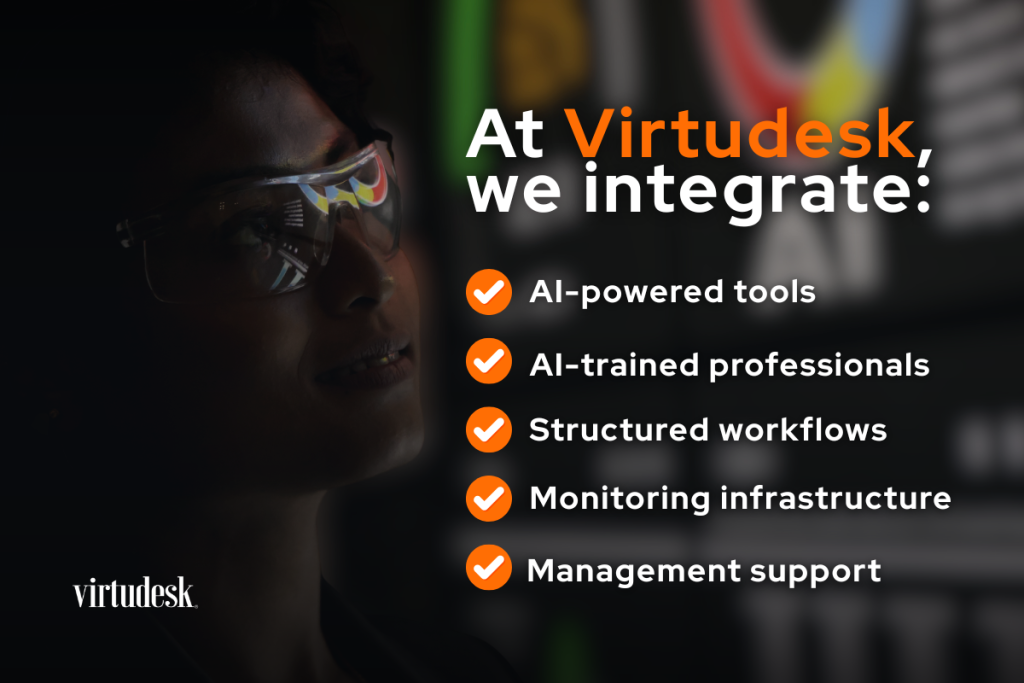
Integrating these elements within a system is how AI produces a return.
AI adoption without the right infrastructure produces activity, not results.
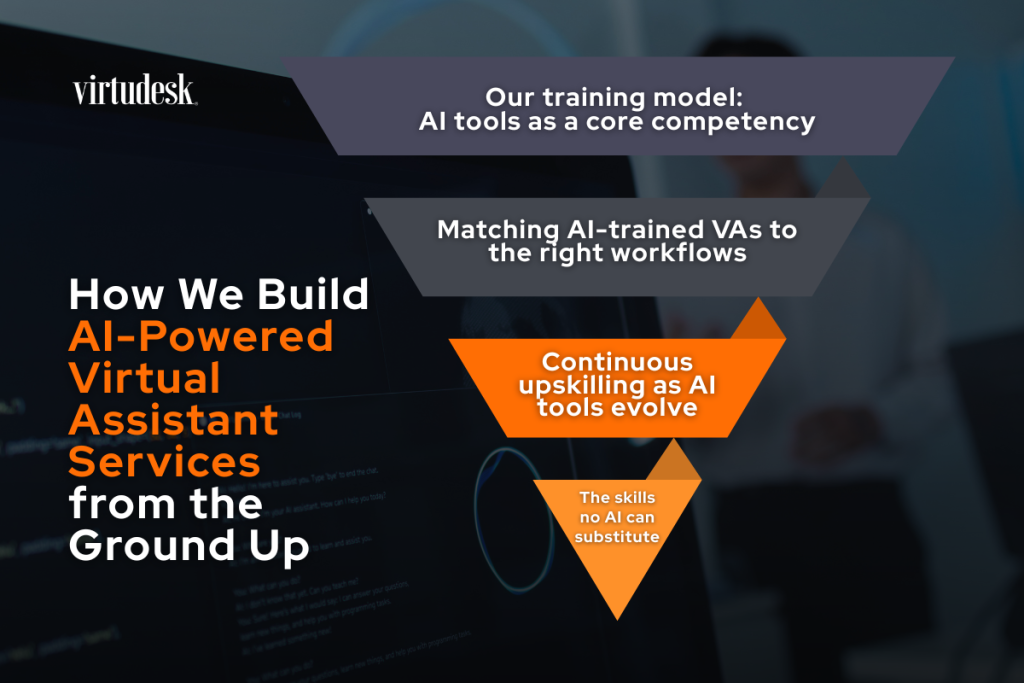
How We Build AI-Powered Virtual Assistant Services from the Ground Up
As our CEO, Pavel Stepanov, explains in this short video, every VA we place has completed our academy training program and keeps upskilling. Our program covers general skills, role-specific skills, specific industry-related skills, and the AI tools they will use in their daily workflow.
Nowadays, AI proficiency has become a baseline requirement. Our clients receive a professional who can work with AI from day one. And if you have your own AI tools, we’ll train them on it as well.
1. Our training model: AI tools as a core competency
Our training covers role tracks across many industries. Our Industries page lists the main ones, although the request for VAs keeps expanding to other areas, and so do our services and training accordingly. Real estate, healthcare, legal services, property management, education, e-commerce, marketing, logistics, and general business operations are those areas in which we receive more demand.
But regardless of the business field, our VAs learn the most commonly used AI tools and those that apply to their specific tasks. Drafting tools for content and communication work. CRM automation for lead management and follow-up. Scheduling platforms for administrative support. Data analysis tools for research and reporting.
Instead of giving our virtual assistants a one-time orientation, we provide a structured program with assessed milestones. Each program, each course has been designed by a group of subject matter specialists in each area. A VA who graduates from Virtudesk Academy has demonstrated both exposure and competency. The latest is non-negotiable and is particularly important when your tools are running live workflows for your business.
At Virtudesk, besides our own training and certifications, our virtual assistants are trained and certified by any external organization as per industry or role requirements.
2. Matching AI-trained VAs to the right workflows
When you begin working with us, your dedicated account manager maps your current workflows. And dedicated management is part of the VA's pack of services you get when you hire through us. Managers identify where AI-assisted support produces the highest returns. They match you with a VA whose training aligns with your specific requirements.
A real estate team needing AI-assisted lead nurturing gets a VA trained in those tools. A healthcare practice needing scheduling automation accesses a fully HIPAA compliant VA trained in that workflow. We make the match around what your operations actually need.
3. Continuous upskilling as AI tools evolve
New AI tools keep emerging, and existing AI tools and platforms keep updating on a daily basis. Skills that represent competency today shift within a blink. Our academy program includes ongoing upskilling so the VA on your team stays current on the most relevant or innovative ones. Your account manager coordinates upskilling when new tools become relevant or your business needs change. You don’t carry that training burden; we do.
4. The skills no AI can substitute
When we state that AI-powered virtual assistant services give you access to a smarter workforce, we don’t refer only to their hard skills. VAs need to have soft skills, whether when dealing with customers or teammates. For example:
- Communication: There will be times when, in a customer-facing role, they’ll have to handle stressful moments. Be empathic. Listen. Resolve. Or escalate. Haven’t you ever felt frustrated because an AI tool doesn’t understand what your real problem is and keeps you in a friction loop?
- Problem-solving skills: Artificial intelligence models break down problems into small steps and propose solutions to them using algorithms and pattern recognition. They mimic humans, predict outcomes, and refine their answers through users’ feedback. But no two situations are the same. Sometimes there has to be a person behind, applying their lateral thinking skills. Instead of a linear approach, they need to use a creative, indirect problem-solving approach to find unexpected solutions to unexpected problems.
- Research skills: Many times, we simply ask AI models to research a topic for us. And they present us with an “apparently” decent outcome. But what about the veracity of AI outcomes? There are countless cases of students who lost their exams, and even professional journalists who lost their jobs for inserting AI-fabricated quotes in their publications.
AI is a tool, not a replacement for virtual assistants, precisely because they lack human touch and discernment. In our article, AI and Virtual Assistants: Efficiency and Human Touch, we dig further into this topic.
For the reasons outlined, at Virtudesk, we ensure all our professionals get holistic training, enhancing the talents that are inherent to us, humans.
Timedly: The AI Tool That Makes Remote Work Visible
Without accurate data on time allocation, neither you nor your account manager can assess how AI-assisted workflows are performing. And how any of your assistants is performing. Then bottlenecks may remain undetected. Workload decisions lack a factual basis.
Timedly, our AI-powered time-tracking platform solves this. All our clients have access to it as part of our services. It provides the data that makes remote team management work. Mistrust around hybrid and remote workers persists. According to Microsoft’s Work Trend Index, 85% of leaders say “the shift to hybrid work has made it challenging to have confidence that their employees are being productive”.
Timedly is the answer to that concern without exposing you to the risks of micromanagement.
What Timedly tracks and how that helps owners and managers
Timedly tracks attendance, captures active work time, and simplifies payroll and recordkeeping with a streamlined timesheet approval process. It tracks application usage and takes periodic screenshots during logged hours.
It gives you a real-time picture of your VA's day. You can see what they are working on and how time is being allocated across your active projects.
An important distinction here is that our platform is designed for visibility, not surveillance. Data is accessible to the client and account manager. The virtual assistants know how the tracker works and why. And this is important because transparent monitoring maintains or improves worker output, while covert or unclear surveillance reduces it by 17%.
Timedly is built on the transparent model.
How Timedly supports AI-assisted workflow accountability
When a VA uses AI tools, output speed increases. That speed needs to be matched by quality checks. Timedly data gives your account manager the information needed to assess whether work reflects genuine productivity. It shows whether AI-assisted drafts are moving through without adequate review.
That quality loop separates a managed AI-powered virtual assistant service from a VA who simply has access to AI tools. The monitoring layer makes the difference observable and correctable.
Timedly does not replace trust. It creates the data foundation that makes trust between you and your remote team verifiable.
Tymbl Dialer: AI-Assisted Outbound at Scale
Tymbl Dialer provides the outbound infrastructure for high-volume calling campaigns. Tymbl is our proprietary VoIP dialing platform. It supports outbound lead generation, appointment setting, customer follow-up, and re-engagement campaigns. Tymbl also integrates text messaging. It allows you to easily send and receive SMS texts from prospective clients or leads.
Moreover, you can pick your own US or Canadian phone number, which will appear on a caller ID and where you can receive callbacks.
To take advantage of Tymbl Dialer, pair it with an AI-skilled VA that manages the workflow around each call. Before launching a campaign, an AI-enhanced VA will use AI tools to create and segment the contact list, research each prospect, conduct benchmarking research, and draft personalized call notes.
Tymbl handles the dialing volume while your VA handles the intelligence beneath.
What Does an AI-Powered Virtual Assistant Actually Do?
An AI-powered virtual assistant is different from standard remote hires because they structure their daily workflow around AI-assisted output at each stage of their role. And they apply human judgment at the points where AI alone falls short.
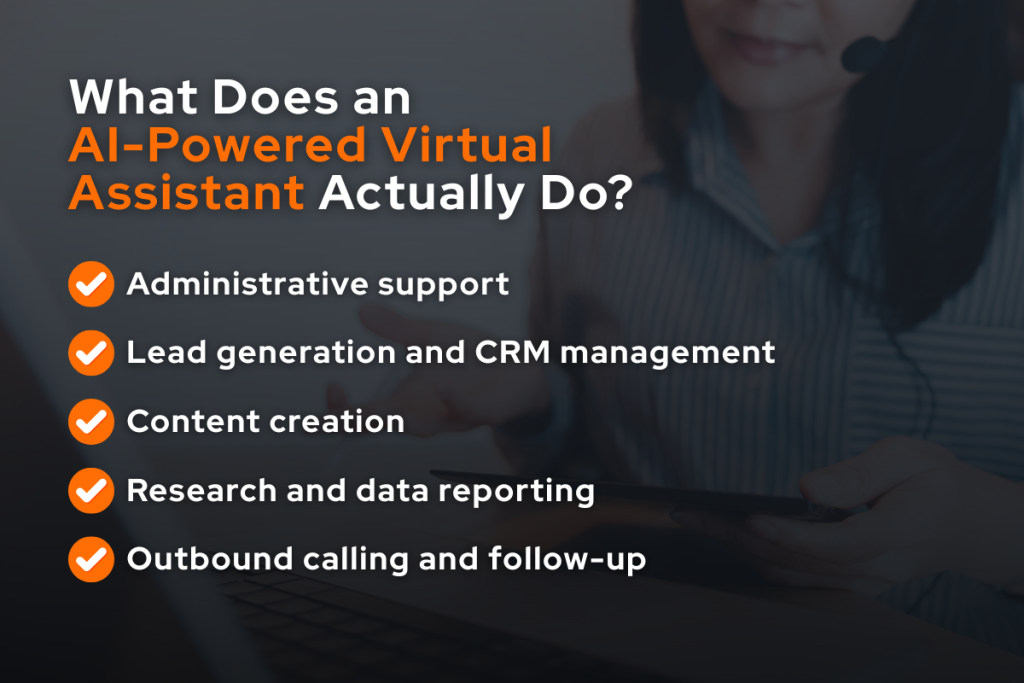
Some typical AI-driven business support solutions are:
Administrative support
Your VA uses AI scheduling platforms to manage your calendar and coordinate appointments. Inbox management tools sort, prioritize, and draft responses, which your VA reviews, edits, and sends.
Lead generation and CRM management
AI tools score inbound leads, suggest follow-up priorities, and generate initial outreach drafts. Your VA manages the workflow, personalizes each communication, and updates your CRM. Your VA handles the relationship with your customers or suppliers, not a tool, and the AI handles the volume.
Content creation
Your VA uses AI drafting tools to brainstorm, produce first outlines of posts, email sequences, blog outlines, ads, and images that match your brand. The VAs do the editing to make sure all content follows the brand voice. They also check for accuracy before publishing anything. It’s your VA's judgment that makes the AI outputs usable.
Research and data reporting
AI tools extract and organize data from your platforms or spreadsheets. Some tools create visual representations of statistical information. Your VA interprets the output and identifies what is relevant for your business decisions before presenting it to you. They build the summaries and reports you need. Raw data without interpretation has no value. Your VA does the first interpretation stage.
Outbound calling and follow-up
Paired with reliable communication technologies, VAs can run high volumes of outbound campaigns. AI-assisted dialing and automated voicemail help them manage and organize the volume. But human agents are the ones who manage every live conversation.
Why Human Management Still Drives the Results
AI-powered workflows produce better output when they are managed well. The human layer is the mechanism that makes AI output reliable enough to use.
At Virtudesk, our structure provides human oversight at two levels:
- The account manager oversees your VA relationship and performance.
- The VA applies professional judgment to every AI-assisted output before it reaches you or your clients.
The account manager: direction, feedback, and course correction
Every Virtudesk client works with a dedicated account manager. That account manager monitors your VA's performance through Timedly. They conduct regular check-ins, provide feedback on output quality, and coordinate upskilling when needed.
But this oversight is not passive. If AI-assisted outputs are moving too fast and keeping their pace is compromising work quality, your account manager detects it and acts. If your workflows evolve and the current tool set no longer fits, they coordinate the adjustment and VAs’ training.
When AI output needs a human call
There are some tasks AI handles quite well. Others carry too high a cost of error to rely on AI output without careful human review. Our VAs are trained to notice the difference.
Client communications where tone matters, or escalations requiring situational judgment, are the moments when an AI-powered VA replaces the tool (or interacts with it). It is what makes our professionals dependable across industries, from healthcare and legal to real estate and marketing.
AI-Powered Virtual Assistant Services and Cost Savings
The productivity argument for AI-augmented remote teams is well supported. Enterprise workers using AI tools save between 40 and 60 minutes per day. This means they can spend more time moving forward with other tasks. Likewise, this makes the cost argument clear too: If you hire a VA, you pay for a certain number of hours a week.
Hiring our AI-powered virtual assistant services save you money in other areas, too. Creating an in-house infrastructure requires hiring and training professionals, and investing in AI tools and tracking software. Add to that the costs of managing your remote assistant. When you don’t need to manage your VAs, you can spend your time on revenue-generating tasks. When working with us, you don’t have that overhead.
The training, the tools, Timedly, and the management support are part of our services.
Frequently Asked Questions
What makes Virtudesk AI-powered virtual assistant services different from standard VA services?
A standard VA brings skills and availability, while an AI-powered virtual assistant brings those same qualities plus AI tool proficiency and structured workflow integration. Monitoring and management ensure output quality over time. Instead of just hiring a person who can use a few apps, you are deploying a managed system.
How does Virtudesk train virtual assistants to use AI tools effectively?
Our academy training program covers both role-specific skills and the AI tools that apply to each role. VAs complete assessed milestones before working with clients. Demonstrated competency rather than exposure is the standard.
Is Timedly available to all Virtudesk clients?
Yes. Every client has access to Timedly as part of their service. The platform provides real-time visibility into your VA's work activity through active time tracking, application monitoring, and periodic screenshots.
How do I know if my business is ready for AI-powered virtual assistant services?
If you have repeatable tasks that consume time you would rather spend on revenue-generating work, you are ready. Skilled business owners spend time on operational tasks that a trained, AI-equipped professional can handle for them.
Conclusion: The Future of Work Is Already Your Advantage
The businesses that are scaling fastest are those that don’t wait to see how AI develops. They have set an infrastructure that makes AI-assisted work reliable and consistent. Trained professionals, organized workflows, monitoring systems, and management support: these are the pillars of a scalable operation.
And that infrastructure is what we bring with our AI-powered virtual assistant services. In a single engagement, you get the results of a modern, AI-augmented operation without building it yourself.
Call us at 1 (800) 470-8136 or schedule your free discovery call through our contact form and tell us what is consuming your time. We’ll show you what that workload will look like if you decide to hire our system. Because through us, you hire remote teams and the whole system behind. To review the role categories and industry tracks before your call, visit our virtual assistant services page or download any of our free guides that list some of the tasks a VA can do for you, depending on your specific industry or areas of your business where you need professional support.
Share this article
Meet our Most Trusted
Partners & Clients

Byron Lazine
Co-Founding Chief-of-Operations at BAM (Broke Agent Media)I’ve been using Virtual Assistants for years throughout all of my companies. Once we found Virtudesk the process got even easier and allowed us to scale out our hiring. Highly skilled and accountable professionals. 100% recommend!

Rebecca Guy
Realtor / Content CreatorBefore getting started with Virtudesk I had my doubts that they would find what I was looking for. I needed a very particular person to add to my team and let me tell you I am highly pleased! My virtual assistant Myril is the best! I am excited to grow my socialmedia accounts with her. Thank you Virtudesk!

Chelsea Erickson
Realtor La Belle RE GroupI am very happy with the assistance Virtudesk is providing for my real estate business. This is a newer position for my company and we are working through the creation and efficiency.


