
Mid-Year Business Check: Preparing for a Strong Second Half




A mid-year business check is a planned, thorough review of your first-half-year operations, team capacity, and systems.
The difference between your quarter two (Q2) performance and your actual quarter four (Q4) results is almost always a consequence of the operational decisions you make right now at mid-year. Conducting a mid-year review has a purpose. The goal is to identify what you need to change before Q4 demands arrive. Businesses that take advantage of this timeframe to solve delegation gaps, strengthen their support teams, and adjust their systems and processes will not scramble in October. They execute right after the mid-year business check.
Key Takeaways
- A mid-year business check, instead of a mere performance report, is a forward-looking operational decision that determines how well prepared your business is once Q4 demand arrives.
- The difference between Q2 results and Q4 performance is almost always a consequence of what you do, or don't do, in Q3.
- Studies estimate that 20% to 30% of operating expenses are wasted on inefficiency. Most of that waste becomes clearly visible at mid-year, before Q4 pressure makes it impossible to address.
- According to research across more than 1,000 companies by RevenueHero, businesses that respond to leads within an hour are almost seven times more likely to reach decision-makers. Response time is an operational problem before it becomes a sales problem.
- A Walmart Business survey of 500 small business owners found that 70 % experienced burnout at least once a month. The primary reason named was their inability to disconnect from work. Delegation is the structural fix, not a personal one.
- Losing a team member mid-Q4 is one of the most expensive operational events a business can face; it costs between 50% and 200% of their annual salary, according to Gallup.
- Virtual assistants, call center services, management, Timedly, and Tymbl Dialer are not separate products. They are components of one integral operational system. For businesses, a mid-year business check is the right time to integrate and configure that system before year-end demand puts them to the test.
.
Reviewing First-Half Challenges: Doing a Mid-Year Business Check
When mid-year arrives, business owners usually have a rough sense of what went wrong. But a rough sense does not solve anything. A mid-year business check changes that by turning the first half review into data; data that becomes diagnostic info. For example, it can reveal which processes failed, which tasks were returned to you, and where the team ran out of capacity before the work did.
The output is not a summary of what happened. Instead, consider it a prioritized action list of what to fix before Q4.
Operational gaps and process breakdowns
When you own or manage a business, understanding your operations is essential to detect where performance is slipping and where processes need attention; where’s a need for improvement or change. You need to detect any operational gaps. A gap is the difference between where your company is and where you expect it to be. Analyzing gaps enables you to “improve processes, surpass goals, and overcome organizational barriers”.
By operational gap, we are talking about any point where your business operations slowed, stalled, or work came back to you because there was no clear process to follow. There are no systems or Standard Operating Procedures (SOPs). These gaps show up as repeated questions, tasks completed each time differently, inconsistent responses, and decisions that required your input or approval to move forward.
Now mid-year is here, and you need to look back at Q1 and Q2 with one question in mind: Where did the same problem appear repeatedly?
You might have found that clients’ follow-ups kept failing, or you ended up doing tasks that are not core to your business growth (and are the real revenue-generating ones, or maybe approvals kept waiting for you too long, or handoffs produced inconsistent results. Each of them is a process gap, not a performance gap. Most likely, the person handling the work didn’t fail at all, but the instructions, ownership, or escalation path did.
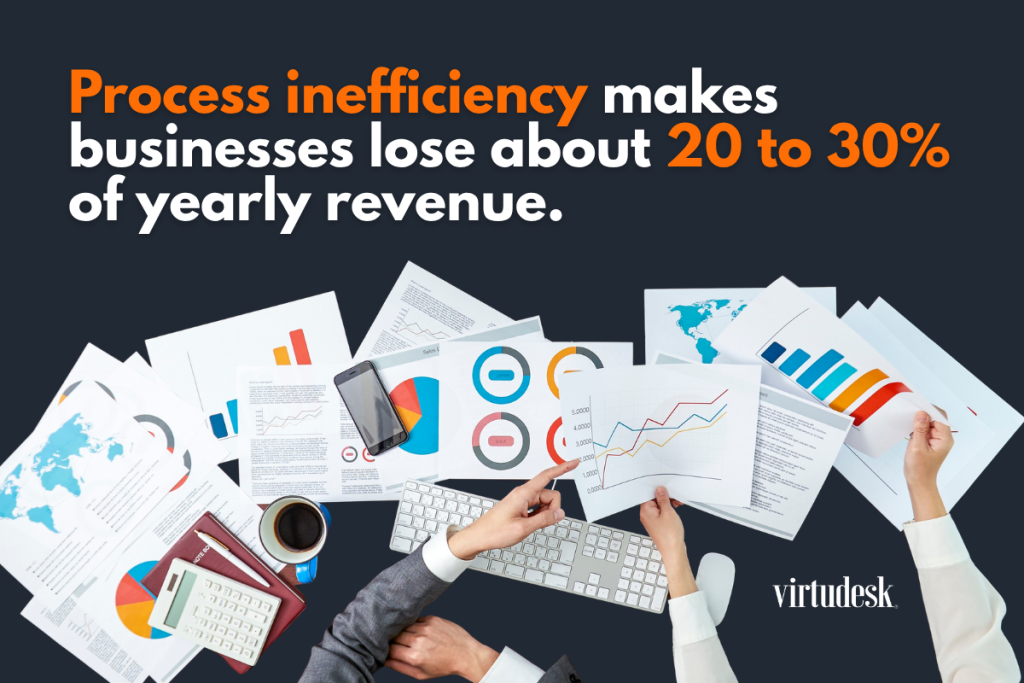
Studies showed that process inefficiency makes businesses lose about 20% to 30% of yearly revenue. In most businesses, those inefficiencies are visible well before Q4 pressure makes them impossible to address. Mid-year is when you can still act on them without adding crisis management to an already difficult quarter.
A skilled virtual assistant (VA) identifies the still unwritten processes your business already runs on and turns recurring procedures and decisions into written instructions your team can follow independently. Those instructions become the standard operating procedures (SOPs) that prevent the same gaps from reappearing in Q4. And if you still don’t have clearly defined systems and procedures, a VA can help you with it. In our article How a Virtual Assistant Can Help You Build Systems and SOPs we elaborate on this topic.
Missed opportunities and overloaded teams
Mistaking a fully redlined team for a highly efficient one is quite common. But running your team at or near maximum capacity for months, in the end, doesn’t maximize its output. What it creates, instead, is an operational bottleneck. A team that consistently pushes its limits loses the breathing room it needs to take on new tasks. The danger of this is that it happens in silence.
Business capacity and team capacity are related, yet different concepts. While the first refers to the maximum amount of work a company can sustain over a specific timeframe using its resources (staff, equipment, and technology), the second is the maximum amount of work your team can accomplish within a specific period.
When a team works at its capacity limit for two consecutive quarters, the quality of its output drops long before anyone actually speaks up to admit they are struggling.
They might still get the work done, but your margin for error completely disappears. This strain triggers an initially hidden cost for your business.
This pattern repeats across industries. A real estate team running prospecting, transaction coordination, and client communication through the same two or three people hits its ceiling when listing volume increases. A healthcare practice that absorbs more patients without adding administrative support starts missing follow-up calls. A legal firm managing intake, scheduling, and deadline tracking manually loses billable hours to coordination work. An e-commerce operation with seasonal demand spikes finds its customer service queue backing up before the peak even arrives.
The work gets done, but one unexpected claim or request, one team member’s absence for one day, or one difficult client is enough to disrupt the workflow.
It’s harder to see the missed opportunities than the breakdowns, but they are equally costly. A lead that did not get a timely callback, a proposal that went out late, or a client question that was waiting in an inbox for two days are capacity failures.
A mid-year business check surfaces both where your operations and team ran out of capacity before Q4 turns that into lost revenue.
Preparing for Q4 Growth
Q4 arrives without warning. Your work volume builds, your customer expectations stay the same, and any weakness in your support structure becomes visible under increased load. The businesses that struggle in Q4 are usually the ones that failed to build a strong support infrastructure while they still had time.
That means adding capacity before your business needs it, not after. For example, it implies putting the contact layer, administrative support, sales outreach, and technological infrastructure in place while there is still time to train, configure, and test them. Hiring in Q4 or adopting new technologies to solve a Q4 problem results in a quarter that ends before the new hires reach full effectiveness and the new tech is fully deployed.
Customer support and lead management before demand peaks
For any business, providing fast response times is one competitive advantage, and is also one of the easiest to lose when work volume increases. A 2024 study by RevenueHero across over 1,000 companies discovered that businesses responding to leads within an hour are almost seven times more likely to reach decision-makers than those that take longer. The average response time across those same companies was a bit over 29 hours.
That is a staffing problem. When your team is already at its limit, inbound leads get skipped. Your team members focus on whatever is most urgent that day. By the time someone follows up, the prospect has moved on.
To prevent that, our call center services put a dedicated contact layer behind your inbound volume. Customer service virtual assistants (VAs) manage inquiry responses, appointment scheduling, and follow-up so that no lead waits because your core team is busy. For businesses running active outbound campaigns heading into Q4, Tymbl Dialer, our proprietary VoIP platform, supports high-volume outbound calling with the speed a manual process cannot match.
Before Q4 arrives, the contact layer is one of the first things to configure because it is the first thing that breaks under volume.

Administrative support and sales outreach infrastructure
Back-office work is where Q4 preparation either holds or fails. Scheduling, CRM management, data entry, reporting, and outbound prospecting sequences require consistent and dependable execution. When those functions fall into an already strained team, Q4 volume pushes them aside in favor of whatever is most urgent. Consequently, the underlying work accumulates until it becomes a crisis.
Administrative VAs handle the recurring back-office tasks that consume disproportionate time but don’t require owner-level judgment. Sales prospecting VAs manage CRM records, qualify leads, and run outbound sequences so your sales team works from a clean, organized pipeline rather than building one while closing deals at the same time.
For Q4 marketing infrastructure specifically, our post on building a Q4 marketing plan covers how to align your content, campaign, and outreach strategy with the demands of year-end. Admin and sales support work best when the marketing layer is also in place.
Build your back-office infrastructure in Q3, and Q4 will use every piece of it.
It takes time to configure, train, and test the support layer properly. Building it in Q3 is the right moment.
Avoiding Burnout Through Better Support
Burnout builds across two quarters of pressure, undelegated work, and a team working without enough support. By the time the year-end rush comes, the owner and the team are already depleted. Q4 then becomes a test of endurance rather than a window for growth.
Addressing burnout at mid-year means addressing it before it becomes a performance or retention problem. There are two distinct levels at which burnout operates, and both require a different response.
Personal burnout: when the owner absorbs the gap
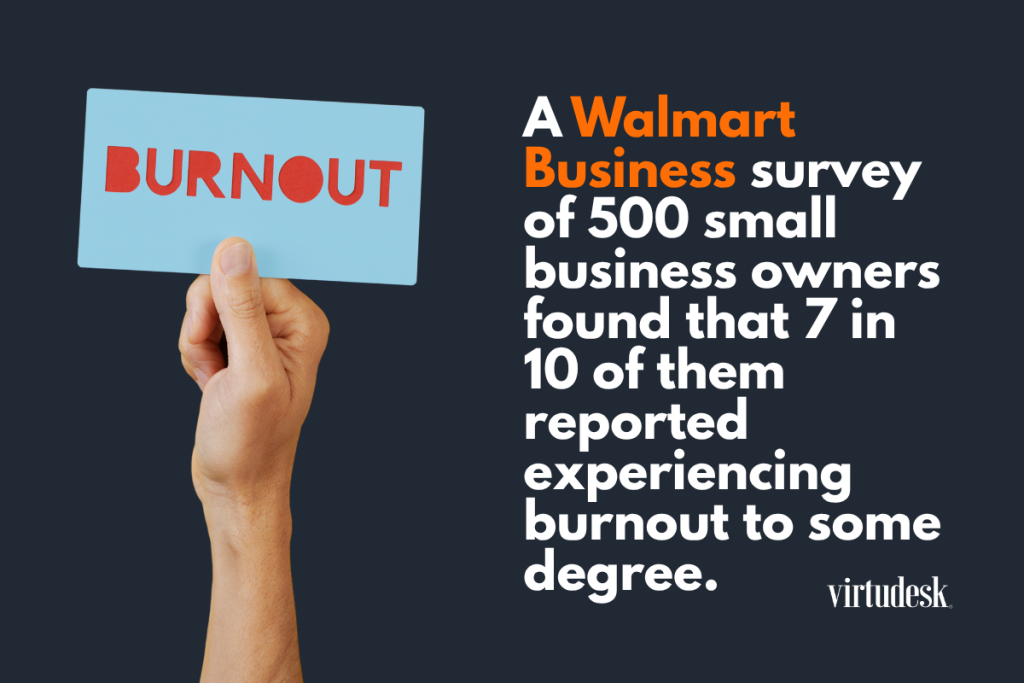
A Walmart Business survey of 500 small business owners found that 7 in 10 of them reported experiencing burnout to some degree. The most common reason was the difficulty in disconnecting from work. The reason behind that difficulty is a structure where the owner is the backup for every undelegated task.
When a task has no clear owner, it returns to the owner. A process breaks and the owner fixes it. Or when a decision needs to be made quickly, the owner makes it. Individually, each case is manageable. But when these instances accumulate over two quarters, they consume the hours that the owner should spend on growth work.
The problem is a lack of delegation or a poorly structured one. The fix? Building an operational structure that handles the recurring, non-owner work so it stops landing back on you. If your team is overwhelmed, delegation shouldn’t be a last resort. Delegating at the right time is actually making a sustainable growth decision.
Our virtual assistant services and management services create that structure. VAs take on the task categories that consume the owner's time but don’t really need the owner's judgment or specialized skills. Our management team holds accountability for output, consistency, and continuity so that you are not the fallback when something needs attention.
We notice this in almost every discovery call with a business owner who has been operating without a support layer for two or more quarters. The work is done, but the owner is holding it together. That is a dependency and something you won’t want. The system should be autonomous and keep you out of the operational loop. Our article How to Build a System That Runs Without You covers exactly how to get there.
Team burnout: when volume exceeds capacity without support
Workplace burnout and team burnout are closely related but are not the same.
Workplace burnout is the individual exhaustion from chronic workplace stress not successfully managed, which results in reduced productivity, disengagement, and high turnover.
Team burnout is an organizational problem where team members exhibit similar symptoms of chronic exhaustion (degraded collaboration, imposter syndrome, lack of motivation, and disengagement). Both have a negative impact on your business, and both show up before anyone admits they are struggling.
When a team absorbs more volume than its structure supports, roles are ambiguous, the team works under tight deadlines, priorities are unclear, or instructions are contradictory, stress and anxiety rise. Output quality drops before anyone says they are struggling, response times slow, and errors increase. The kind of work that requires focus and precision gets done in the margins.
As a Gallup study confirmed, burnout costs for organizations can be classified in three main areas:
- Declined productivity and performance
- Weakened team morale
- Increased turnover and related costs.
Increased turnover: a costly burnout consequence
There are many consequences to burnout, but the costs of increased turnover are too frequently overlooked. That justifies dedicating a small section to this topic.
Did you know that replacing an employee can cost you between 50% and 200% of their annual salary? Those costs include recruiting, onboarding, and training. But you need to consider the knowledge also. It took months for them to acquire, and you don’t know how long it may take for a new hire to reach that level of knowledge and productivity. And you still have to consider the costs derived from a disruption in your operations.
Losing a team member in Q4, when immediately onboarding a fully performing replacement is utterly difficult, means you’ll either absorb the gap personally or watch service quality or output decline through the most demanding quarter of the year.
Virtual assistants add capacity without the overhead, onboarding timeline, or commitment of a full-time hire. Management services provide the oversight structure that keeps a team operating consistently under pressure, flagging performance issues before they become coverage gaps. Our post on running a Q1 operational review covers how to read the early signals that a team is approaching its capacity limit, and most of those signals appear well before mid-year.
The right time to add team capacity is before the quarter that will demand it arrives, not during.
Scale Smarter Before Q4 Arrives
Preparing for Q4 addresses infrastructure. Your mid-year review also gives you decision clarity. Two quarters of data now show you which tasks you should move off your plate, which functions keep returning to you, and where your current structure hits its ceiling. That turns delegation from a vague intention into a specific action list.
A mid-year business check is an ideal point to start delegating. Because at this moment, you have two quarters showing you which tasks took time without adding to growth, which tasks kept returning to you, and where your current structure hits its ceiling. This data turns delegation from a vague ideal into a to-do list.
When businesses scale without increasing their internal headcount, it’s because they built their support structure before demand required it. The simplest and most effective solution for business owners to sort this out is through delegation. Delegating in Q3 gives you an entire quarter to onboard, define processes, and test the support layer before Q4 puts it under pressure. If you delegate in Q4, the quarter will end before the new structure reaches full effectiveness.
If you delegate before Q4, you have an entire quarter to set up a fully operational structure before year-end demand arrives.
How can you delegate after the mid-year business check?
Outsourcing secondary or repetitive tasks to a business service provider before Q4 can be done for just a short period, such as to face your industry’s peak season. Yet if growth continues at a steady pace, you already have a remote team that knows your business and processes. You can keep working and growing along with the same people you primarily hired for just a short period.
Our virtual assistant services cover the tasks that commonly block owner-level focus. For instance: administrative coordination, client communication, CRM management, research, and follow-up. You can extend your outreach capacity without hiring new on-site employees. With our management services, you get the support and accountability layer that keeps growing to your expected standards without requiring your attention to go back into constant oversight. Managers monitor performance and detect areas for improvement before mistakes happen, while supporting your VAs in case any doubts or issues arise.
If you delegate at mid-year, you will have an entire quarter to onboard, define processes, and have a fully operational structure before Q4 puts it to the test.
Strengthening Customer Experience
Operations and customer experience are not separate departments. What your customers experience is a direct consequence of how your internal processes, response times, and team structure are functioning. When your internal system is strained, the customer feels it first.
A mid-year business review is where the two connect. The operational breaches identified in the first half are the same that will produce slower service, inconsistent communication, and dropped follow-ups in Q4. Closing these gaps now is an internal improvement and a customer-facing one as well.
Faster communication and response consistency
The difference between what customers expect and what businesses actually deliver can be surprisingly wide.
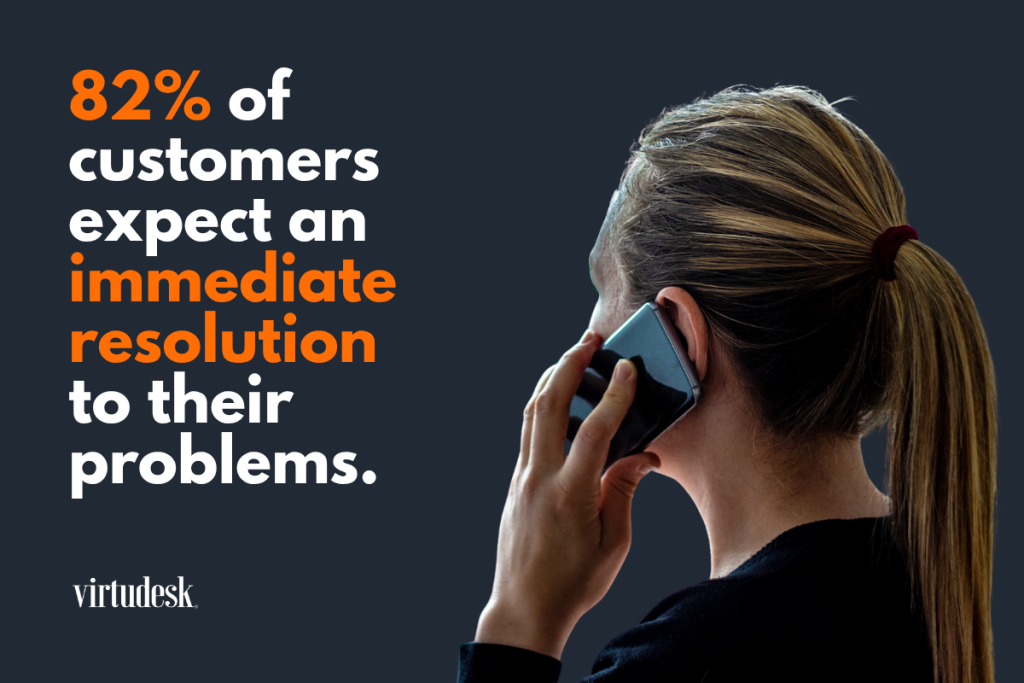
82% of customers expect an immediate resolution to their problems. Most businesses are far from meeting that standard. What about yours? The same applies to other areas: claims, lead response, appointment setting.
This is, again, a capacity problem. When your team is managing multiple functions, inbound response becomes reactive and loses reliability. The answer to a customer inquiry depends on someone’s time to send it, not on a defined process that guarantees a window. A mid-year business check reveals your response times and the reasons why. Sometimes tasks are lacking ownership or overlapping, or you might lack dedicated staff for each function, or you might also have outdated technology to support the “contact” demand.
Here are just a few examples of how a defined structure, with the right staff and technology, can help you:
- Customer service VAs can manage inbound communication, inquiry resolution, and follow-up sequences on a defined schedule
- Call center services can handle inbound volume at scale
- Sales prospecting VAs using speed dialing software (such as Tymbl Dialer) can contact leads before your competitors do
The result is a contact function that operates predictably, regardless of how busy everything else is.
Service quality and continuity through Q4
Speed matters, but that’s not all. A fast response that does not resolve the customer's issue, or one that contradicts what they were told last week, damages trust faster than a slow one. Consistency is the variable that determines whether customer experience improves or simply becomes faster at being unreliable.
Timedly, our proprietary time-tracking and monitoring software, gives you real-time visibility into what every remote team member is working on, how time is allocated, and where output is trending below standard. That visibility lets our management team identify and correct inconsistencies before they reach the customer.
Last year, a mid-sized logistics coordination firm came to us at the beginning of Q3 after two consecutive quarters of declining customer satisfaction metrics. A team of seven was handling client communication, dispatch coordination, and administrative work without a defined division of responsibility. Response times depended on who picked up the task first, follow-ups were inconsistent, and no one had a clear idea of how each client account should be managed.
They hired two of our administrative VAs to handle client communication and follow-up tracking. We configured Timedly so the owner and our management team could monitor the VAs' output in real time. In less than 60 days, the average response time dropped from 11 hours to under two hours, and client satisfaction scores recovered to their highest point in 18 months. That simple operational fix improved customer experience and customer retention.
Frequently Asked Questions
Below are the most common questions business owners have when it is time to run a mid-year operational review and get ready for Q4.
What is a mid-year business check, and why does it matter?
A mid-year business check is a structured operational review conducted at the halfway point of the year. It examines how time was spent, which processes stalled or broke, where and why the team ran out of capacity, and what needs to change before Q4 demand arrives. It is forward-looking. The goal is not just to assess the first half but to use what it revealed to build a more supported, more capable second half. Businesses that run this review in Q3 have time to add team capacity, close delegation gaps, and integrate new systems before the year-end pressure removes that option. Those who skip this stage absorb Q4 the same way they absorbed Q1 and Q2: without the infrastructure to handle it cleanly.
How do I prepare my team for increased Q4 demand?
First, identify where the team hit its limit in Q1 and Q2. Look for the precise functions where response times slowed, errors increased, or work returned to the owner. These are the areas where Q4 volume will add the most pressure. From there, the modification is structural: add virtual assistant support in the task categories that consumed the most team efforts, set a call center to handle inbound communication, like client support, before volume peaks, and configure a monitoring and accountability system so performance stays constant as it accompanies workload increase. Timedly provides real-time visibility into remote team activity across all functions. Management services bring the oversight that keeps output to standard without requiring the owner to manage each team member directly. The goal is to have the full support structure operational before Q4 arrives. Not partway through it.
How can a virtual assistant help during a mid-year business check?
A virtual assistant contributes to a mid-year business review in two ways. First, a VA who has been handling recurring tasks can spot where processes are unclear, inconsistent, or keep returning to the owner. That information is actionable diagnostic data that emerged from the review. Second, the review typically generates a delegation action list, and hiring a VA is the simplest way to act on it. Categories of tasks that kept landing back on the owner, handoffs that failed because no one had a defined process to follow, and back-office functions that consumed team capacity without adding to growth are areas where a trained VA can take full and quick ownership. For businesses without a VA, the mid-year review is the right time to start delegating. Q3 gives sufficient runway to finish onboarding, systematize processes, and have a functioning support layer before year-end demand steps in.
Conclusion
At Virtudesk, we work with business owners and professional practices who have reached mid-year and notice the distance between where their operations are and where they need to be before Q4. We help them to cover this gap. Although virtual assistants, call center services, Timedly, Tymbl Dialer, and management services may be hired as separate products that you add one at a time, they are components of an operational system. Your business can benefit from our integrated system. With your mid-year business check in hand, we customize our services around your specific business needs before demand increases.
If you prepare your business before demand increases, you’ll be fully equipped to finish the year strong.
Schedule a free discovery call or call us at 1 (800) 470-8136. Tell us what your first half revealed, and we will identify what needs to be in place before Q4 arrives.
Share this article
Meet our Most Trusted
Partners & Clients

Byron Lazine
Co-Founding Chief-of-Operations at BAM (Broke Agent Media)I’ve been using Virtual Assistants for years throughout all of my companies. Once we found Virtudesk the process got even easier and allowed us to scale out our hiring. Highly skilled and accountable professionals. 100% recommend!

Rebecca Guy
Realtor / Content CreatorBefore getting started with Virtudesk I had my doubts that they would find what I was looking for. I needed a very particular person to add to my team and let me tell you I am highly pleased! My virtual assistant Myril is the best! I am excited to grow my socialmedia accounts with her. Thank you Virtudesk!

Chelsea Erickson
Realtor La Belle RE GroupI am very happy with the assistance Virtudesk is providing for my real estate business. This is a newer position for my company and we are working through the creation and efficiency.


