
Why Virtudesk Invests in Its Employees Through In-Person Events



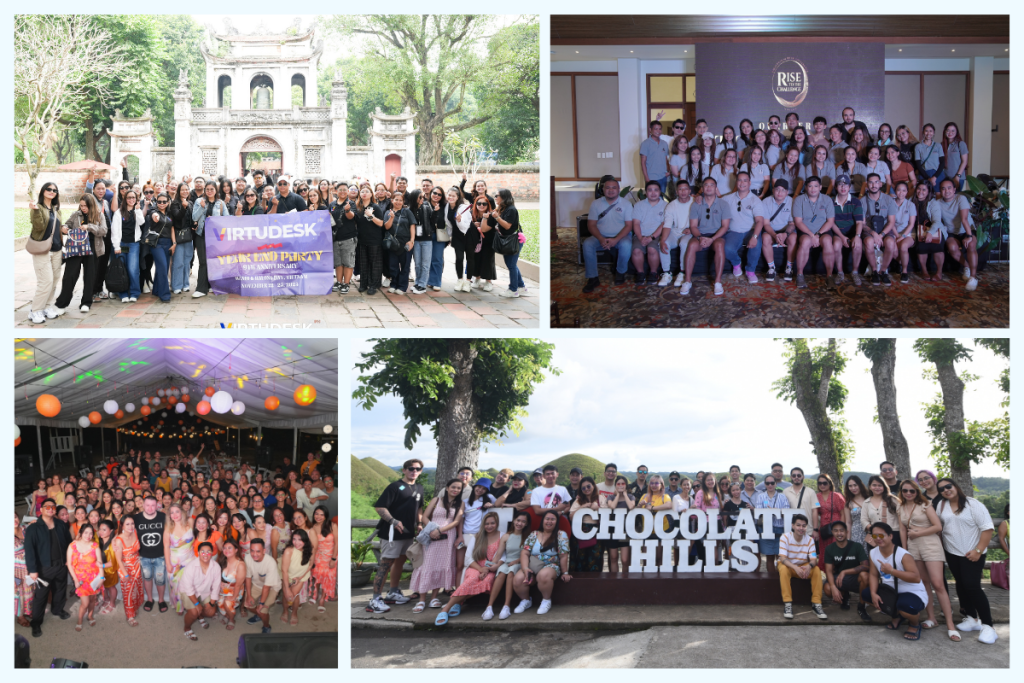
In-person events for remote teams are company gatherings that bring distributed professionals together. The main objectives of these events? Building trust, fostering communication, and shaping a shared culture that screens cannot replicate. And that is precisely what our in-person events for remote teams create: an experience that stays with every attendee. Our events nurture us all, both at a personal and professional level. We organize two such events every year: Summercon and an End-of-Year celebration. Since 2016, between 150 and 250 team members and managers have attended each gathering, which is, for all of us, a celebration we plan and expect with enthusiasm. So does our CEO, Pavel Stepanov. The trust we build during those days mirrors how we serve all our clients.
Can you imagine 200 people distributed across the Philippines working for the same company, sharing its values and its work culture, but not a workspace? Each of them punctually logs in every day to serve their clients, handle their accounts and systems, and do the work that allows the business to move forward. The majority of these remote workers have never met the colleagues who sit behind the same company name. This is the reality of distributed work, and it’s precisely why in-person events for remote teams exist.
For two or three days, everything changes. We finally see the faces behind the names, share meals, play games, have competitions, laugh together, and share experiences. None of us goes back to our desks the same way.
Key Takeaways
- Since 2016, we have held in-person events for remote teams twice a year, without exception—except during the COVID-19 pandemic, when travel and gathering restrictions were in place. Each event gathers between 150 and 250 participants, including team members, managers, and leadership.
- Remote work solves logistics and operational business problems, but it does not automatically build the trust, relational knowledge, and shared purpose that a high-performing team needs.
- Having remote teams but not deliberately investing in human connection has a foreseeable cost. According to Buffer's 2023 State of Remote Work report, 23% of remote workers consider loneliness as a top struggle.
- When companies deliver employee recognition in person, in front of peers, the effect on retention is stronger than when the same recognition is delivered through a screen or email. It is motivating and boosts the morale of the person who receives it.
- We plan each event thoroughly, including transportation and accommodation. We combine four main activity types, each with distinct purposes: team building, employee recognition, talent competitions, and social gatherings.
- Sharing meals, competitions, and free time for a couple of days builds the kind of familiarity that months of digital communication cannot.
- Strong service delivery begins with a strong team. How well our remote professionals know, trust, and communicate with each other shapes their relationships with their clients.
- Holding two events a year helps us maintain the cohesion that sustains performance over time.
Why Remote Teams Still Need Real Human Connection
Thanks to remote work, geographic hiring constraints disappear, and overhead costs decrease. Workers gain the flexibility that traditional office structures can’t match. Solving a logistical problem, though, is not the same as building a team.
There are things screens cannot replicate
Sophisticated tools power remote work today. Video calls, messaging platforms, collaborative software, AI-powered tools, and project management systems connect distributed professionals across time zones. What they can’t do is replicate the conditions where trust actually forms.
Nonverbal communication shapes how people interpret each other in ways that text and video don’t fully convey. Tone, expression, and the signals exchanged during direct conversation tell colleagues how to read each other. Remove those, and communication becomes accurate but thin. Teams that have never shared a physical space communicate effectively, but carefully, with more effort and friction behind every exchange. And at a shallower level, without connecting with the being behind the screen or message.
The impact of face-to-face communication on teams’ performance is not new. It has been documented for decades. Research published by Harvard Business Review highlights the importance of face-to-face interaction on team performance. Communication patterns account for as much as 35% of the variation in team output across industries. Spontaneous conversation, shared meals, and unstructured time tell colleagues how each other functions, something that no scheduled meeting does. That understanding enables faster communication, earlier resolution of misunderstandings, and better performance when work gets difficult.

The business cost of a disconnected remote team
Disconnection has a measurable cost. Gallup's Employee Engagement vs. Employee Satisfaction and Organizational Culture report found that companies with highly engaged teams see 51% lower voluntary turnover than their disengaged counterparts. The opposite is equally true: UC Berkeley Haas research suggests that a full-time remote workforce may find it hard to communicate, acquire new information, and collaborate. Consequently, performance is affected.
Turnover compounds the problem further. Replacing an employee costs between 50% and 200% of their annual salary, according to SHRM. For companies built on distributed teams, preventable turnover carries a financial burden that headcount numbers rarely capture. Every team member who leaves takes accumulated knowledge, client context, and relationship capital with them. This means they take with them the value in a company’s relationships with its customers or vendors. Part of the cumulative value of trust, goodwill, and mutual respect built through professional and interpersonal connections leaves with each worker who leaves.
But the costs go beyond employee replacement. Back in 2022-2023, Gallup already noted that engaged teams achieved 23% higher profitability and 18% higher productivity (sales). And engagement is not something businesses create through financial incentives. Employee engagement is the consequence of a strategic management decision and refers to the psychological commitment to one’s work, to the team, and to the organization. Workplace culture and events are indispensable components of it.
A remote workforce without regular human connection is more a collection of coordinated individuals rather than a cohesive unit. We designed our investment in in-person events for remote teams to achieve the cohesiveness that ensures improved and uniform results.
Remote work improves efficiency. Yet, it does not, on its own, build the trust and relational knowledge that keep a team together over time.
Ten Years of In-Person Events for Remote Teams
When Pavel Stepanov founded Virtudesk, the two annual events became a policy that has been maintained year after year through Summercon and the End-of-Year Celebration.
Two events a year, every year since 2016
Our two-event structure creates a rhythm. We meet in the first half of the year, and months later to close the year together at the year’s final event.
In past events, our team members gathered at some of the Philippines' most celebrated destinations. Palawan, Bohol, Bataan and Batangas have each hosted our gatherings. Each location is different. The purpose stays unchanged: shared experiences, planned activities, and free time to build relationships that carry through the rest of the year.
Virtudesk, we built our model around remote professionals who rarely occupy the same room (except those working at our headquarters in Bellevue); that scale carries weight. Two annual gatherings of that size reflect our culture, a culture we treat as an operational priority. You can see what earlier gatherings looked like in our Summer Con 2022 recap.
Taking the team beyond the Philippines
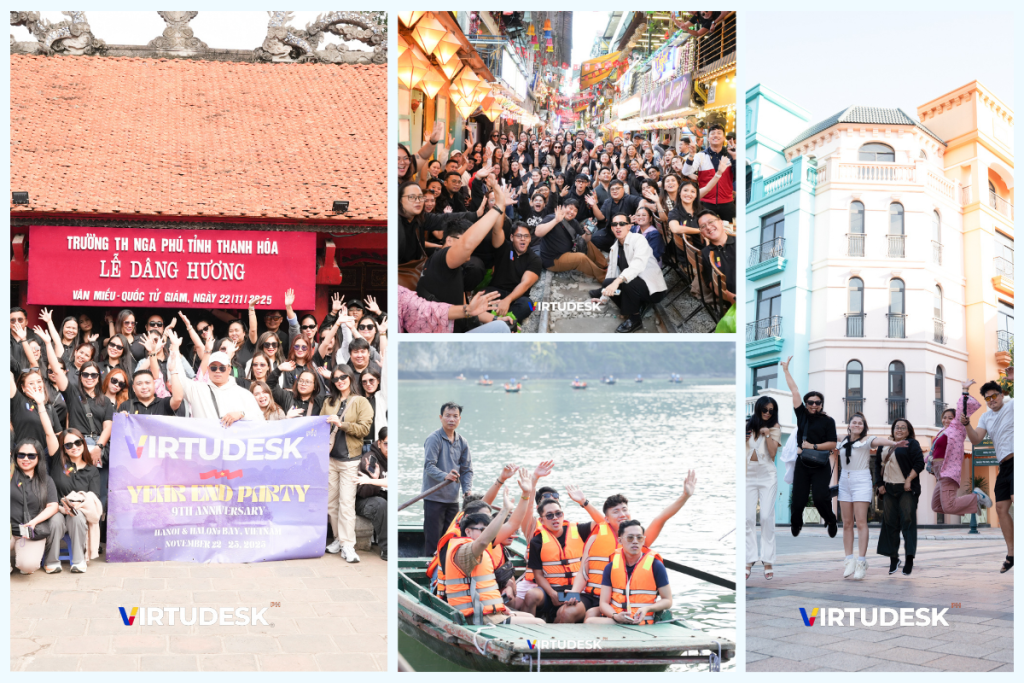
In November 2025, we held our first international team event in Vietnam. As always, we fully covered all travel expenses for the participants. The decision to move beyond the Philippines was deliberate. As we grow, the investment in the people working with us grows with us. And, business aside, we enjoy sharing amazing times with our remote staff and with those based at the headquarters.
Events of this kind carry costs that are easy to quantify: travel, accommodation, activities, and time away from daily work. We invest in them because the alternative produces predictable results: a team that never meets in person tends to show higher attrition, weaker communication, and lower performance over time.
As a study published in ScienceDirect, says “Meeting coworkers face to face, even occasionally, has been found to result in positive effects, such as job satisfaction”. Which company wouldn’t want satisfied teams?
And, of course, besides creating bonds, sharing work experiences and advice and building trust, we share memorable experiences and have lots of fun. Because sometimes words are not descriptive enough, we invite you to watch this short video from our Vietnam event and enjoy a bit of the moments and emotions we shared.
The Cebu City Summercon in May 2026 continues the cadence. The locations vary, but the commitment and spirit remain.
Ten years of gatherings across Palawan, Bohol, Batangas, and now Vietnam, reflect one of our core convictions: the people doing the work are the business.
What Happens at These Events, and What It Builds
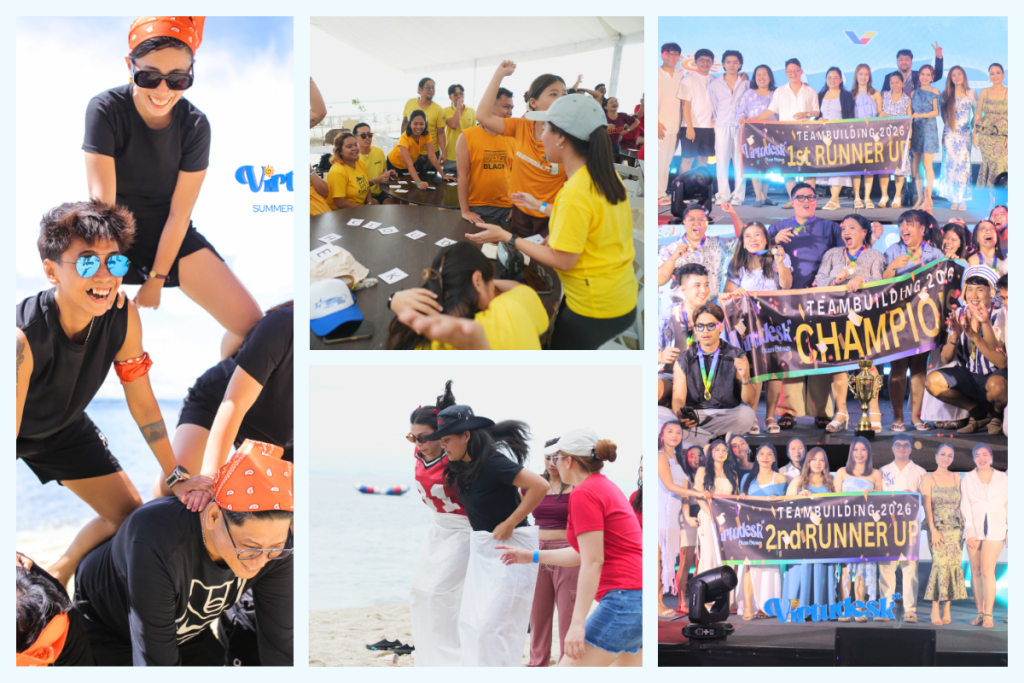
Two to three days is a short window, and we like to take the most out of every minute. What it produces depends entirely on how time is structured. Each of our events is built around four core activity types, and none is incidental. Each serves a distinct purpose, both in the moment and in how the team performs long after the event ends. There’s thorough prior planning for the activities, including free time to connect spontaneously and relax.
We plan each event around four main types of activities, and each one serves a purpose that outlasts the event itself.
1. Team building activities
Team-building activities put people from different functions in situations that require collaboration, problem-solving, and direct communication. Many of the team members who attend these events have worked alongside each other, serving the same client, for months. Without ever having been in the same room. Team-building activities accelerate the relational work that would otherwise take far longer to develop through screens alone.
The effect extends well past the event itself. In their article “Getting virtual teams right”, Harvard Business Review directly stated that virtual teams should meet in person at certain times, such as kick-offs or milestones, to celebrate achievements. And celebrating is, precisely, the intention of our year-closing events.
A virtual assistant who has met a colleague face-to-face communicates more directly in the months that follow. We constantly witness this among our staff, particularly among those working on the same project or for the same client. They flag problems earlier and interpret a message without misreading tone. Across a team of 200 (and counting), those small shifts compound into a communication culture that functions with practically no friction.
2. Employee recognition programs
Employee recognition, the act of expressing gratitude for a worker’s achievements and efforts, is one of the most consistent retention tools. As an article by Dale Carnegie on the importance of employee recognition explains, when employees receive recognition, they get more confident, are less prone to leave, and perform better. They become even more creative when solving work issues. And when that recognition is given in person, in front of their colleagues, the effect is stronger. The person receives it in a setting with real social weight. Their peers witness the standard it represents.
At each event, we formally acknowledge individual and team contributions from the preceding months. The recognition is specific. It names what was done, the impact it made, and who did it. That specificity separates recognition that reaches and retains people from impersonal recognitions that read as ceremonial.
In-person recognition in front of the full team tells top performers they are seen and valued. It also shows everyone else what the expected standard looks like. When applied consistently over years, recognition builds a culture where performance gets noticed and rewarded in a way that people remember. And that motivates them to keep upskilling and doing their best.

3. Talent competitions and social gatherings
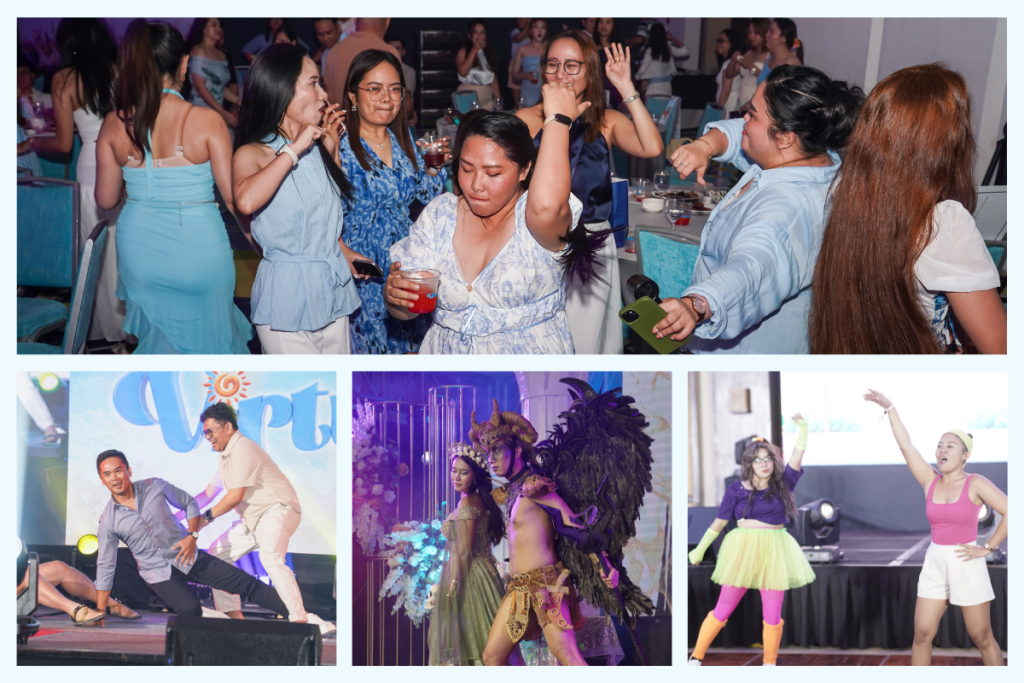
Talent competitions give team members a platform outside their daily work roles. They surface capabilities and qualities that work tasks never show. A colleague who manages workflows during the week may perform on a stage during the event. That shift in context creates a different kind of familiarity than any professional interaction produces. It gives a space for the person behind a role to become the main player.
Social gatherings serve a different function alongside that. Unstructured time, shared meals, and informal conversation deepen relationships past the work level. People show what they find funny, how they interact without an agenda, and what kind of colleagues they are when nothing is required of them. They also bring team members, managers, and leadership together at the same level. That knowledge makes collaboration, conflict resolution, and direct communication easier for months afterward.
Team building, recognition, competitions, and social time have different purposes. When brought together, they originate and strengthen the cohesion that doesn’t develop through digital-only contact, and the lasting effect is visible in how long team members stay and how well they work.
Two to three days together. The returns from these gatherings appear in communication patterns, retention rates, and the commitment that holds a distributed workforce together across the year.
How Does Investing in Employees Improve Client Results?
The case for in-person events for remote teams is most often framed around employee experience. The same thinking that drives our investment in managing and tracking tools like Timedly and our dialing and messaging system Tymbl Dialer, and in the ongoing training we provide our staff, motivates our investment in these events. Strong operations require strong people. Our model was built to offer our clients more than merely task coverage. Virtual assistants, call center representatives, dedicated management, real-time visibility through Timedly, and high-volume outbound calling through Tymbl Dialer are components of our coordinated system. The events that keep our team cohesive and motivated, are part of this system as well.
When you invest in your employees, specifically through bonding experiences like social events, you are actually following the economic cycle known as the Service-Profit Chain. This management framework establishes a “direct connection between profitability and employee satisfaction”. And, as the American Psychological Association explains, the sense of belonging matters deeply. Connection and belonging make employees more productive, happier, and less prone to leave.
For our clients, when we invest in in-person events, this translates into faster response times and the overall better output quality they get. Consistency is another benefit, and not a minor one. The same person who started working for them is still there six months later. They acquired the knowledge, standards, and core values of the business they work for.
When a team member knows their colleagues, values their workplace, feels valued, and intends to stay, the client relationship gains continuity.
According to Buffer's 2023 State of Remote Work report, 23% of remote workers identify loneliness as one of their top struggles. This figure reflects the reality of distributed work without deliberate investment. Our event calendar is one of the ways we address this topic. When our team members attend Summercon and the End-of-Year celebrations, they no longer experience their work as anonymous remote labor. They experience it as part of a team with shared history and develop a sense of belonging.
Quartz gave us the Best Companies for Remote Workers in 2022 award. That recognition shows what uninterrupted, long-term investment in our staff builds. Our team members, regardless of where each one is based, remain stable, engaged, and committed to the work they do for the businesses that rely on us.
When clients hire us, they don’t do so solely for task coverage. They hire us because they know we train, manage, and invest in the people who will work for them. The connection between team quality and client results is direct. Our 92.45% client retention rate, evaluated over a period of 90 days, reflects what a cohesive, well-managed remote team produces. These annual events are part of how we protect the quality of our services and retain our clients, year after year.
Our virtual assistant services and management services give clients the operational structure that sustains that performance. The events sustain the people inside that system.
When you invest in your people as we do at Virtudesk, your clients feel it.
The link between employee investment and service quality shows up in every account monthly.
Frequently Asked Questions
Remote teams and the clients who delegate to them frequently ask the same question: Does gathering a distributed workforce in person really translate to better work? These three questions answer that.
Why does Virtudesk hold in-person events for its remote team?
We hold these gatherings because remote efficiency and team cohesion are two different things. Our staff operates primarily from the Philippines, and daily work takes place through digital communication tools. But those tools cannot build trust, relational knowledge, and the shared purpose that direct interaction builds. Without regular in-person gatherings, a distributed team performs tasks in parallel but lacks the shared context and trust that high performance requires.
How often does Virtudesk hold company events, and who attends?
We have held two in-person events for remote teams per year since our founding in 2016: Summercon in the summer and an End-of-Year celebration. Both have been held consistently ever since, with 150 to 250 team members attending each gathering. Events span two to three days at different destinations each year. Past locations include Palawan, Bohol, Bataan and Batangas in the Philippines. The November 2025 End-of-Year event in Vietnam was our first international gathering, with all travel expenses covered by us.
How do in-person events affect the quality of service Virtudesk delivers to clients?
Team performance and service quality are directly linked. A team that has met in person communicates with less friction and resolves problems faster. Our staff works at a higher baseline of trust than a staff that has never shared a physical space or seen their faces. Trust, sense of belonging, and feeling appreciated translate directly into client experience: faster turnaround, more consistent results, and better handling of problems when they arise. Retention matters here too. When team members stay, clients get continuity in their working relationships and do not need to invest in new hires. The same professionals who understand a client's preferences and systems are still there the following quarter. That continuity is part of what we protect through our annual event investment.
Final Thoughts
As we continue to grow, investing in people remains one of our top priorities. Strong teams create stronger businesses. A remote team that never meets in person does not really feel like a team. They just feel like lone workers who happen to share a company name.
The professionals on our remote team, from virtual assistants to call center representatives, marketing specialists, and managers, make every service we offer possible. They handle the work, maintain the client relationships, and carry the standards we set.
Investing in the latest technologies is mandatory, given the type of services we offer. Likewise, investing in our people, recognizing their contributions, and giving them a reason to stay, all these protect the quality of work you will get. Now and over time.
If you are looking for a remote team that stays together, feels connected regardless of their placement, communicates well, and performs consistently, reach out to us. Schedule a free discovery call by filling out our contact form, or directly call us at 1 (800) 470-8136. We will explain in detail how our model works and what it means for your business.
To explore our virtual assistant services and the industries we support, visit our services page. And to see what hiring a professionally managed remote team can cost, our pricing page is a clear starting point, with no hidden costs.
Share this article
Meet our Most Trusted
Partners & Clients
Byron Lazine
Co-Founding Chief-of-Operations at BAM (Broke Agent Media)I’ve been using Virtual Assistants for years throughout all of my companies. Once we found Virtudesk the process got even easier and allowed us to scale out our hiring. Highly skilled and accountable professionals. 100% recommend!

Rebecca Guy
Realtor / Content CreatorBefore getting started with Virtudesk I had my doubts that they would find what I was looking for. I needed a very particular person to add to my team and let me tell you I am highly pleased! My virtual assistant Myril is the best! I am excited to grow my socialmedia accounts with her. Thank you Virtudesk!

Chelsea Erickson
Realtor La Belle RE GroupI am very happy with the assistance Virtudesk is providing for my real estate business. This is a newer position for my company and we are working through the creation and efficiency.


